Event-triggered iterative learning control for output constrained multi-agent systems
Wei Cao, Huanhuan Li, Jinjie Qiao, Yi Zhu

TL;DR
This paper introduces a control strategy for multi-agent systems that reduces communication by using event-triggered learning, ensuring accurate tracking of desired outputs.
Contribution
The novelty lies in the event-triggered iterative learning control algorithm that enables consensus tracking without real-time communication.
Findings
The proposed algorithm ensures convergence using a Lyapunov function.
Simulation results confirm the effectiveness of the control protocol.
The method allows consistent tracking of desired trajectories with output constraints.
Abstract
An event-triggered iterative learning consensus tracking control strategy is proposed for output constrained nonlinear discrete-time multi-agent systems. Firstly, the estimated Pseudo partial derivative(PPD) algorithm is determined based on the input and output data of the system, and the output observer is designed based on the estimated PPD. Secondly, the deadband controller is designed based on the output estimation error of the observer, and the event trigger condition is determined by comparing the size of the output estimation error and the deadband controller function value, and the agents communicate when the trigger condition is satisfied, and do not communicate when it is not satisfied. Then, the event-triggered iterative learning control algorithm is constructed using the estimated PPD, the trigger condition and the measurement error, and the convergence of the algorithm is…
Genes, proteins, chemicals, diseases, species, mutations and cell lines named across the full text — each resolved to its canonical identifier and authoritative record.
Click any figure to enlarge with its caption.
 Figure 1
 Figure 2
 Figure 3
 Figure 4
 Figure 5
 Figure 6
 Figure 7
 Figure 8
 Figure 9
 Figure 10
 Figure 11
 Figure 12
 Figure 13
 Figure 14
 Figure 15
 Figure 16
 Figure 17
 Figure 18
 Figure 19
 Figure 20
 Figure 21
 Figure 22
 Figure 23
 Figure 24
 Figure 25
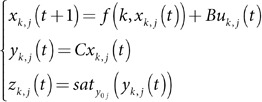 Figure 26
 Figure 27
 Figure 28
 Figure 29
 Figure 30
 Figure 31
 Figure 32
 Figure 33
 Figure 34
 Figure 35
 Figure 36
 Figure 37
 Figure 38
 Figure 39
 Figure 40
 Figure 41
 Figure 42
 Figure 43
 Figure 44
 Figure 45
 Figure 46
 Figure 47
 Figure 48
 Figure 49
 Figure 50
Peer Reviews
No public reviews on file for this paper yet. If you reviewed it on a platform where reviews are public (OpenReview, ICLR, NeurIPS, ICML), you can paste yours below so the community can read it here.
Videos
No videos yet. Explain this paper in a talk, walkthrough, or lecture? Add one.
Taxonomy
TopicsIterative Learning Control Systems