Immunogenicity and safety of measles-mumps-rubella vaccine delivered by the aerosol, intradermal and intramuscular routes in previously vaccinated young adults: a randomized controlled trial protocol
Sumanta Saha, Melanie Millier, Ari Samaranayaka, Liza Edmonds, Emma Best, James Ussher, Andrew Anglemyer, Jennifer Lee, Michael Tatley, Felicity Cutts, Rob van Binnendijk, Peter McIntyre, Arnaud Kombe Kombe, Arnaud Kombe Kombe, Arnaud Kombe Kombe, Arnaud Kombe Kombe

TL;DR
This study compares the effectiveness and safety of delivering the MMR vaccine through three different methods in young adults who have already received two doses.
Contribution
The study introduces a trial protocol to evaluate non-standard delivery routes (intradermal and aerosol) of the MMR vaccine in previously vaccinated individuals.
Findings
The trial will assess antibody responses and safety of intradermal and aerosol MMR vaccine delivery compared to intramuscular.
Participants will be tested for antibody levels at multiple time points up to 18 months post-vaccination.
Systemic and local reactions to each vaccine delivery method will be evaluated as secondary outcomes.
Abstract
There are increasing reports of outbreaks of measles in countries that achieved measles elimination using two doses of measles-mumps-rubella (MMR) vaccine, particularly in health care settings. While responses to a third dose of MMR in two-dose recipients have been examined, these studies have all administered MMR by the standard (intramuscular or subcutaneous) route, and data on the duration of antibody are limited. We have developed a protocol for an open-label parallel-arm randomized-controlled trial to compare measles antibody responses and safety after intradermal and aerosol administration of MMR with intramuscular, the usual mode of administration in Aotearoa (New Zealand). Eligible participants are aged ≥ 18 years who have previously received two doses of the MMR vaccine and based on levels of IgG antibody to measles or mumps below the threshold for seropositivity in…
Genes, proteins, chemicals, diseases, species, mutations and cell lines named across the full text — each resolved to its canonical identifier and authoritative record.
Click any figure to enlarge with its caption.
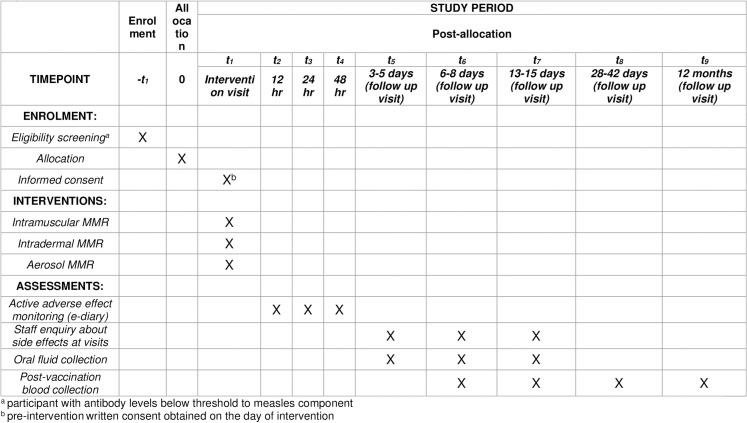 Figure 1
Peer Reviews
No public reviews on file for this paper yet. If you reviewed it on a platform where reviews are public (OpenReview, ICLR, NeurIPS, ICML), you can paste yours below so the community can read it here.
Videos
No videos yet. Explain this paper in a talk, walkthrough, or lecture? Add one.
Taxonomy
TopicsVirology and Viral Diseases · Vaccine Coverage and Hesitancy · Respiratory viral infections research