Greater mouse-tailed bats use their tail as a tactile sensor when navigating backwards
Sahar Hajyahia, Mor Taub, Ofri Eitan, Orit Dashevsky, Yossi Yovel

TL;DR
Greater mouse-tailed bats use their tail as a tactile sensor to navigate backwards and detect textures.
Contribution
The study reveals a novel sensory function of the tail in bats for tactile navigation and texture discrimination.
Findings
Bats with intact tails navigated around obstacles faster than with anesthetized tails.
Bats could discriminate between surface textures using their tail.
Abstract
Animals use a wide arsenal of sensory modalities to orient, often combining information from different modalities to improve sensing. Animals mostly move forward and hence most of their sensory organs are frontal. In some situations, moving backwards is a necessity and some animals have evolved designated sensory strategies. The greater mouse-tailed bats (Rhinopoma microphyllum) belong to one of few bat families that possess a long free tail which they wag in a pendulum like pattern when moving backwards up walls and between obstacles. We show that greater mouse-tailed bats use their tail to navigate around obstacles and are hindered when their tail is anesthetized. Additionally, we find that they use their tail to discriminate between textures and can sense subtle changes. We suggest that the use of the tail as a tactile sensor enables these bats to move backwards quickly when other…
Genes, proteins, chemicals, diseases, species, mutations and cell lines named across the full text — each resolved to its canonical identifier and authoritative record.
Click any figure to enlarge with its caption.
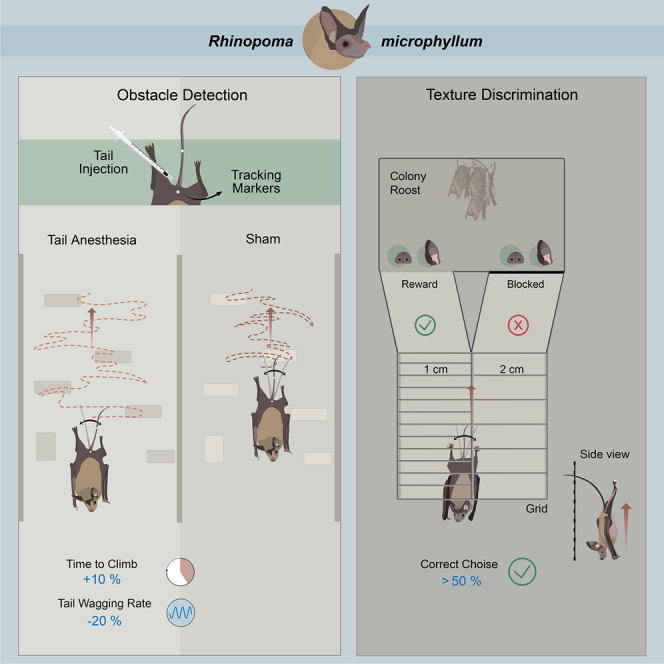 Figure 1
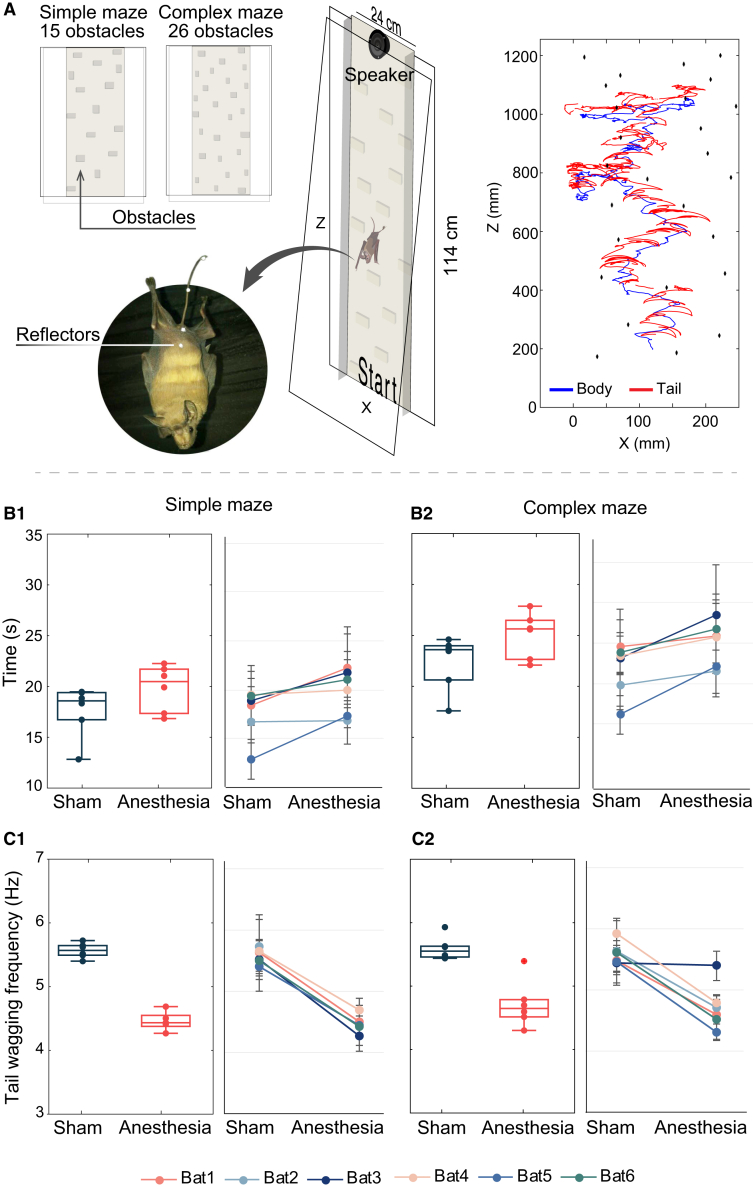 Figure 2
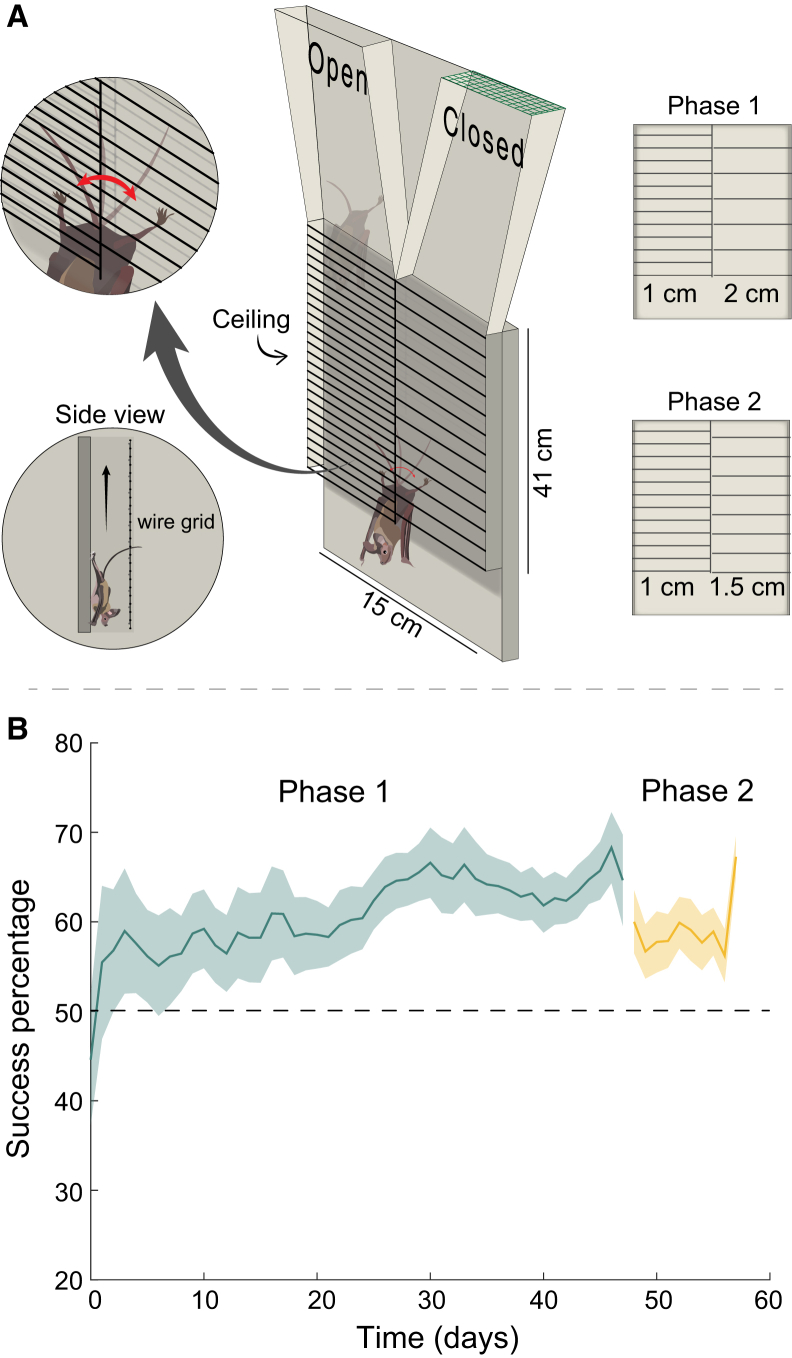 Figure 3
Peer Reviews
No public reviews on file for this paper yet. If you reviewed it on a platform where reviews are public (OpenReview, ICLR, NeurIPS, ICML), you can paste yours below so the community can read it here.
Videos
No videos yet. Explain this paper in a talk, walkthrough, or lecture? Add one.
Taxonomy
TopicsBat Biology and Ecology Studies · Experimental and Theoretical Physics Studies · Marine animal studies overview