Perceived benefits and barriers to the use of long-acting injectable antiretroviral treatment among adolescents and young people living with HIV in Western Kenya: qualitative findings from the KuwaFree! LiveFree! Study
Shukri A. Hassan, Dennis Munyoro, Mehar Maju, Whitney Biegon, Salim Bakari, Eunice Kaguiri, Anjellah Jumah, Mark Omollo, Valerie Obare, Caitlin Bernard, Edith Apondi, Edwin Were, Rena C. Patel

TL;DR
This study explores how adolescents and young people in Kenya view long-acting injectable HIV treatment, highlighting benefits like privacy and adherence, but also health system challenges.
Contribution
The study provides novel qualitative insights into AYPLHIV and stakeholder perceptions of LA ART in a resource-limited setting.
Findings
Participants identified benefits like improved adherence, reduced stigma, and convenience with LA ART.
Barriers included health system challenges such as clinic burden and supply chain issues.
Individual concerns like fear of injections and side effects were also noted as barriers.
Abstract
Adolescents and young people living with HIV (AYPLHIV) face significant hurdles in adhering to daily oral antiretroviral therapy (ART). Long-acting (LA) ART, such as injectable cabotegravir and rilpivirine, may help overcome these hurdles. However, little is known about the perceived benefits and barriers to LA ART usage by AYPLHIV in resource-limited settings. We conducted focus group discussions (FGDs) with four target groups of adolescents/youth, providers, policymakers, and other advocates in western Kenya from November 2021 to April 2022. The FGDs elicited participants' thoughts on LA ART implementation in Kenya, particularly the benefits and barriers of LA ART use amongst AYPLHIV. Our analysis combined both inductive and deductive approaches, beginning with open coding of the data, then organizing them in predetermined socio-ecological model (SEM) domains. We conducted a total…
Genes, proteins, chemicals, diseases, species, mutations and cell lines named across the full text — each resolved to its canonical identifier and authoritative record.
Click any figure to enlarge with its caption.
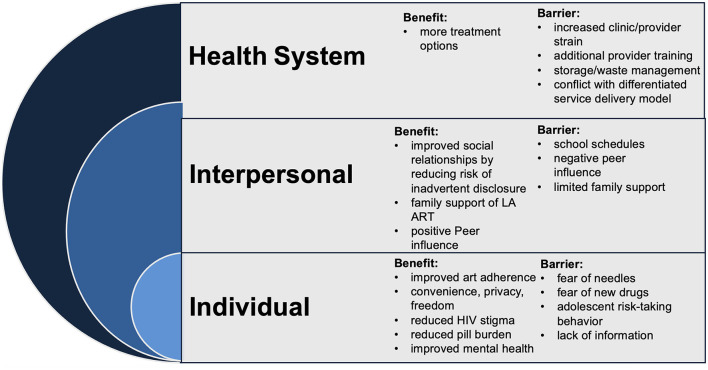 Figure 1
Peer Reviews
No public reviews on file for this paper yet. If you reviewed it on a platform where reviews are public (OpenReview, ICLR, NeurIPS, ICML), you can paste yours below so the community can read it here.
Videos
No videos yet. Explain this paper in a talk, walkthrough, or lecture? Add one.
Taxonomy
TopicsHIV/AIDS Research and Interventions · Global Maternal and Child Health · HIV, Drug Use, Sexual Risk