Registered report: Cognitive ability, but not cognitive reflection, predicts expressing greater political animosity and favouritism
Abigail L. Cassario, Shree Vallabha, Jordan L. Thompson, Alejandro Carrillo, Prachi Solanki, Samantha A. Gnall, Sada Rice, Geoffrey A. Wetherell, Mark J. Brandt

TL;DR
Higher cognitive ability is linked to stronger political favoritism and animosity, especially among liberals, while cognitive reflection is not.
Contribution
Shows cognitive ability, not cognitive reflection, predicts political group attitudes in a large US sample.
Findings
Higher cognitive ability correlates with more political animosity and favoritism.
This pattern is stronger among liberals than conservatives.
Cognitive reflection does not predict political attitudes.
Abstract
Liberals and conservatives both express political animosity and favouritism. However, less is known about whether the same or different factors contribute to this phenomenon among liberals and conservatives. We test three different relationships that could emerge among cognitive ability, cognitive reflection and political group‐based attitudes. Analysing two nationally representative surveys of US Americans (N = 9035) containing a measure of cognitive ability, we find evidence that compared to people lower in cognitive ability, people higher in cognitive ability express more animosity towards ideologically discordant groups and more favouritism towards ideologically concordant groups. This pattern was particularly pronounced among liberals. In a registered report study, we then test whether the same is true of cognitive reflection in another large dataset (N = 3498). In contrast to…
Genes, proteins, chemicals, diseases, species, mutations and cell lines named across the full text — each resolved to its canonical identifier and authoritative record.
Click any figure to enlarge with its caption.
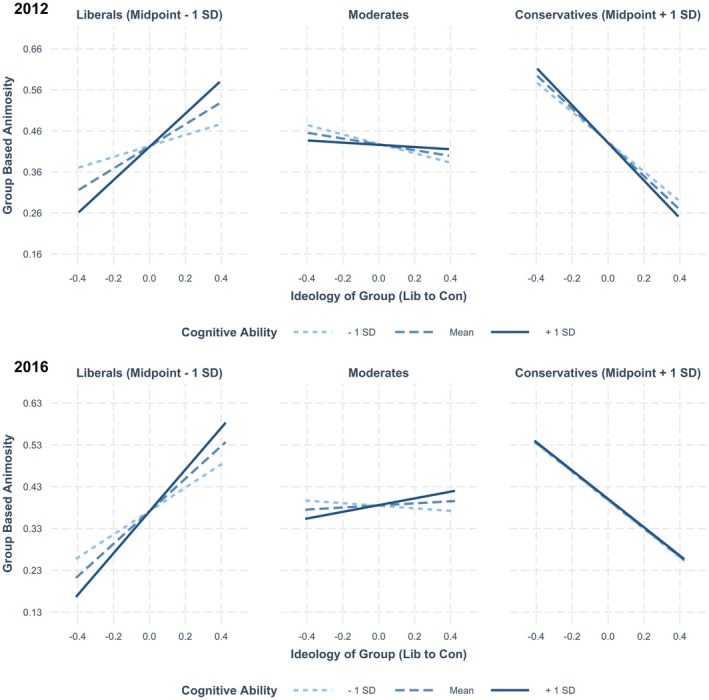 Figure 1
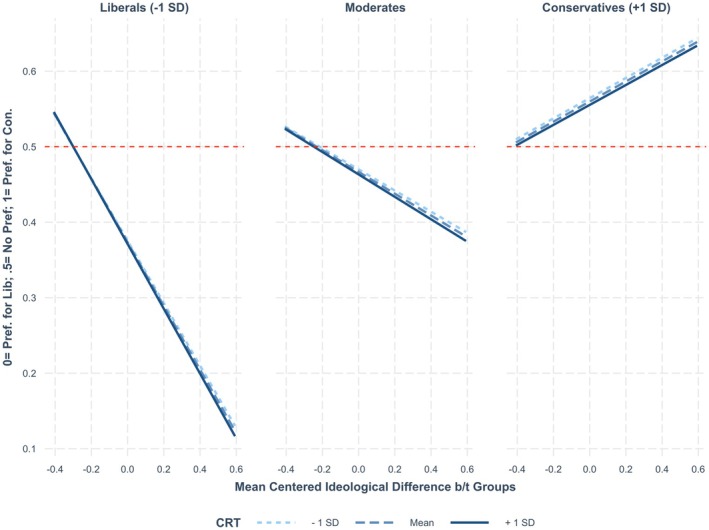 Figure 2
Peer Reviews
No public reviews on file for this paper yet. If you reviewed it on a platform where reviews are public (OpenReview, ICLR, NeurIPS, ICML), you can paste yours below so the community can read it here.
Videos
No videos yet. Explain this paper in a talk, walkthrough, or lecture? Add one.
Taxonomy
TopicsSocial and Intergroup Psychology · Electoral Systems and Political Participation · Social and Cultural Dynamics