Comparison of the initial and residual speed of Amblyomma americanum kill on dogs treated with a single dose of Bravecto® Chew (25 mg/kg fluralaner) or Simparica TRIO® (1.2 mg/kg sarolaner, 24 µg/kg moxidectin, 5 mg/kg pyrantel)
Kathryn E. Reif, Michael W. Dryden, Dorothy M. Normile, Qing Kang, Brian H. Herrin, Jeba R. J. Jesudoss Chelladurai, Naemi P. Bickmeier, Cameron J. Sutherland, Mallory S. Beltz

TL;DR
This study compares how quickly two dog medications kill ticks, finding one acts faster.
Contribution
Demonstrates Bravecto® achieves faster initial and residual tick control than Simparica TRIO®.
Findings
Bravecto®-treated dogs showed 81.6% tick control within 8 hours, reaching 98% by 12 hours.
Bravecto® outperformed Simparica TRIO® in controlling ticks at 12 and 24 hours post-infestation.
Both products met label claims, with no adverse reactions observed.
Abstract
To manage tick infestations and reduce tick-borne pathogen transmission risk to dogs, compliant administration of a fast-acting ectoparasiticide is necessary. Isoxazoline-containing ectoparasiticide products provide systemic whole-body coverage; however, differences in tick kill have been observed between products and these differences may be more pronounced when controlling common dose-limiting tick species such as Amblyomma americanum. Dogs were ranked by tick carrying capacity, randomly allocated to one of three treatment groups, and administered Bravecto® Chews (minimum 25 mg/kg fluralaner), Simparica TRIO® (minimum 1.2 mg/kg sarolaner, 24 µg/kg moxidectin, 5 mg/kg pyrantel), or no treatment. Dogs were infested with approximately 50 unfed adult (25 female, 25 male) A. americanum on days −2, 21, 28, and 35. Live tick counts were performed at 8, 12, 24, 48, and 72 h post-treatment…
Genes, proteins, chemicals, diseases, species, mutations and cell lines named across the full text — each resolved to its canonical identifier and authoritative record.
Click any figure to enlarge with its caption.
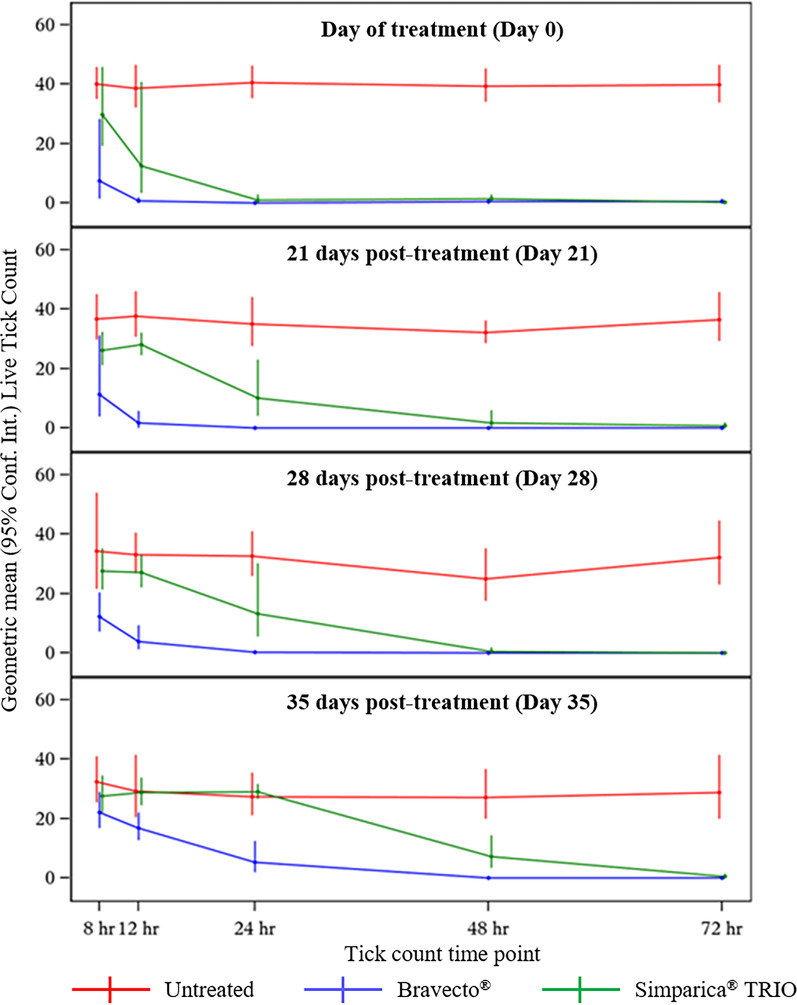 Figure 1
 Figure 2
Peer Reviews
No public reviews on file for this paper yet. If you reviewed it on a platform where reviews are public (OpenReview, ICLR, NeurIPS, ICML), you can paste yours below so the community can read it here.
Videos
No videos yet. Explain this paper in a talk, walkthrough, or lecture? Add one.
Taxonomy
TopicsVector-borne infectious diseases · Dermatological diseases and infestations · Helminth infection and control