EPYSQLI (SB12; Biosimilar to Reference Eculizumab) in Asian and Non‐Asian Patients With Paroxysmal Nocturnal Hemoglobinuria: Subgroup Analysis of a Global Phase III Randomized Controlled Trial
Jun Ho Jang, Ciprian Tomuleasa, Hanna Oliynyk, Theerin Lanamtieng, Jihye Park, Younsoo Kim, Jinah Jung, Paola Russo, Soo Min Lim, Régis Peffaultde Latour

TL;DR
This study confirms that a biosimilar drug (SB12) works as well as the original drug (eculizumab) in treating a rare blood disorder in both Asian and non-Asian patients.
Contribution
The study provides new evidence that a biosimilar drug is equally effective and safe in Asian and non-Asian subgroups of PNH patients.
Findings
SB12 showed comparable efficacy and safety to eculizumab in Asian and non-Asian PNH patients.
Transfusion avoidance and hemoglobin stabilization were not significantly different between SB12 and eculizumab.
Results were consistent with the overall population findings from the Phase III trial.
Abstract
SB12 demonstrated equivalence to reference eculizumab (ECU) in complement inhibitor‐naïve patients with paroxysmal nocturnal hemoglobinuria (PNH) in the previous randomized, double‐blind, multi‐national, crossover, Phase III study. The scope of this post‐hoc study was subgroup analysis by race to compare the efficacy and safety of SB12 and ECU in PNH patients in the Asian and Non‐Asian subgroups of the Phase III study. Results including lactate dehydrogenase (LDH), number of units of packed red blood cells and safety as primary and secondary endpoints demonstrated comparable efficacy and safety of SB12 and ECU in Asian and Non‐Asian PNH patients, in line with the study results in the overall population. In addition, transfusion avoidance (68.1% for SB12 vs. 72.9% for ECU, p‐value of 0.4492) and hemoglobin stabilization (SB12–ECU: 6.3%, 95% confidence interval [CI] [‐21.5, 34.1] and…
Genes, proteins, chemicals, diseases, species, mutations and cell lines named across the full text — each resolved to its canonical identifier and authoritative record.
Click any figure to enlarge with its caption.
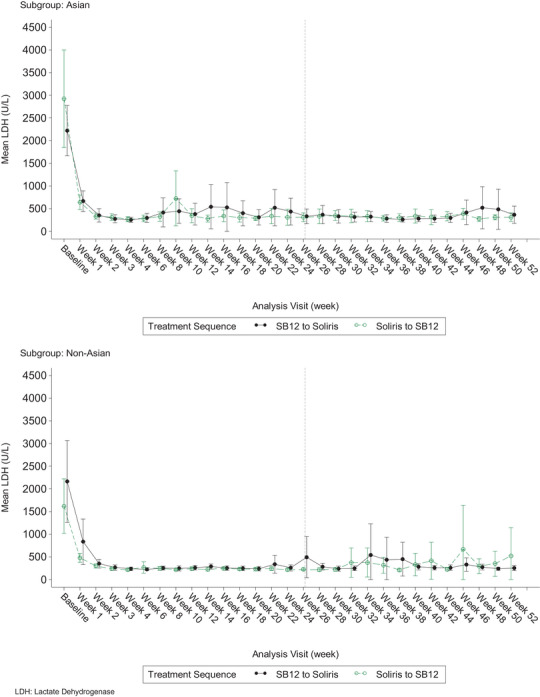 Figure 1
Peer Reviews
No public reviews on file for this paper yet. If you reviewed it on a platform where reviews are public (OpenReview, ICLR, NeurIPS, ICML), you can paste yours below so the community can read it here.
Videos
No videos yet. Explain this paper in a talk, walkthrough, or lecture? Add one.
Taxonomy
TopicsComplement system in diseases · Renal Diseases and Glomerulopathies · Blood groups and transfusion