Microcatheter-assisted guidewire manipulation via peroral pancreatoscopy for recanalization of pancreaticojejunostomy obstruction
Michihiro Yoshida, Yasuki Hori, Akihisa Kato, Hidenori Sahashi, Tadashi Toyohara, Yusuke Kito, Hiromi Kataoka

Abstract
Genes, proteins, chemicals, diseases, species, mutations and cell lines named across the full text — each resolved to its canonical identifier and authoritative record.
Click any figure to enlarge with its caption.
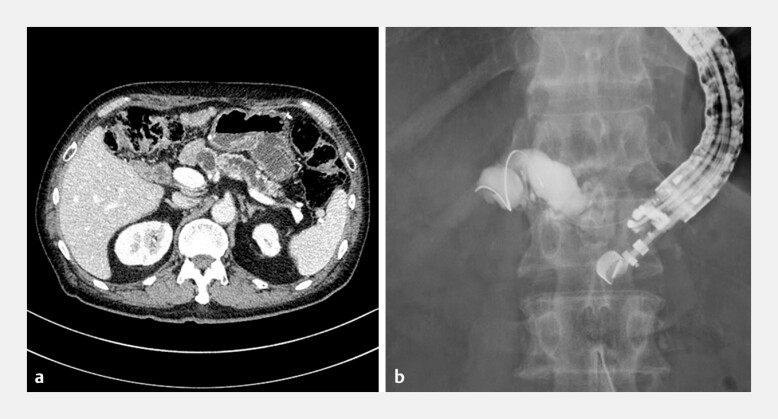 Fig. 1
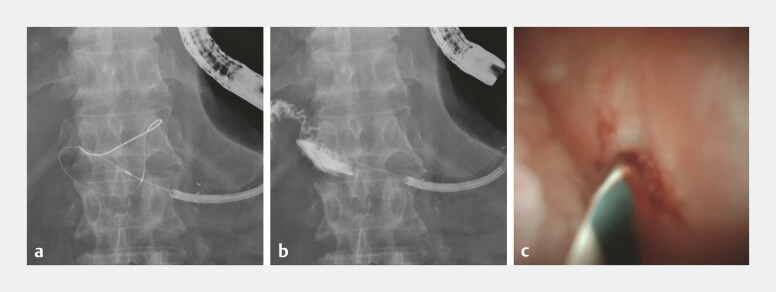 Fig. 2
Peer Reviews
No public reviews on file for this paper yet. If you reviewed it on a platform where reviews are public (OpenReview, ICLR, NeurIPS, ICML), you can paste yours below so the community can read it here.
Videos
No videos yet. Explain this paper in a talk, walkthrough, or lecture? Add one.
Taxonomy
TopicsPancreatic and Hepatic Oncology Research · Pancreatitis Pathology and Treatment · Esophageal and GI Pathology
Pancreatojejunostomy stricture is one of the complications after pancreaticoduodenectomy 1 . Endoscopic ultrasound-guided pancreatic duct drainage (EUS-PD) has emerged as an alternative to enteroscopy-guided treatment. We present a case demonstrating the successful coordinated manipulation of a 3-Fr microcatheter and pancreatoscopy for recanalization of a complete pancreaticojejunostomy obstruction.
A 72-year-old man, who had previously undergone pancreaticoduodenectomy for distal bile duct cancer, presented with pancreatitis due to a pancreaticojejunostomy anastomotic stricture ( Fig. 1 a ). As the anastomosis could not be identified by the enteroscopy-guided approach, EUS-PD was performed. The anastomosis was completely stenosed on contrast imaging and an attempt to negotiate the obstruction using a guidewire under fluoroscopic guidance failed; therefore, a plastic stent was deployed in the main pancreatic duct ( Fig. 1 b ).
Initial imaging. a Computed tomography scan showed dilation of the main pancreatic duct. b Attempts to advance the guidewire through the obstruction were unsuccessful.
Another attempt to advance the guidewire through the anastomotic obstruction was unsuccessful 3 months after EUS-PD. A covered metal stent (Hanaro Benefit; Boston Scientific, Marlborough, Massachusetts, USA) was placed over the fistula of the pancreaticogastrostomy. Then, 1 week later, the SpyGlass DS digital single-operator cholangioscope (Boston Scientific) was inserted into the pancreatic duct via the metal stent. However, the obstruction could still not be breached with guidewire manipulation under peroral pancreatoscopy. A 3-Fr microcatheter (Daimon-ERCP-catheter; Hanaco Medical, Saitama, Japan) was then introduced through the pancreatoscope, and guidewire manipulation under the microcatheter enhanced maneuverability, facilitating breakthrough and enabling successful penetration of the anastomotic site ( Fig. 2 ). After confirming the jejunum using contrast injection through the microcatheter, a plastic stent was successfully placed transgastrically to bridge the pancreatic duct and jejunal anastomosis in an antegrade fashion ( Video 1 ).
Successful guidewire placement. a Coordinated manipulation of the guidewire and a 3-Fr microcatheter (Daimon-ERCP-catheter; Hanaco Medical, Saitama, Japan) under the SpyGlass DS digital single-operator cholangioscope (Boston Scientific, Marlborough, Massachusetts, USA) allowed successful penetration of the anastomotic site. b Confirmation of the jejunum using contrast injection through the microcatheter. c The peroral pancreatoscopy image showed the guidewire penetrating the anastomotic site.
3-Fr microcatheter-assisted peroral pancreatoscopy via pancreaticogastrostomy for recanalization of pancreaticojejunostomy obstruction.Video 1
Peroral pancreatoscopy through the pancreaticogastrostomy fistula has been reported as an effective and safe option for antegrade guidewire placement 2 , but challenges persist, particularly when navigating the guidewire through the pancreatoscope. The microcatheter offers distinct advantages, including the ability to obtain selective contrast-enhanced images and enhanced maneuverability of the guidewire for a super-selective approach 3 .
Endoscopy_UCTN_Code_TTT_1AS_2AD
The reference list from the paper itself. Each links out to its DOI / PubMed record.
- 1Cioffi JL Mc Duffie LA Roch AM Pancreaticojejunostomy stricture after pancreatoduodenectomy: outcomes after operative revision J Gastrointest Surg 20162029329910.1007/s 11605-015-3012-z 26553264 · doi ↗ · pubmed ↗
- 2Suzuki A Ishii S Fujisawa T Efficacy and safety of peroral pancreatoscopy through the fistula created by endoscopic ultrasound-guided pancreaticogastrostomy Pancreas 20225122823335584379 10.1097/MPA.0000000000002003 · doi ↗ · pubmed ↗
- 3Yoshida M Naitoh I Hayashi K Various innovative roles for 3-Fr microcatheters in pancreaticobiliary endoscopy Dig Endosc 20223463264034716952 10.1111/den.14181 · doi ↗ · pubmed ↗