Mechanochromic Break Points Control the Toughness of Entangled Polyphenylenes
Annina Missikewitsch, Hartmut Komber, Till Biskup, Michael Sommer

TL;DR
This paper shows how adding specific chemical units to a polymer can control its toughness and mechanical failure behavior.
Contribution
The study introduces mechanochromic break points to predictably tune the mechanical failure of entangled polyphenylenes.
Findings
Incorporating DFSN motifs into PmmpP significantly reduces strain at break in a predictable manner.
In situ UV–vis and EPR spectroscopy reveal homolytic bond scission and radical formation during mechanical stress.
The reversibility of bond scission suggests potential for self-healing materials with controlled failure.
Abstract
Toughness engineering of a kinked polyphenylene (PmmpP) is demonstrated by using mechanochromic molecular break points. Varying amounts of thermally stable yet mechanically labile difluorenylsuccinonitrile (DFSN) motifs incorporated into PmmpP allow to largely tune mechanical failure of the specimen. While strain at break values of pristine PmmpP reach up to 300%, an increasing concentration of DFSN break points leads to a strongly decreasing and predictable strain at break. Homolytic bond scission of DFSN and formation of colored DFSN radicals is characterized by in situ UV–vis spectroscopy, which allows us to discern regions of necking and strain hardening during tensile testing. The formation and lifetime of radicals is further probed by EPR spectroscopy, suggesting reversibility of bond scission and thus the possibility to design tough materials with predicted failure and…
Genes, proteins, chemicals, diseases, species, mutations and cell lines named across the full text — each resolved to its canonical identifier and authoritative record.
Click any figure to enlarge with its caption.
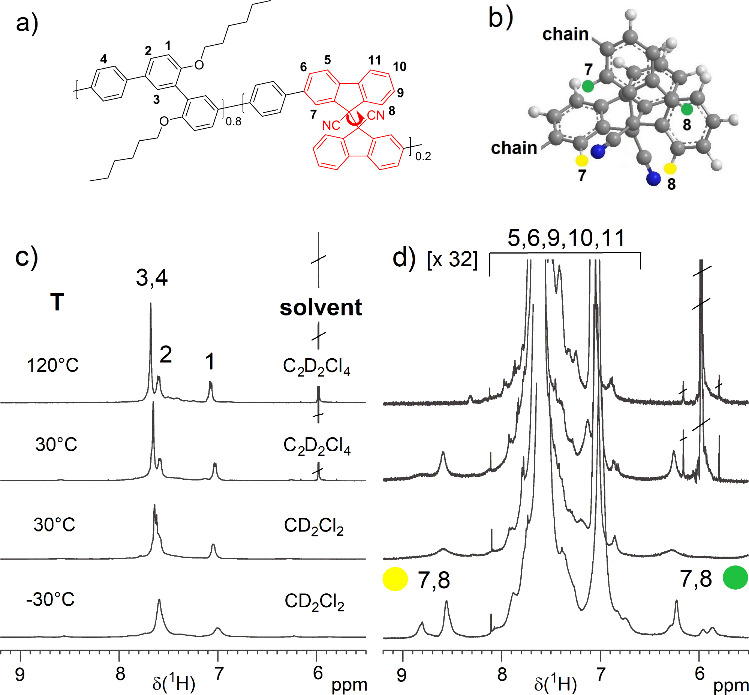 Figure 1
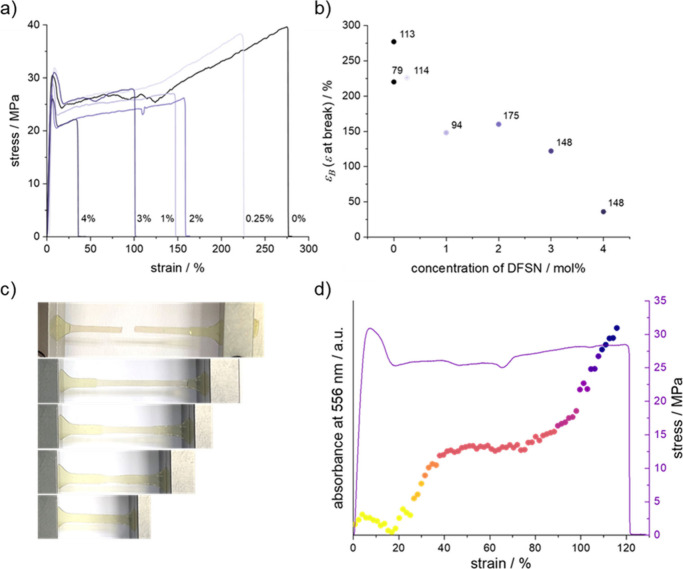 Figure 2
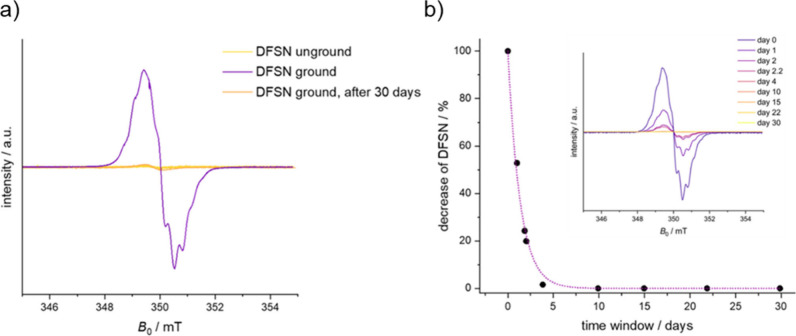 Figure 3
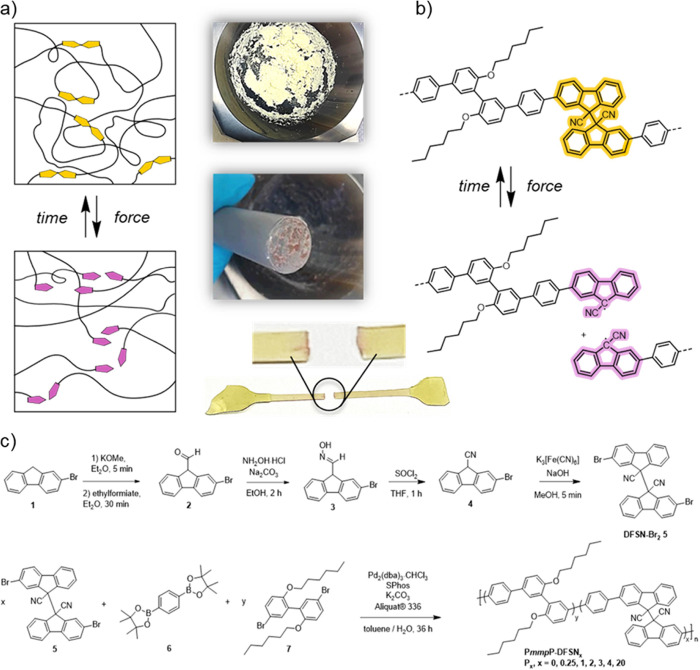 Figure 4
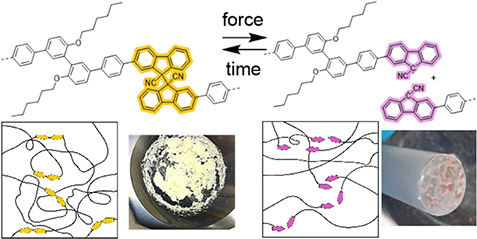 Figure 5
- —Technische Universität Chemnitz10.13039/100009117
- —Deutsche Forschungsgemeinschaft10.13039/501100001659
- —Deutsche Forschungsgemeinschaft10.13039/501100001659
Peer Reviews
No public reviews on file for this paper yet. If you reviewed it on a platform where reviews are public (OpenReview, ICLR, NeurIPS, ICML), you can paste yours below so the community can read it here.
Videos
No videos yet. Explain this paper in a talk, walkthrough, or lecture? Add one.
Taxonomy
TopicsForce Microscopy Techniques and Applications · Luminescence and Fluorescent Materials · Carbon Nanotubes in Composites
Molecular break points using covalently installed mechanophores in polymers allow to direct mechanical deformation and stress to weak points of the chain, giving rise to mechanoresponsive behavior and eventually generating new functions.^1−4^ Potential applications span a wide range of possibilities, including optical detection and quantification of forces to map stress distributions of a macroscopic specimen,^5^ access to unusual reaction pathways or products,^6−9^ self-healing and reinforcement of gels,^10^ or the release of small molecules in biomedical applications.^11^ While mechanochromic polymers display changes in stress by color change, which may not necessarily be accompanied by chain scission,^12−14^ mechanical activation of molecular break points by chain cleavage may^7−9,15−19^ or may not^20^ produce colored products.^21^ For example, spiropyran-based force probes indicate stress by bond cleavage, but the resulting merocyanine can isomerize back to SP and ensure that the molar mass of the chain remains unchanged. If, however, distinct applications require mechanical deformation to produce both color change and a change in mechanical properties (i.e., viscosity, strength, toughness, strain at break), colored mechanophores that function via covalent bond scission need to be used.
Colored, stabilized mechanoradicals open up pathways to force responsiveness by both chain cleavage and visible color generation. While the reduction in molar mass upon chain scission changes mechanical properties, the resulting radicals can be detected optically or by means of electron paramagnetic resonance (EPR) spectroscopy.^4^ Modulating the reactivity of mechano-generated radicals can furthermore be a useful handle to control subsequent reactions related to cross-linking processes,^22^ hydrogen abstractions,^22,23^ and antioxidant properties.^24,25^ Along these lines, diarylbenzofuranones (DABBF)^26^ and difluorenylsuccinonitrile (DFSN)^27^ exhibit a variable temperature range for their activation. DFSN has been used as a functional cross-linker^22,28,29^ to toughen^28^ or self-strengthen^22,30^ materials or mapping stress^30,31^ of networks. A further useful property is the low reactivity of DFSN radicals toward oxygen,^27^ which opens up possibilities for recombination and thus self-healing under ambient conditions. DFSN further exhibits a reasonably high thermal stability up to 130 °C, which is ideal regarding its synthesis and incorporation into polymers at elevated temperature.^27,32,33^ However, DFSN motifs carry hydroxymethyl groups,^22,27−29,34^ which limit the range of polymer chemistries and matrices to be used for covalent incorporation and thus the range of smart materials accessible.
To make use of the unique properties of the DFSN motif also in more rigid and tough polymers, we here report the synthesis of a brominated DFSN derivative, 2,2′-dibromo-9,9′-bi-9H-fluorene-9,9′-dicarbonitrile (DFSN-Br_2_), and its incorporation into the tough and glassy poly(meta–meta–para)phenylene, PmmpP, via Suzuki polycondensation (Scheme 1).^35^ PmmpP with hexyloxy side chains is amorphous with a glass transition temperature Tg of ∼110 °C, a Young’s modulus of 0.9 GPa^35^ and strain at break values up to 300%,^35^ provided that molar mass is sufficiently high. These properties arise from the high share of meta linkages in the backbone,^35,36^ which cause an entanglement molar mass of Me = 4.8 kg·mol^–1^.^37,38^ The large strain at break values of PmmpP render this polymer ideal to investigate stress-related phenomena in situ during tensile testing.^14,39,40^ With increasing concentration of DFSN in the PmmpP chain, the strain at break values continuously decrease. The unique beneficial toughness of PmmpP is entirely eliminated for DFSN concentrations as low as ∼5%. In situ UV–vis absorption spectroscopy during tensile testing indicates that the first fraction of DFSN is activated within the necking region. A second, possibly larger, fraction of DFSN mechanophores fails within the strain hardening regime, where the force per chain increases. EPR spectroscopy of ground powders indicates a half-life of the radicals of 0.94 d at room temperature ascribed to recombination.
We synthesized tough PmmpP with varying amounts of DFSN units incorporated statistically into the backbone, furnishing a series of PmmpP-DFSN_x, with x and y being the molar fractions of DFSN-Br_2 and biphenyl monomer 7, respectively, such that x + y = 100 mol % in the monomer feed (Scheme 1, Table 1). The yellow color of as-prepared PmmpP-DFSN_x_ changes upon mechanical activation via tensile testing or grinding, resulting in a pink color (Scheme 1a,b).
The DFSN-Br_2_ monomer 5 was prepared in five steps starting from 2-bromofluorene 1 using a modified procedure from Sakai et al.^27^ First, 1 was deprotonated with potassium methoxide and quenched with ethyl formate to generate the aldehyde functionality in 9-position (Scheme 1c). The aldehyde 2 was further converted into oxime 3, which was directly used to obtain the corresponding nitrile 4 via oxidation with SOCl_2_. The final dimerization step to furnish DFSN-Br_2_5 with potassium ferrocyanide(III) as oxidant was optimized by using degassed solvents to achieve a relatively high yield of 36% (see Supporting Information for details).
DFSN-Br_2_5 is a mixture of two stereoisomers due to the chiral 9,9′ carbons. Furthermore, steric interactions result in strongly preferred gauche conformations for the central C9–C9′ bond.^41,42^ This produces rotamers that interconvert by rotation around this bond. A study on the rotational isomerism for the unsubstituted DFSN was reported by Lam et al.^42^ The rate of the inversion process influences the appearance of the NMR signals and results in temperature-dependent NMR spectra. A detailed characterization of DFSN-Br_2_5 via NMR spectroscopy including information on stereoisomers is presented in the Supporting Information.
DFSN-Br_2_5 was copolymerized with 1,4-benzenediboronic acid bis(pinacol)ester 6 and 5,5′-dibromo-2,2′-bis(hexyloxy)-1,1′-biphenyl 7(14,35) to get PmmpP-DFSN_x_ with 0.25 mol % < x < 20 mol % (Scheme 1c, Table 1). Statistical incorporation of DFSN is expected due to an anticipated similar reactivity of 5 and 7.
The detection and quantification of DFSN units in PmmpP-DFSN_x_ was challenging due to the low intensity of the relevant signals, but also due to the dynamic processes mentioned above causing very broad ^1^H NMR signals at room temperature. The sample with the highest DFSN content, PmmpP-DFSN_20_, shows few broad DFSN signals at 30 °C and was measured in different solvents and at different temperatures to improve DFSN detection (Figure 1). At elevated temperatures, the signals from the DFSN unit shift and are likely overlapped by backbone signals and thus cannot be clearly identified. Slowing down the dynamic processes at −30 °C leads to well-detectable signals of protons 7 and 8, whereas other signals are overlapped. The assignment is based on the ^1^H NMR study of the DFSN-Br_2_ monomer (see Supporting Information). Under similar conditions, semiquantification of the covalently incorporated DFSN was possible also for the polymers with low content, confirming similarity between monomer feed ratios and copolymer composition (see Supporting Information, Figure S13, and Table 1). The additional DFSN units are not expected to significantly change the physical properties of the PmmpP chain in the concentration range used. For example, the glass transition temperatures of pristine PmmpP and PmmpP-DFSN_4_ are 121 and 118 °C (see Figure S15), confirming this assumption.
The series of PmmpP-DFSN_x_ with varying DFSN content allows investigation of their mechanical properties as a function of the density of break points. Specimens for tensile testing were prepared by punching dog bone-shaped specimens from solution-cast films. For pristine PmmpP with a high molar mass (Mw > 90 kg/mol), large strain at break values up to ε_B_ ∼ 300% are reported.^35^ This is the case of P_0_, which delivered ε_B_ = 277%, while all other samples P_x_ with x = 0.25–4 showed significantly smaller values of ε_B_ (Figure 2a,b, Table 1). As strain at break also depends on molar mass, an effort was made to maintain a similar level of Mw values, as far as this was possible for products made by polycondensation (note that Mn values are strongly influenced by the shape of the SEC curve of these kinked polymers and are therefore less meaningful). Figure 2b depicts the combined effects of the DFSN content and molar mass variation on ε_B_. This explains why the two samples with Mw < 100 kg/mol, P_0_ and P_1_, fail at relatively small values of ε_B_ compared to the other samples. However, an overall clear trend of an increasing DFSN content causing strongly decreasing strain at break from ε_B_ = 277% (P_0_) to ε_B_ = 36% (P_4_) emerged. P_20_ did not show film-forming properties and could therefore not be tested. Stress at break values were less dependent on DFSN content (Figures 2a and S17). P_3_ and P_4_ showed a faint pink color upon failing, which was only visible at the breaking edge of the sample, while intensity of color formation was generally weak along the necked areas, being hardly visible by the naked eye (Scheme 1b, Figure 2c).
To further monitor DFSN cleavage, the mechano-optical characterization of PmmpP-DFSN_x_ (x = 2, 3) was carried out via tensile testing with in situ UV–vis absorption in transmission. Pristine PmmpP does not show a significant absorbance beyond 500 nm. Although the overall intensity of the pink DFSN radical was weak, absorbance at 556 nm^27^ clearly showed mechanically induced formation of DFSN radicals. However, scattering effects caused by thick specimens complicated analysis (see Supporting Information). PmmpP-DFSN_3_ developed an absorbance peak with increasing strain (Figures S17–S19) that vanished following specimen failure and relaxation (Figure S21). This suggests recombination of DFSN radical-terminated chains, which is remarkable in light of the high Tg and large molar mass compared to room temperature and the entanglement molecular weight of PmmpP,^38^ respectively. Following the absorbance of PmmpP-DFSN_3_ at 556 nm as an example, DFSN cleavage can be correlated with different regions of the stress–strain curve (Figure 2d). The onset of absorption at 556 nm occurs as soon as the specimen enters the necking region where plastic flow allows the transduction of macroscopic force to the chain. During the first half of the necking region, the absorbance at 556 nm remained mostly constant.
At the end of the necking and in the beginning of the strain hardening region, absorbance further increased with saturation of this process finally not being reached due to early failure of the specimen. This second increase in absorbance is explained by increasing stress in the entangled network.
To gain information about the formation and also stability of DFSN radicals over time and thus further insight into DFSN mechanochemistry, PmmpP-DFSN_20_ was ground and investigated via EPR spectroscopy. EPR spectra were taken from bulk powders before and after grinding, as well as after different times after the grinding process. Figure 3a shows the absence of an EPR signal before grinding as well as an intense signal with hyperfine splitting directly after grinding. The splitting and experimental Landé g-factor of 2.003 align with the DFSN derivative as described by Sakai et al.^27,43^ The intensity of the EPR spectra over time decreased continuously until the signal vanished after ∼5 days (Figure 3b), along with the discoloration of the ground powder. Fitting the decay with a monoexponential fit yields a half-life of 0.94 days for this sample, i.e., for the ground bulk powder of low molar mass sample P_20_. This decrease may be explained by the kinetics of a first order reaction.
Since DFSN radicals exhibit remarkable stability toward oxygen and as the shape of the decaying EPR spectra does not suggest the formation of a new species with unpaired electrons, we assume the decaying intensity of the EPR spectra to result from recombination of radicals. Such process was suggested on the basis of in situ UV–vis spectroscopy following specimen failure (Figure S21), but can be clearer seen and quantified by EPR spectroscopy.
However, reactions that produce noncolored and EPR-silent products other than those from DFSN radical recombination cannot be entirely ruled out. While spectroscopic characterization of such reaction via NMR spectroscopy is challenging due to the issues of spectroscopic detection mentioned (vide supra), we have furthermore subjected ground powders of PmmpP_20_ to SEC analysis, where a broadening of the molecular weight distribution toward both longer as well as shorter chains, was observed (see Figure S25). Upon addition of tetrahydrofuran, the pink color instantaneously disappeared, possibly due to an increased chain mobility facilitating recombination. The appearance of chains longer than those present in the original SEC distribution can only be explained by cleavage of DFSN furnishing scrambled lengths of recombined chains. Upon recombination of longer segments, larger molar masses than those present in the original molecular weight distribution may form, suggesting chain segment recombination at the expense of DFSN radicals. This is in line with literature data that supports a robust DFSN radical capable of selective C–C bond breaking and recombination without major side reactions.^26,34^
In conclusion, we have designed tough polyphenylenes PmmpP-DFSN_x_ with varying amounts of mechanochromic molecular break points based on the difluorenylsuccinonitrile (DFSN). A brominated DFSN monomer was successfully prepared and incorporated into a tough polyphenylene via Suzuki polycondensation. In a series of PmmpP-DFSN_x_ copolymers, the composition according to the monomer feed was confirmed by NMR spectroscopy. The mechanical properties are a strong function of DFSN content, whereby 4 mol % DFSN in the copolymer almost entirely eliminated the unique toughness behavior of PmmpP. More specifically, strain at break can be controlled through DFSN density in the chain, allowing one to predict material failure. The investigation of mechano-optical behavior showed that two fractions of covalently incorporated DFSN were activated in the necking and strain hardening regime of the stress strain region. While the pink color of the DFSN radicals is rather weak rendering detection of low concentrations challenging, the DFSN radicals are remarkably stable and EPR-active, which opens up providing opportunities for analytical detection. Yet, while DFSN radicals are robust, they also recombine and thus open up possibilities for the design of tough materials with controlled mechanical and potentially self-healing properties.
The reference list from the paper itself. Each links out to its DOI / PubMed record.
- 1Caruso M. M.; Davis D. A.; Shen Q.; Odom S. A.; Sottos N. R.; White S. R.; Moore J. S. Mechanically-Induced Chemical Changes in Polymeric Materials. Chem. Rev. 2009, 109 (11), 5755–5798. 10.1021/cr 9001353.19827748 · doi ↗ · pubmed ↗
- 2Huang Z.; Boulatov R. Chemomechanics: Chemical Kinetics for Multiscale Phenomena. Chem. Soc. Rev. 2011, 40 (5), 2359–2384. 10.1039/c 0cs 00148 a.21283850 · doi ↗ · pubmed ↗
- 3Li J.; Nagamani C.; Moore J. S. Polymer Mechanochemistry: From Destructive to Productive. Acc. Chem. Res. 2015, 48 (8), 2181–2190. 10.1021/acs.accounts.5b 00184.26176627 · doi ↗ · pubmed ↗
- 4Chen Y.; Mellot G.; van Luijk D.; Creton C.; Sijbesma R. P. Mechanochemical Tools for Polymer Materials. Chem. Soc. Rev. 2021, 50 (6), 4100–4140. 10.1039/D 0CS 00940 G.33543174 · doi ↗ · pubmed ↗
- 5Chen Y.; Yeh C. J.; Qi Y.; Long R.; Creton C. From Force-Responsive Molecules to Quantifying and Mapping Stresses in Soft Materials. Sci. Adv. 2020, 6 (20), eaaz 509310.1126/sciadv.aaz 5093.32440548 PMC 7228757 · doi ↗ · pubmed ↗
- 6Lenhardt J. M.; Ong M. T.; Choe R.; Evenhuis C. R.; Martinez T. J.; Craig S. L. Trapping a Diradical Transition State by Mechanochemical Polymer Extension. Science 2010, 329 (5995), 1057–1060. 10.1126/science.1193412.20798315 · doi ↗ · pubmed ↗
- 7Mc Fadden M. E.; Barber R. W.; Overholts A. C.; Robb M. J. Naphthopyran Molecular Switches and Their Emergent Mechanochemical Reactivity. Chem. Sci. 2023, 14 (37), 10041–10067. 10.1039/D 3SC 03729 K.37772118 PMC 10530568 · doi ↗ · pubmed ↗
- 8Barber R. W.; Mc Fadden M. E.; Hu X.; Robb M. J. Mechanochemically Gated Photoswitching: Expanding the Scope of Polymer Mechanochromism. Synlett 2019, 30 (15), 1725–1732. 10.1055/s-0037-1611858. · doi ↗