Watching tetrahedral intercalation in transition metal hydroxides in situ
Luis M Liz-Marzán

Abstract
Genes, proteins, chemicals, diseases, species, mutations and cell lines named across the full text — each resolved to its canonical identifier and authoritative record.
Click any figure to enlarge with its caption.
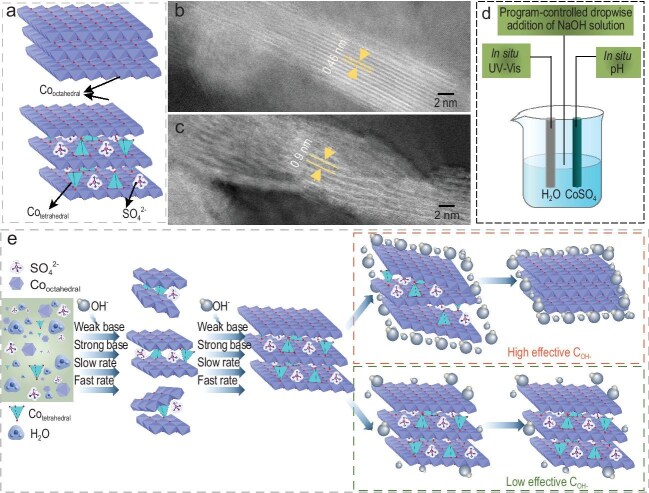 Figure 1
Peer Reviews
No public reviews on file for this paper yet. If you reviewed it on a platform where reviews are public (OpenReview, ICLR, NeurIPS, ICML), you can paste yours below so the community can read it here.
Videos
No videos yet. Explain this paper in a talk, walkthrough, or lecture? Add one.
Taxonomy
TopicsMinerals Flotation and Separation Techniques · Mesoporous Materials and Catalysis · Methane Hydrates and Related Phenomena
Transition metal hydroxides (TMHs) can be used as model systems to understand nucleation and crystallization in hydroxide-rich minerals [1]. Beyond their fundamental significance, TMHs additionally find application in various fields, such as catalysis, energy storage, and electronic devices [2,3]. The synthesis of TMHs typically relies on wet chemistry, using OH^−^ concentration to drive the transformation of water/anion-coordinated metal ions [4]. Ultimately, a complex network of anion-coordinated metal polyhedra is obtained, containing metal ions with unconventional coordination numbers (UCN) together with the conventional octahedral (6-coordinated) structures. The way in which such polyhedra with UCN intercalate and deintercalate in the network plays a major role in the nucleation, growth, final composition, and the properties/functionality of the obtained TMHs [5]. However, the relevant dynamic behavior of polyhedra with UCN during TMH formation remains poorly understood due to the limitations of conventional ex situ characterization techniques.
An international collaboration team led by Prof. Minghua Huang from Ocean University of China, Dr. Saskia Heumann from the Max Planck Institute for Chemical Energy Conversion, Prof. Heqing Jiang from the Chinese Academy of Sciences, and Prof. Helmut Cölfen from the University of Konstanz, has now been able to confirm the presence of UCN in Co(OH)2 and how it affects the overall structure (Fig. 1a–c) [6]. Comprehension of the intercalation/deintercalation mechanism in tetrahedral Co^2+^ in Co(OH)2 was achieved through a multimodal in situ characterization suite. By simultaneous in situ pH determination (through a H^+^-selective electrode) and UV-Vis spectroscopy, both OH^−^ concentration and the evolving coordination environment of Co^2+^ were monitored in real time. It should be noted that specific UV-Vis signals for tetrahedral Co^2+^ facilitated the observation of its incorporation and release during TMH precipitation [7]. Another advantage of this system is the possibility to modulate the reaction rate by controlled introduction of NaOH and NH_3_ (Fig. 1d), thereby revealing further insights into the factors governing intercalation/deintercalation of undercoordinated polyhedra (tetrahedral Co^2+^). This combined approach uncovered a critical correlation between tetrahedral Co^2+^ intercalation and OH^−^ concentration. As shown in Fig. 1e, at early stages of Co(OH)2 formation, tetrahedral Co^2+^ is preferentially incorporated into the lattice, whereas its retention is largely dictated by the effective OH^−^ concentration.
This combined methodology significantly advances our fundamental understanding of TMH crystallization. Additionally, it provides a framework for the rational synthesis design of tunable coordination environments, which can be used to optimize TMH materials for applications such as oxygen evolution reaction (OER) catalysis. The unique combination of in situ techniques employed in this study represents a powerful tool to investigate other hydroxide-based materials beyond Co(OH)2 and subsequently design synthesis strategies toward enhanced material functionalities.
In summary, this work represents a significant step toward decoding the intercalation dynamics of polyhedra with UCN in TMHs. By bridging the gap between synthesis conditions and structural evolution, it offers a new paradigm for the controlled modulation of metal coordination environments. This approach holds great potential for advancing both fundamental research and the development of high-performance hydroxide materials for energy and environmental applications.
The reference list from the paper itself. Each links out to its DOI / PubMed record.
- 1Liu X, Tournassat C, Grangeon S et al. Nat Rev Earth Environ 2022; 3: 461–76.10.1038/s 43017-022-00301-z · doi ↗
- 2Yu J, Wang Q, O'Hare D et al. Chem Soc Rev 2017; 46: 5950–74.10.1039/C 7CS 00318 H 28766671 · doi ↗ · pubmed ↗
- 3Mefford JT, Akbashev AR, Kang M et al. Nature 2021; 593: 67–73.10.1038/s 41586-021-03454-x 33953412 · doi ↗ · pubmed ↗
- 4Chen Z, Schmid R, Wang X et al. Nat Synth 2023; 2: 670–7.10.1038/s 44160-023-00281-y · doi ↗
- 5Alsaç EP, Zhou K, Rong W et al. Energy Environ Sci 2022; 15: 2638–52.10.1039/D 2EE 00396 A · doi ↗
- 6Chen Z, Fan Q, Wang X et al. Natl Sci Rev 2025; 12: nwae 427.10.1093/nsr/nwae 42739926197 PMC 11804801 · doi ↗ · pubmed ↗
- 7Ma R, Liu Z, Takada K et al. Inorg Chem 2006; 45: 3964–9.10.1021/ic 052108 r 16676955 · doi ↗ · pubmed ↗