3D-architected acceptor affords efficient, stable and stretchable photovoltaics
Jin-Woo Lee, Jung-Yong Lee, Bumjoon J Kim

Abstract
Genes, proteins, chemicals, diseases, species, mutations and cell lines named across the full text — each resolved to its canonical identifier and authoritative record.
Click any figure to enlarge with its caption.
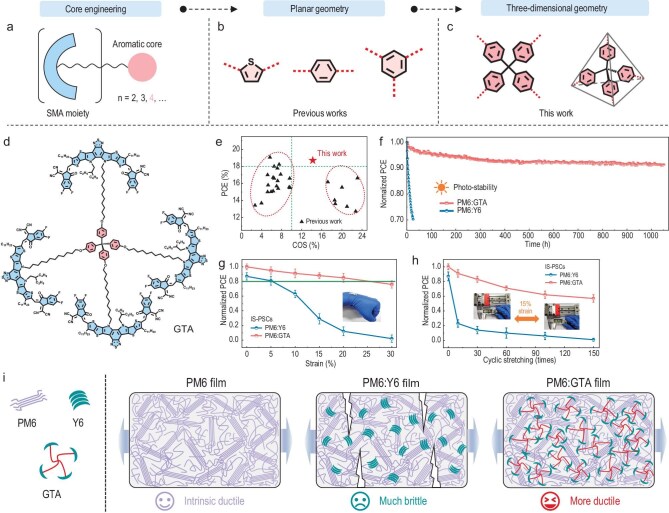 Figure 1
Peer Reviews
No public reviews on file for this paper yet. If you reviewed it on a platform where reviews are public (OpenReview, ICLR, NeurIPS, ICML), you can paste yours below so the community can read it here.
Videos
No videos yet. Explain this paper in a talk, walkthrough, or lecture? Add one.
Taxonomy
TopicsOrganic Electronics and Photovoltaics · Thin-Film Transistor Technologies · Advanced Sensor and Energy Harvesting Materials
Polymer solar cells (PSCs) have emerged as a transformative photovoltaic technology, offering inherent advantages such as light weight, flexibility, cost-effectiveness and environmental friendliness [1]. These attributes make PSCs particularly suitable for applications in wearable devices. Over the past decades, the evolution from fullerene-based acceptors to diverse small-molecule acceptors (SMAs) has been driven by innovative molecular design and in-depth understanding of the structure-performance relationships [2]. This progress has propelled PSCs to achieve unprecedented power conversion efficiencies (PCEs) beyond 20%. Yet, challenges related to stability and mechanical durability continue to hinder their path toward commercial application [3].
Recently, oligomerization of SMAs has been shown to effectively elevate the glass transition temperature (Tg) of these materials, delaying molecular diffusion kinetics and suppressing thermodynamically driven phase segregation [4,5]. Unfortunately, the inherent rigidity of oligomeric SMAs creates hard, isolated aggregated structures, resulting in the brittleness of blend films in PSCs [6]. The aggregated structures in blend films can be tailored by fine-tuning the regioregularity, molecular weight and the conjugated molecular structures [7]. Typically, this aggregated structure consists of hard lamellar crystalline domains interspersed with rubbery amorphous phases. Under mechanical deformation, the amorphous phases play a crucial role in dissipating mechanical stress, thereby promoting strain hardening and improving film toughness [8,9]. Therefore, the key to improving mechanical resilience of these blend films, without compromising PCE and long-term stability, lies in precisely regulating the aggregated structure of the acceptor component and the intermixed domains with the donor materials in blend films.
In a recent study published in National Science Review, Prof. Zhiguo Zhang's group from Beijing University of Chemical Technology, in collaboration with Prof. Long Ye's group from Tianjin University, suggests a new tethered SMA design (Fig. 1) that simultaneously achieves the high PCE, morphological stability and mechanical robustness in PSCs [10]. Unlike traditional oligomeric acceptors linked via stiff end-groups, their newly designed tethered acceptor, GTA, features flexible alkyl chain linkages arranged in a tetrameric geometry. The key to this design is using tetraphenylmethane as the linking core to create (1) a three-dimensional structure that increases free volume and (2) a high C2 symmetry that preserves fast charge transport, thereby enhancing the mechanical robustness of blend films while retaining excellent electrical properties. As demonstrated by dynamic mechanical analysis and film-on-elastomer characterizations, this unique structural design preserves sub-Tg relaxation dynamics while forming a mechanically resilient yet dynamically adaptive network. As a result, intrinsically stretchable PSCs incorporating GTA exhibit outstanding mechanical robustness, retaining 88% of their initial PCE at 15% strain and 76% after 150 fatigue cycles. In addition, the GTA-based PSCs demonstrate excellent PCE and exceptional photostability. This study represents an excellent demonstration of a binary PSC system that simultaneously enhances efficiency, stability and stretchability through delicate molecular design. The tethered oligomerization approach provides a new pathway for addressing the long-standing challenges impacting the figure-of-merit in wearable devices.
In summary, this research highlights the potential of three-dimensional tethered oligomerization as a transformative strategy for intrinsically stretchable photovoltaics. With further development, this approach could accelerate the commercialization of wearable solar technologies and contribute significantly to the advancement of next-generation sustainable energy solutions.
The reference list from the paper itself. Each links out to its DOI / PubMed record.
- 1Park JS, Kim G-U, Lee S et al. Adv Mater 2022; 34: 2201623.10.1002/adma.20220162335765775 · doi ↗ · pubmed ↗
- 2Yi J, Zhang G, Yu H et al. Nat Rev Mater 2024; 9: 46–62.10.1038/s 41578-023-00618-1 · doi ↗
- 3Ding P, Yang D, Yang S et al. Chem Soc Rev 2024; 53: 2350–87.10.1039/D 3CS 00492 A 38268469 · doi ↗ · pubmed ↗
- 4Zhuo H, Qiu B, Li X et al. Giant 2024; 20: 100336.10.1016/j.giant.2024.100336 · doi ↗
- 5Lee J-W, Park JS, Jeon H. Chem Soc Rev 2024; 53: 4674–706.10.1039/D 3CS 00895 A 38529583 · doi ↗ · pubmed ↗
- 6Siddika S, Peng Z, Balar N et al. Joule 2023; 7: 1593–608.10.1016/j.joule.2023.06.002 · doi ↗
- 7Li S, Gao M, Zhou K et al. Adv Mater 2024; 36: 2307278.10.1002/adma.20230727837865872 · doi ↗ · pubmed ↗
- 8Lee J-W, Oh ES, Lee S et al. Joule 2025; 9: 101792. 10.1016/j.joule.2024.11.009 · doi ↗