Determinants of smoking prevention behavior of senior high school students: A short report
Muthmainnah Muthmainnah, Galuh Mega Kurnia, Avinka Nugrahani

TL;DR
This study explores factors influencing smoking prevention behavior among Indonesian high school students and identifies key predictors like perceived risk and self-efficacy.
Contribution
The study identifies specific behavioral determinants influencing smoking prevention among Indonesian adolescents using a health belief model framework.
Findings
Perceived susceptibility, severity, benefits, self-efficacy, and cues to action significantly correlate with smoking prevention behavior.
High perceived susceptibility was associated with 34.4% of students showing good prevention behavior.
Self-efficacy showed a strong link, with 36.7% of students with high self-efficacy demonstrating good behavior.
Abstract
With Indonesia ranking top in the Association of Southeast Asian Nations for the number of smokers aged 13–15 years, this study aims to analyze the factors associated with smoking prevention behavior among students of senior high school. This cross-sectional pilot study, conducted in 2022 with 90 samples of grade 10–11 students at SMA Negeri 1 Taman Sidoarjo East Java Indonesia, examined variables such as perceived vulnerability (the belief about the risk of experiencing a health issue), severity (the belief about the seriousness of the health issue), benefits (the belief in the benefit of taking preventive actions), barriers (the perceived obstacles to performing preventive behaviors), self-efficacy (the confidence in one's ability to perform preventive behaviors successfully), and cues to action (factors that trigger the decision to engage) in relation to health behaviors. Data were…
Genes, proteins, chemicals, diseases, species, mutations and cell lines named across the full text — each resolved to its canonical identifier and authoritative record.
Click any figure to enlarge with its caption.
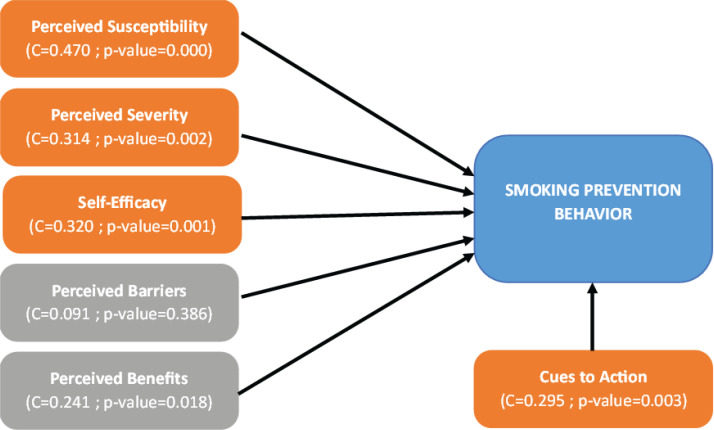 Figure 1
|
|
|
|
|
|
| |||||
|---|---|---|---|---|---|---|---|---|---|---|
|
|
| |||||||||
|
|
|
|
|
|
| |||||
| Perceived susceptibility | High | 31 | 34.4 | 12 | 13.3 | 43 | 47.8 | 17.122 | 0.000 | 0.470 |
| Low | 9 | 10 | 38 | 42.2 | 47 | 52.5 | ||||
| Perceived severity | High | 30 | 33.3 | 21 | 23.3 | 51 | 56.7 | 17.31 | 0.002 | 0.314 |
| Low | 10 | 11.1 | 29 | 32.2 | 39 | 43.3 | ||||
| Perceived benefit | High | 26 | 28.9 | 20 | 22.2 | 46 | 51.1 | 21 | 0.018 | 0.241 |
| Low | 14 | 15.6 | 30 | 33.3 | 44 | 48.9 | ||||
| Perceived barriers | High | 26 | 28.9 | 28 | 31.1 | 54 | 60 | 15 | 0.386 | 0.091 |
| Low | 14 | 15.6 | 22 | 24.4 | 36 | 40 | ||||
| Self-efficacy | High | 33 | 36.7 | 25 | 27.8 | 58 | 64.4 | 26.22 | 0.001 | 0.320 |
| Low | 7 | 7.8 | 25 | 27.8 | 32 | 35.6 | ||||
| Cues to action | High | 26 | 28.9 | 17 | 18.9 | 43 | 47.8 | 18 | 0.003 | 0.295 |
| Low | 14 | 15.6 | 33 | 36.7 | 47 | 52.2 | ||||
Peer Reviews
No public reviews on file for this paper yet. If you reviewed it on a platform where reviews are public (OpenReview, ICLR, NeurIPS, ICML), you can paste yours below so the community can read it here.
Videos
No videos yet. Explain this paper in a talk, walkthrough, or lecture? Add one.
Taxonomy
TopicsSmoking Behavior and Cessation · Obesity, Physical Activity, Diet · School Health and Nursing Education
INTRODUCTION
In Indonesia, smoking among adolescents is a significant concern, with the Southeast Asia Tobacco Control Alliance reporting high smoking rates, particularly among males aged 13–15 years^1^. The 2019 Global Youth Tobacco Survey showed 19.2% of students currently smoke^2^, with a significant increase in smoking prevalence among those aged 15–19 years, from 2013 to 2018 by 1.4%^3^. In East Java, 9.84% of adolescents aged 10–18 years smoke, and in Sidoarjo District, 20.46% of the population aged ≥10 years smoke daily^4^.
Peer influence is a significant risk factor for adolescent smoking, with studies showing that peer smoking behavior can increase the likelihood of smoking by up to 10-fold^5,6^. Smoking at a young age increases the risk of long-term health problems due to prolonged exposure to tobacco toxins^6^. Health Belief Model (HBM) theory, which focuses on factors such as perceived susceptibility, severity, self-efficacy, benefits, and barriers, is commonly used to analyze health behavior change^7^. Previous research has shown that HBM-based interventions, such as smoking prevention counseling, can positively influence adolescents’ perceptions of smoking risks and benefits. However, some adolescents with low perceptions of smoking’s risks may overlook its harms^8^. This study aims to analyze factors associated with smoking prevention behavior among students at a senior high school in Indonesia to help design more effective smoking prevention interventions.
METHODS
This study in 2022 was located in Sidoarjo Regency, Indonesia, and used a cross-sectional method. The population in this study consisted of students from SMA Negeri 1 Taman Sidoarjo East Java Indonesia, specifically those in grades 10 and 11. The total population of grade 10 and 11 students was 727, with 382 students in grade 10 and 345 in grade 11. This population was chosen because smoking behavior is most prevalent in the high school age group. Grade 12 students were excluded from the study as they were focused on preparing for national exams. Population data were obtained from secondary data related to the number of students in the school. The sampling method used in this study was convenience sampling, where questionnaire links were distributed to class leaders and then shared with their classmates. The final sample of 90 students was drawn from this population of Senior High School 1 Taman students.
Measures
The questionnaire was developed based on the Health Belief Model (HBM) theory and consists of seven main domains: perceived susceptibility, perceived severity, self-efficacy, perceived benefits, perceived barriers, cues to action, and prevention behavior. The questionnaire was tested for validity and reliability on 30 respondents at a different school with similar characteristics. Each domain was assessed using specific items on an ordinal scale, and the results were categorized based on the mean value (high >mean, and low ≤mean). The following is a detailed explanation of each domain:
Perceived susceptibility: This domain measures respondents’ perceptions of their risk of developing health problems due to smoking behavior. It consists of five questionnaire items assessed on an ordinal scale.Perceived severity: This domain evaluates respondents’ perceptions of the seriousness of health threats caused by smoking. It includes five questionnaire items on an ordinal scale.Self-efficacy: This domain assesses respondents’ confidence in preventing smoking or resisting smoking-related temptations. It comprises six questionnaire items measured on an ordinal scale.Perceived benefits: This domain captures respondents’ perceptions of the effectiveness of smoking prevention behaviors. It includes five questionnaire items on an ordinal scale.Perceived barriers: This domain identifies respondents’ obstacles to adopting smoking prevention behaviors. It consists of five questionnaire items measured on an ordinal scale.Cues to action: This domain examines respondents’ responses to cues or stimuli that encourage smoking prevention behaviors. It includes five questionnaire items on an ordinal scale.Prevention behavior: This domain evaluates the efforts made by respondents to avoid smoking and its associated risks. It consists of six questionnaire items assessed on an ordinal scale.
The time required to complete the questionnaire was approximately 10–15 minutes, and participants’ identities were kept strictly confidential to ensure privacy and encourage honest responses. The questionnaire is provided in the Supplementary file.
Statistical analysis
This study uses the chi-squared test to analyze the association between the independent and dependent variables. Data analysis was carried out with IBM SPSS Statistics (Version 18).
RESULTS
The cross-tabulation results show that the perceived vulnerability variable has a positive correlation with smoking prevention behavior (C=0.470; p=0.000) (Table 1 and Figure 1). Similarly, on the perceived severity variable, a positive association was found with smoking prevention behavior (C=0.314; p=0.002). The results also showed that on the perceived benefits variable, there was a positive association with smoking prevention behavior (C=0.241; p=0.018). However, for the perceived barriers variable, no correlation was found with smoking prevention behavior (C=0.091; p=0.386). In addition, in the self-efficacy variable, an association was found with smoking prevention behavior (C=0.320; p=0.001). Finally, the cues to action variable also showed a positive association with smoking prevention behavior (C=0.295; p=0.003).
Factors influencing smoking prevention behavior
DISCUSSION
The perceived vulnerability was positively correlated with smoking prevention behavior. Students who perceive a higher risk of smoking-related diseases tend to adopt better prevention behaviors. This suggests that greater awareness of health risks enhances the likelihood of taking preventive actions. Previous studies also show that adolescents who view smoking as a stress reliever are more likely to smoke, indicating that perceptions of smoking’s benefits can influence vulnerability to smoking^9^. Perceived severity was also positively associated with smoking prevention behavior. Students who perceive smoking-related diseases as serious are more motivated to engage in preventive actions. The recognition of the significant negative impacts of smoking can drive individuals to prioritize prevention over treatment^10^.
Similarly, perceived benefits correlated positively with smoking prevention behavior. Students who see the benefits of smoking prevention are more likely to adopt preventive behaviors. When choosing health behaviors, people often weigh the benefits against the availability of resources and environmental support^11^. On the other hand, perceived barriers did not show a positive correlation with smoking prevention behavior, contradicting previous studies suggesting that higher perceived barriers reduce smoking intentions. This finding indicates the importance of strategies that reduce the perceived barriers to prevention, such as increasing cigarette prices and taxes to limit access^12,13^.
Self-efficacy was positively correlated with smoking prevention behavior. Students with high self-efficacy are more likely to engage in prevention behaviors, and their confidence in their ability to succeed in avoiding smoking is an essential factor. Programs targeting smoking prevention can benefit from fostering self-efficacy, such as by establishing anti-smoking student cadres in schools^14^. Cues to action, both internal and external, were also positively related to smoking prevention behavior. Students who are exposed to cues, like peer influence or media messages, are more likely to adopt smoking prevention behaviors. The presence of smoking peers and parental smoking behaviors can serve as triggers for initiating or maintaining smoking habits^15,16^.
Strengths and limitations
This study addresses a significant public health issue in Indonesia, namely the high prevalence of adolescent smoking. This study explores the factors that influence smoking prevention behavior among high school students and provides valuable insights for smoking prevention efforts at the adolescent level. The findings provide a strong basis for the development of smoking prevention policies in Indonesian high schools. Identifying factors that influence smoking prevention behavior can help design more effective interventions.
This study has several limitations. First, there is a potential for respondent bias due to reliance on self-reported data from students, including recall bias or the tendency to provide socially desirable answers, which may reduce the validity of the results. Second, the study was conducted in only one high school in Indonesia, limiting its generalizability to other regions or countries. Third, the study lacks adjusted comparisons using regression models, which could provide a more robust analysis. Additionally, residual confounding may still exist, and there are empty categories in certain variables, such as female former smokers, which limit the comprehensiveness of the analysis. Despite extensive research on the HBM in smoking prevention, no prior study has specifically analyzed adolescent smoking behavior using this model at this school. Future studies should address these limitations to enhance the reliability and applicability of findings.
CONCLUSIONS
The majority of smoking prevention behaviors among students of Senior High School 1 Taman were rated as suboptimal. Relationships were found between perceived susceptibility, severity, benefits, self-efficacy, and cues to action with adolescent smoking prevention behavior. However, no correlation was found between perceived barriers and smoking prevention behavior among adolescents at Senior High School 1 Taman in Indonesia.
Supplementary Material
The reference list from the paper itself. Each links out to its DOI / PubMed record.
- 1Lian TY, Dorotheo U. The Tobacco Control Atlas: ASEAN Region. 4th ed. SEATCA; 2018. Accessed February 3, 2025. https://seatca.org/dmdocuments/SEATCA%20Tobacco%20Control%20Atlas%20ASEAN%20Region%204th%20Ed%20Sept%202018.pdf
- 2World Health Organization, Ministry of Health Republic of Health. Indonesia: Global Youth Tobacco Survey 2019: 2019 Factsheet. World Health Organization; 2020. Accessed February 3, 2025. https://cdn.who.int/media/docs/default-source/searo/tobacco/global-youth-tobacco-survey/gyts-indonesia-extended-factsheet.pdf?sfvrsn=d 202f 34f_3
- 3Arjoso S. Atlas Tembakau Indonesia 2020. Accessed February 3, 2025. https://www.tcsc-indonesia.org/wp-content/uploads/2020/06/Atlas-Tembakau-Indonesia-2020.pdf
- 4The Ministry of Health of Indonesia. Riset Kesehatan Dasar (Riskesdas) 2018. Accessed February 3, 2025. https://layanandata.kemkes.go.id/katalog-data/riskesdas/ketersediaan-data/riskesdas-2018
- 5Sari A. Smoking behavior among high school students in Padang city. Perilaku merokok di kalangan siswa sekolah menengah atas di kota Padang. Jurnal Ilmiah Kesehatan Masyarakat. 2019;11:238-244. doi:10.52022/jikm.v 11i 3.9 · doi ↗
- 6Ningsih P, Tirto Husodo BT, Kusumawati A. Gambaran faktor kegagalan berhenti merokok pada remaja putri di SMK wilayah kerja puskesmas Srondol. Jurnal Kesehatan Masyarakat. 2020;8(4):528-534.
- 7Glanz K, Rimer BK, Viswanath K. Health Behavior: Theory, Research, and Practice. 5th ed. Jossey-Bass; 2015.
- 8Anuar H, Shah SA, Gafor H, Mahmood MI, Ghazi HF. Usage of health belief model (HBM) in health behavior: a systematic review. Malaysian Journal of Medicine and Health Sciences. 2020;16(SUPP 11):201-209. Accessed February 3, 2025. https://medic.upm.edu.my/upload/dokumen/2021010809001826_2020_0366_.pdf