Hantaan Virus (HTNV) Human Infection on Jeju Island, South Korea: Unique Phylogeny and Epidemiology of HTNV
Misun Kim, Sang Taek Heo, Su Yeon Kang, EunJin Bae, Jeong Rae Yoo, Yoon‐Jae Song, Michael Wiley, Jessica D. Wiley, Huy Chau Nguyen, Andrew G. Letizia, Keun Hwa Lee

Abstract
Genes, proteins, chemicals, diseases, species, mutations and cell lines named across the full text — each resolved to its canonical identifier and authoritative record.
Click any figure to enlarge with its caption.
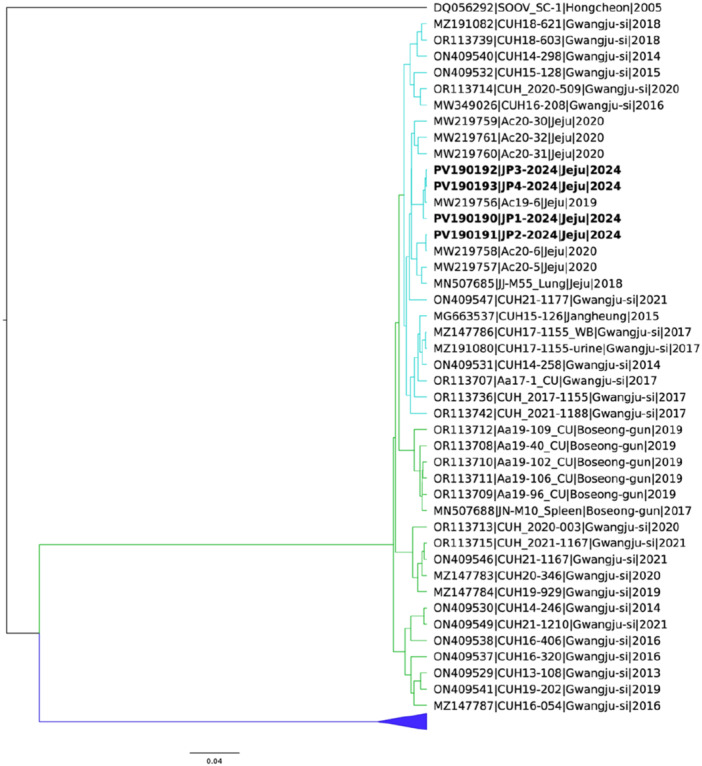 Figure 1
| Patient | Age (years) /sex | Exposure area | Occupation | Exposure to rodents | Date of sampling | ANC (/μL) | Hct (%) | Platelet (x10³/μL) | AST (IU/L) | ALT (IU/L) | Cr (mg/dL) | LDH (IU/L) | PT (sec) | PT (INR) | aPPT (sec) | Proteinuria on dipstick test | Outcome |
|---|---|---|---|---|---|---|---|---|---|---|---|---|---|---|---|---|---|
| JP1‐2024 | 50/M | Jocheon‐eup, | Engineer | No | May 24 | 12 712 | 39.8 | 41 | 49 | 32 | 6.81 | 427 | 12.6 | 1.15 | 40 | 4+ | Recovered |
| Hallim‐eup, | |||||||||||||||||
| Odeung‐dong | |||||||||||||||||
| JP2‐2024 | 56/M | Aewol‐eup | Farmer | No | April 24 | 26 838 | 61 | 34 | 185 | 50 | 4.68 | 1472 | 13.8 | 1.27 | 43 | 4+ | Recovered |
| JP3‐2024 | 60/M | Ora‐dong | Unemployed | No | May 24 | 10 458 | 46.1 | 28 | 38 | 17 | 1.94 | 463 | 12.6 | 1.15 | 38 | 3+ | Recovered |
| JP4‐2024 | 44/M | Sangye‐dong | Lawyer | No | June 24 | 4720 | 38.6 | 65 | 68 | 57 | 2.14 | 548 | 11.1 | 1 | 35.7 | 4+ | Recovered |
- —This work was supported by the Korea‐US Collaborative Research Project funded by the Ministry of Science, ICT & Future Planning and Ministry of Health and Welfare of Korea (Grant RS‐2024‐00467046), a
Peer Reviews
No public reviews on file for this paper yet. If you reviewed it on a platform where reviews are public (OpenReview, ICLR, NeurIPS, ICML), you can paste yours below so the community can read it here.
Videos
No videos yet. Explain this paper in a talk, walkthrough, or lecture? Add one.
Taxonomy
TopicsViral Infections and Vectors · Vector-Borne Animal Diseases · Mosquito-borne diseases and control
To the Editor,
Orthohantavirus hantanense (Hantaan virus, HTNV) is an enveloped, tripartite, negative‐sense, and single‐stranded RNA virus (seven serotypes and genotypes of HTNV) that infects various species of rodents [1, 2]. Striped field mice (Apodemus agrarius) are natural reservoirs of HTNV with the virus identifiable in urine and feces [1, 2, 3, 4, 5]. Spread to humans occurs after contact with infected rodents, their droppings, urine, or possibly inhalation of virus particles in places containing large amounts of rodent droppings. HTNV can cause hemorrhagic fever with renal syndrome (HFRS), which can lead to kidney damage [1, 2, 3]. The clinical presentation of HFRS often includes fever, shock, hemorrhage, and acute renal failure [1, 2, 3]. Globally, approximately 100,000 cases of HFRS are reported annually, with the majority occurring in China, Russia, and South Korea [1, 2, 3, 4]. Although HTNV infection is frequently reported in China, each year in Taiwan, HTNV causes 0‐4 human cases of HFRS and not endemic country [5].
In South Korea, approximately 400 cases of HFRS caused by HTNV are reported per year, with a mean mortality rate of 1%–4%. Cases often come in two peaks with the majority of HTNV infection occurring between October and December and a second period from May and July. Approximately 18 HFRS cases were reported from 2011 to 2019 on Jeju Island, South Korea [3, 6]. However, human HTNV infection has not been confirmed on Jeju Island, which is located at the southern end of the Korean Peninsula and among Japan, Taiwan, and China (33°0′ N, 126°0′ E).
In this study, we found autochthonous cases of human HTNV on Jeju Island in 2024 with a clinical presentation consistent with HFRS. A total of 4 HFRS cases were laboratory confirmed and were treated at Jeju National University Hospital (JNUH) from April 2024 to June 2024 (Table 1). The Institutional Review Board of JNUH approved the study (IRB file no. 2024‐09‐028) and all the subjects signed informed consent forms. For the molecular diagnosis of HTNV infection, we performed nested PCR to amplify the partial large (L) segment of the viral RNA from the stored blood and confirm HTNV infection. We sequenced the nested PCR products (356 bp) via the BigDye Terminator Cycle Sequencing Kit (Perkin Elmer Applied Biosystems, Warrington, UK) [7, 8]. Phylogenetic analysis was performed with Bayesian inference in BEAST (v1.10.4) using the best‐fit model (GTR + I + G) identified by jModelTest (v2.1.10) (Supplementary Data).
Autochthonous human HTNV infections on Jeju Island in 2024 may have occurred during a period similar to the previous period (minor epidemic periods, May and July) reported for the Korean Peninsula (Table 1) [3, 4]. All the patients lived on Jeju Island; none reported a history of travel to the HTNV endemic region for HTNV on the Korean Peninsula nor to other endemic countries, such as China or Russia; but all did report that they had visited wooded, hilly, or mountainous areas before the onset of symptoms (Table 1). Our phylogenetic analysis of these samples revealed that the viral sequences were the same as or similar to previously reported partial L segment sequences (99.7%‐100% nucleotide identity) from field mice (Apodemus chejuensis) collected from Jeju Island between 2018 and 2020 and we suggest that A. chejuensis could be the source for the human HTNV infections on Jeju Island (Figures 1 and S1a) [6, 8, 9].
Phylogenetic analysis of South Korea HTNV L segment. The phylogenetic tree was constructed on the basis of full and partial L segment sequences (356 bp) of South Korea HTNV obtained from NCBI in addition to the four samples from this study which were identified from stored blood samples collected in 2024 from patients on Jeju Island, South Korea (bold) (GenBank accession numbers PV190190 to PV190193, respectively). Phylogenetic analysis was performed using the Bayesian inference method in BEAST (v1.10.4) based on the full HTNV L segments trimmed to the coding region (28–6504 nt) as well as other partial HTNV L segments (n = 164). The scale bar indicates the number of nucleotide substitutions per site. The collapsed clade (indicated by a large triangle) includes a number of sequences (Northern South Korea) that formed a separate cluster and were collapsed for readability. Soochong virus (DQ056292) was included as root sequence. Highlighting: Northern South Korea genomes, blue; Southern South Korea genomes, green; Jeju‐specific lineage, South Korea, cyan.
In conclusion, we confirmed autochthonous cases of human HTNV infection on Jeju Island in 2024 and that the genomes differed from those previously reported from the Korean Peninsula, China, and Russia and suggest that A. chejuensis is likely an important source of human HTNV infection on Jeju Island (Figures 1 and S1a,b). Therefore, further epidemiological, clinical, and laboratory research is needed to better understand the transmission dynamics of HTNV on Jeju Island. Additionally, human HTNV infection should be considered when acute renal failure develops in patients with fever and thrombocytopenia on Jeju Island, South Korea. Our study has several limitations. This was a nonrandomized, retrospective study involving convenience samples of a relatively small number of inpatients seen in one university hospital, and the phylogenetic analysis included only those samples collected in 2024.
Author Contributions
Keun Hwa Lee acquired the funding. Keun Hwa Lee, Su Yeon Kang, Misun Kim, EunJin Bae, Sang Taek Heo, Michael Wiley, and Jessica D. Wiley performed the experiments and analyzed the data. Misun Kim, Sang Taek Heo, and Jeong Rae Yoo collected and provided the clinical samples. Keun Hwa Lee, Misun Kim, Sang Taek Heo, Andrew G. Letizia, Michael Wiley, Jessica D. Wiley, and Huy Chau Nguyen interpreted the data. Keun Hwa Lee, Andrew G. Letizia, Sang Taek Heo, Su Yeon Kang, and Misun Kim wrote the manuscript. Andrew G. Letizia, Michael Wiley, Jessica D. Wiley, Yoon‐Jae Song, and Huy Chau Nguyen critically reviewed the manuscript. All the authors have read and agreed to the published version of the manuscript.
Ethics Statement
This study was reviewed and approved by the Local Research Ethics Committee of the Jeju National University Hospital (IRB file no. 2024‐09‐028). Informed consent was obtained from all patients following the principles of the Helsinki Declaration.
Conflicts of Interest
The authors declare no conflicts of interest. The views expressed in this article reflect the results of research conducted by the author and do not necessarily reflect the official policy or position of the Department of the Navy, Department of Defense, nor the United States Government. CAPT Andrew Letizia, MC, USN and LT Huy Nguyen, MC, USN are military service members of the United States Government. This study was prepared as part of their official duties. Title 17 U.S.C. 105 provides that “copyright protection under this title is not available for any work of the United States Government.” Title 17 U.S.C. 101 defines a US Government work as work prepared by a military service member or employee of the US Government as part of that person's official duties.
Supporting information
Supporting information.
Supporting information.
The reference list from the paper itself. Each links out to its DOI / PubMed record.
- 1Centers for Disease Control and Prevention (CDC) , “Hantavirus,” 2024, https://www.cdc.gov.
- 2Y. Z. Zhang , Y. Zou , Z. F. Fu , and A. Plyusnin , “Hantavirus Infections in Humans and Animals, China,” Emerging Infectious Diseases 16 (2010): 1195–1203.20678311 10.3201/eid 1608.090470 PMC 3298307 · doi ↗ · pubmed ↗
- 3Korea Disease Control and Prevention Agency (KDCA) , “Infectious Disease Portal,” 2024, https://health.kdca.go.kr/healthinfo/biz/health/gnrlz Health Info/gnrlz Health Info/gnrlz Health Info View.do?cntnts_sn=2927.
- 4Y. H. Park , “Absence of a Seasonal Variation of Hemorrhagic Fever With Renal Syndrome in Yeoncheon Compared to Nationwide Korea,” Infection & Chemotherapy 50, no. 2 (2018): 120–127.29968979 10.3947/ic.2018.50.2.120PMC 6031598 · doi ↗ · pubmed ↗
- 5Taiwan Centers for Disease Control , “Hantavirus Syndrome,” https://www.cdc.gov.tw/Category/List Content/bg 0g_VU_Ysrgkes_KRU Dg Q?uaid=FRCHC 1Q Nnv Z Mroh Yr WLGNQ.
- 6K. Park , W.‐K. Kim , S.‐H. Lee , et al., “A Novel Genotype of Hantaan Orthohantavirus Harbored by Apodemus Agrarius chejuensis as a Potential Etiologic Agent of Hemorrhagic Fever With Renal Syndrome in Republic of Korea,” P Lo S Neglected Tropical Diseases 15, no. 5 (2021): e 0009400.33979351 10.1371/journal.pntd.0009400 PMC 8143423 · doi ↗ · pubmed ↗
- 7S. H. Lee , W. K. Kim , K. Park , et al., “Genetic Diversity and Phylogeography of Jeju Orthohantavirus (Hantaviridae) in the Republic of Korea,” Virology 543 (2020): 13–19.32056842 10.1016/j.virol.2020.01.012 · doi ↗ · pubmed ↗
- 8B. Klempa , E. Fichet‐Calvet , E. Lecompte , et al., “Hantavirus in African Wood Mouse, Guinea,” Emerging Infectious Diseases 12, no. 5 (2006): 838–840.16704849 10.3201/eid 1205.051487 PMC 3374458 · doi ↗ · pubmed ↗