Trends in the Proportion of Young Women and Girls Prescribed Spironolactone
Sarah E. Soppe, Whitney R. Robinson, Mark P. Lachiewicz, Mollie E. Wood

TL;DR
This study examines how often spironolactone was prescribed to young women and girls between 2000 and 2020.
Contribution
The study provides new insights into the prescription trends of spironolactone in this demographic over two decades.
Findings
The proportion of young women and girls prescribed spironolactone increased over time.
Prescription trends varied by age group and geographic region.
The drug was most commonly prescribed for dermatological conditions.
Abstract
This cohort study evaluates changes in the proportion of young women and girls prescribed spironolactone from 2000 to 2020.
Genes, proteins, chemicals, diseases, species, mutations and cell lines named across the full text — each resolved to its canonical identifier and authoritative record.
Click any figure to enlarge with its caption.
 Figure
| Characteristic | No. (%) (N = 451 234) |
|---|---|
| Age at initiation, y | |
| 12-18 | 51 821 (11.5) |
| 19-25 | 131 109 (29.1) |
| 26-32 | 122 009 (27.0) |
| 33-40 | 146 295 (32.4) |
| Region | |
| North Central | 99 226 (22.0) |
| Northeast | 63 123 (14.0) |
| South | 197 920 (43.9) |
| West | 87 287 (19.3) |
| Unknown | 3678 (0.8) |
| Year of initiation | |
| 2000-2005 | 24 570 (5.4) |
| 2006-2010 | 77 764 (17.2) |
| 2011-2015 | 153 102 (33.9) |
| 2016-2020 | 195 798 (43.4) |
| Indicationa | |
| Acne | 248 061 (55.0) |
| Hirsutism | 37 496 (8.3) |
| Polycystic ovary syndrome | 36 628 (8.1) |
| Hypertension | 17 952 (4.0) |
| Hidradenitis suppurativa | 4490 (1.0) |
| Congestive heart failure | 3679 (0.8) |
| >1 of These | 27 440 (6.1) |
| None of these | 132 634 (29.4) |
Peer Reviews
No public reviews on file for this paper yet. If you reviewed it on a platform where reviews are public (OpenReview, ICLR, NeurIPS, ICML), you can paste yours below so the community can read it here.
Videos
No videos yet. Explain this paper in a talk, walkthrough, or lecture? Add one.
Taxonomy
TopicsHeart Failure Treatment and Management · Hormonal Regulation and Hypertension · Perfectionism, Procrastination, Anxiety Studies
Introduction
Spironolactone is approved by the US Food and Drug Administration for cardiovascular disease, with clinical trials primarily evaluating drug safety among older adults with heart failure.^1,2^ However, it is also widely prescribed for androgen-related conditions such as acne in young women and girls, frequently requiring a higher dose than cardiovascular uses (100-200 mg/d vs 25 mg/d).^1^ To address the lack of trial data on higher doses in younger women, some safety issues have been evaluated through observational studies.^3^ However, concerns of vulvar pain from spironolactone-induced androgen deprivation have been raised in a case series,^4^ a potential safety concern not yet evaluated on a population scale. Given its established widespread use for acne,^5^ including among adolescents with increased susceptibility to hormonal impacts, targeted safety studies may be needed. However, the total proportion of younger women and girls using spironolactone across its broad range of indications is currently unknown. To inform the need for additional safety studies in this population, we assessed prescribing trends from 2000 to 2020 stratified by age.
Methods
This cohort study was approved by the University of North Carolina at Chapel Hill’s institutional review board and did not require patient consent due to use of deidentified insurance claims data. Following Strengthening the Reporting of Observational Studies in Epidemiology (STROBE) reporting guidelines, we constructed a cohort of female patients aged 12 to 40 years in the Merative MarketScan Commercial Claims and Encounters Database. Inclusion criteria included 3 or more months of continuous enrollment with drug coverage and no prior spironolactone prescription fill (eFigure in Supplement 1). New prescriptions were identified with National Drug Codes and defined as prescription fills after 3 months without fills, with adjustment to 6 months in a sensitivity analysis (eTable 1 in Supplement 1). Starting April 2000, age-stratified incidence among all covered lives was calculated for each month and standardized to the region distribution of January 2010, averaging monthly incidences across each year. Indications for use were assessed with *International Statistical Classification of Diseases and Related Health Problems, Ninth *and Tenth Revision codes within 30 days before to 3 days after the first prescription fill (eTable 2 in Supplement 1). Analyses were conducted using SAS version 9.4 (SAS Institute) from January to October 2024.
Results
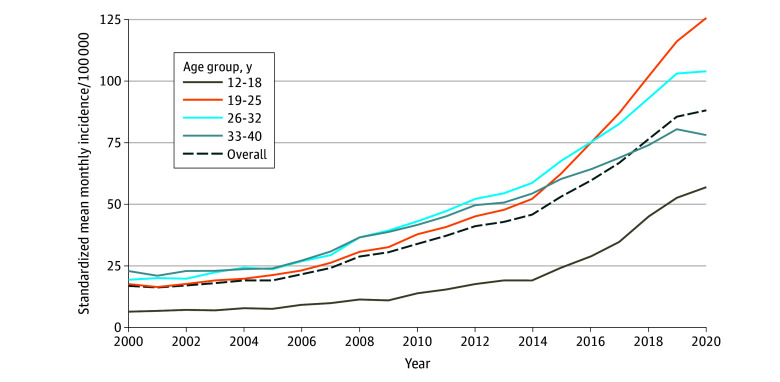
A total of 38 million met inclusion criteria; of those, 451 234 (1.2%) initiated spironolactone with 51 821 (11.5%) aged 12 to 18 years at initiation (Table). A total of 248 061 (55.5%) were diagnosed with acne, followed by hirsutism (37 496 patients [8.3%]) and polycystic ovary syndrome (36 628 patients [8.1%]); 27 440 (6.1%) had multiple indications. Hypertension and congestive heart failure were rare (17 952 patients [4.0%] and 3679 patients [0.8%], respectively), and 132 634 (29.4%) lacked any of these diagnoses. Requiring 6 months of coverage before prescription fill did not substantially change these distributions. New prescriptions increased from a standardized monthly mean (SD) of 17 (1.2) per 100 000 covered individuals in 2000 to 88 (3.7) per 100 000 in 2020 (Figure). The greatest rise was among those aged 19 to 25 years, though considerable increases were observed for all age groups.
Standardized Mean Monthly Incidence of Spironolactone Stratified by Age at InitiationEstimates are standardized to the region distribution of the study population in January 2010.
Discussion
We estimate 1.2% of insured young women and girls initiated spironolactone, with this proportion rising considerably in recent years. Consistent with prior studies,^5^ many prescriptions were associated with acne. However, this condition represented only a portion of total use. Most initiators had androgen-related conditions, indications frequently requiring higher doses than those examined in clinical trials for cardiovascular disease.^1,2^ Limitations of this analysis included potential misclassification of indication, as some diagnoses are more likely to be recorded due to better insurance reimbursement. Nonetheless, we expect minimal misclassification across cardiovascular and androgen-related categories. A total of 29.4% lacked a diagnosis for the examined conditions; these patients may have been prescribed spironolactone to manage ascites and edema-related symptoms during cancer treatment,^6^ an indication that could not be incorporated without cancer registry linkage. Despite these limitations, our findings indicate spironolactone among young women and girls is notable and growing, with the great majority having indications requiring higher doses than those examined in trials. Further investment in safety studies may be warranted.
The reference list from the paper itself. Each links out to its DOI / PubMed record.
- 1Searle TN, Al-Niaimi F, Ali FR. Spironolactone in dermatology: uses in acne and beyond. Clin Exp Dermatol. 2020;45(8):986-993. doi:10.1111/ced.1434032844462 · doi ↗ · pubmed ↗
- 2Pitt B, Pfeffer MA, Assmann SF, ; TOPCAT Investigators. Spironolactone for heart failure with preserved ejection fraction. N Engl J Med. 2014;370(15):1383-1392. doi:10.1056/NEJ Moa 131373124716680 · doi ↗ · pubmed ↗
- 3Thiede RM, Rastogi S, Nardone B, . Hyperkalemia in women with acne exposed to oral spironolactone: a retrospective study from the RADAR (Research on Adverse Drug Events and Reports) program. Int J Womens Dermatol. 2019;5(3):155-157. doi:10.1016/j.ijwd.2019.04.02431360748 PMC 6637080 · doi ↗ · pubmed ↗
- 4Mitchell L, Govind V, Barela K, Goldstein AT. Spironolactone may be a cause of hormonally associated vestibulodynia and female sexual arousal disorder. J Sex Med. 2019;16(9):1481-1483. doi:10.1016/j.jsxm.2019.06.01231351850 · doi ↗ · pubmed ↗
- 5Barbieri JS. Temporal trends in the use of systemic medications for acne from 2017 to 2020. JAMA Dermatol. 2023;159(10):1135-1136. doi:10.1001/jamadermatol.2023.236337585185 PMC 10433135 · doi ↗ · pubmed ↗
- 6Carone L, Oxberry SG, Twycross R, Charlesworth S, Mihalyo M, Wilcock A. Spironolactone. J Pain Symptom Manage. 2017;53(2):288-292. doi:10.1016/j.jpainsymman.2016.12.32028024992 · doi ↗ · pubmed ↗