Allele ages provide limited information about the strength of negative selection
Vivaswat Shastry, Jeremy J Berg

TL;DR
This paper investigates how the age of genetic variants helps understand the effects of natural selection, finding that allele ages add limited value beyond current frequency data.
Contribution
The study introduces a new numerical method to compute allele age distributions and evaluates their utility in estimating selection coefficients.
Findings
Allele ages provide little additional information about the DFE beyond current frequency data for negatively selected alleles.
Including true ages improves selection coefficient accuracy only when frequencies are thresholded and selection is strong.
Estimated ages from haplotype data reduce accuracy due to uncertainty and biased priors.
Abstract
For many problems in population genetics, it is useful to characterize the distribution of fitness effects (DFE) of de novo mutations among a certain class of sites. A DFE is typically estimated by fitting an observed site frequency spectrum (SFS) to an expected SFS given a hypothesized distribution of selection coefficients and demographic history. The development of tools to infer gene trees from haplotype alignments, along with ancient DNA resources, provides us with additional information about the frequency trajectories of segregating mutations. Here, we ask how useful this additional information is for learning about the DFE, using the joint distribution on allele frequency and age to summarize information about the trajectory. To this end, we introduce an accurate and efficient numerical method for computing the density on the age of a segregating variant found at a given sample…
Genes, proteins, chemicals, diseases, species, mutations and cell lines named across the full text — each resolved to its canonical identifier and authoritative record.
Click any figure to enlarge with its caption.
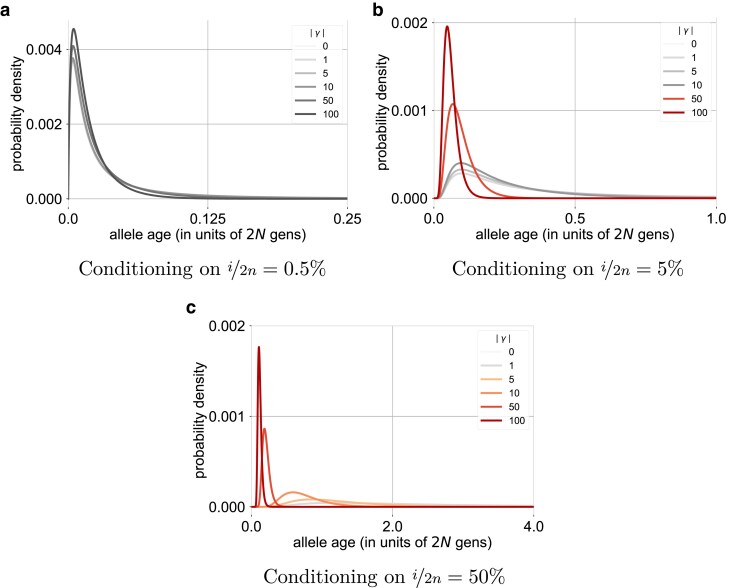 Figure 1
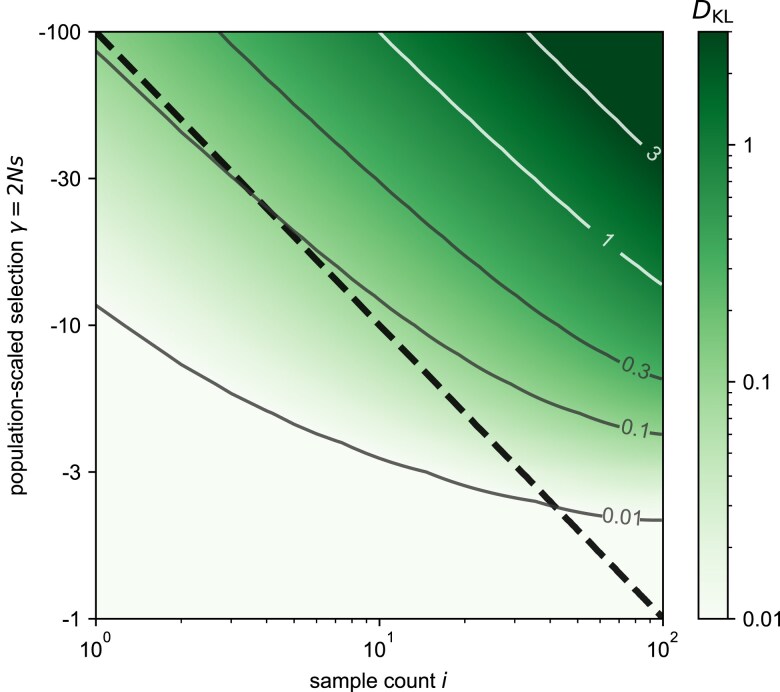 Figure 2
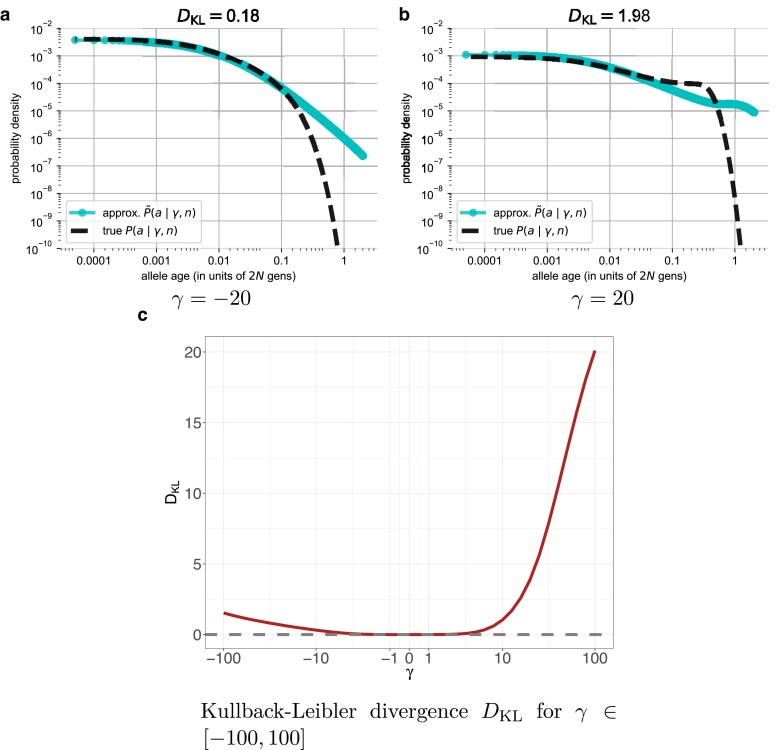 Figure 3
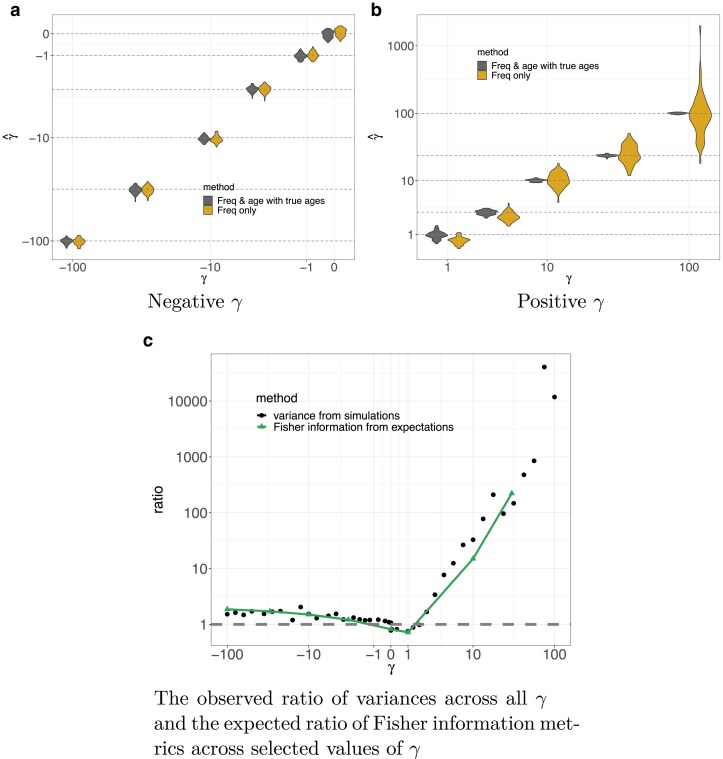 Figure 4
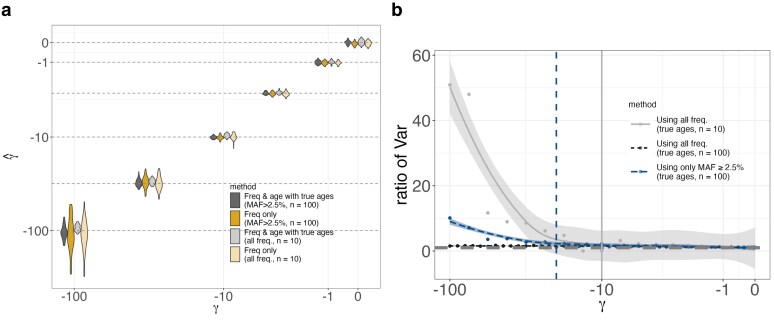 Figure 5
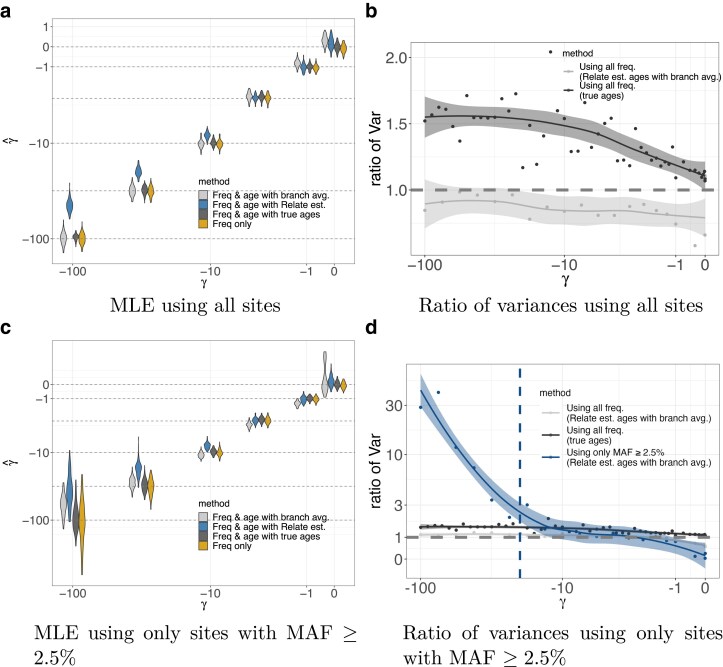 Figure 6
Peer Reviews
No public reviews on file for this paper yet. If you reviewed it on a platform where reviews are public (OpenReview, ICLR, NeurIPS, ICML), you can paste yours below so the community can read it here.
Videos
No videos yet. Explain this paper in a talk, walkthrough, or lecture? Add one.
Taxonomy
TopicsEvolution and Genetic Dynamics · Genetic diversity and population structure · Genetic Associations and Epidemiology