MetaComBin: combining abundances and overlaps for binning metagenomics reads
Francesco Tomasella, Cinzia Pizzi

TL;DR
This paper introduces MetaComBin, a new method for improving the accuracy of identifying and grouping microbial species in metagenomics data by combining abundance and overlap information.
Contribution
The novel contribution is a framework that combines two complementary read-binning approaches to enhance metagenomics binning quality.
Findings
Combining abundance-based and overlap-based methods improves clustering quality in metagenomics.
MetaComBin performs well even when the number of species is unknown.
The approach is effective in realistic metagenomics scenarios.
Abstract
Metagenomics is the discipline that studies heterogeneous microbial samples extracted directly from their natural environment, for example, from soil, water, or the human body. The detection and quantification of species that populate microbial communities have been the subject of many recent studies based on classification and clustering, motivated by being the first step in more complex pipelines (e.g., for functional analysis, de novo assembly, or comparison of metagenomes). Metagenomics has an impact on both environmental studies and precision medicine; thus, it is crucial to improve the quality of species identification through computational tools. In this paper, we explore the idea of improving the overall quality of metagenomics binning at the read level by proposing a computational framework that sequentially combines two complementary read-binning approaches: one based on…
Genes, proteins, chemicals, diseases, species, mutations and cell lines named across the full text — each resolved to its canonical identifier and authoritative record.
Click any figure to enlarge with its caption.
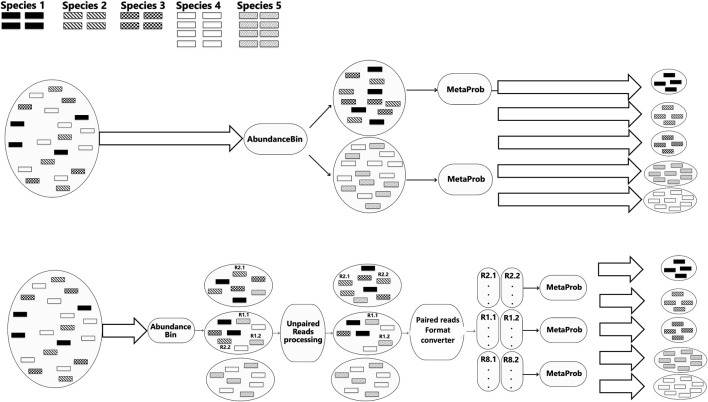 Figure 1
Peer Reviews
No public reviews on file for this paper yet. If you reviewed it on a platform where reviews are public (OpenReview, ICLR, NeurIPS, ICML), you can paste yours below so the community can read it here.
Videos
No videos yet. Explain this paper in a talk, walkthrough, or lecture? Add one.
Taxonomy
TopicsGene expression and cancer classification · Genomics and Phylogenetic Studies · Bioinformatics and Genomic Networks