All-Solid-State Ion-Selective Electrode Inspired from All-Solid-State Li-Ion Batteries
Ryoichi Tatara, Yuki Shibasaki, Daisuke Igarashi, Hiroyuki Osada, Kazuma Aoki, Yusuke Miyamoto, Toshiharu Takayama, Takahiro Matsui, Shinichi Komaba

TL;DR
This paper presents a new all-solid-state ion-selective electrode inspired by battery technology, offering high stability and accurate detection of lithium ions.
Contribution
The novel design integrates solid-state battery components to create a durable and selective lithium ion sensor.
Findings
The electrode shows a Nernstian slope of 60.8 ± 0.5 mV dec–1 for Li+ detection.
It achieves a limit of detection of 10–4.9±0.4 and minimal potential variation over 17 days.
Using a two-phase LiFePO4/FePO4 layer improves the stability of the reference potential.
Abstract
Solid electrolytes employed in all-solid-state Li-ion batteries (ASSBs) electronically isolate the positive and negative electrodes, while allowing the carrier ions, Li+, to pass through. Inorganic solid-state electrolytes, which typically exhibit a Li+-transference number of 1, are theoretically applicable as ion-sensitive membranes of potentiometric ion-selective electrodes (ISEs). Inspired by the ASSB architecture, an all-solid-state Li ISE was developed in a two-layer stacking configuration using a redox-active material (LiFePO4) and a solid electrolyte (Li1+x+yAlx(Ti, Ge)2–xSiyP3–yO12) as inner and outer layers, respectively, on the substrate (i.e., current collector). The solid electrolyte acts as an ion-selective membrane because the Donnan membrane potential obeys a Nernstian response to Li+ activity in the analyte solution. The fabricated ASSB-inspired ISE selectively responds…
Genes, proteins, chemicals, diseases, species, mutations and cell lines named across the full text — each resolved to its canonical identifier and authoritative record.
Click any figure to enlarge with its caption.
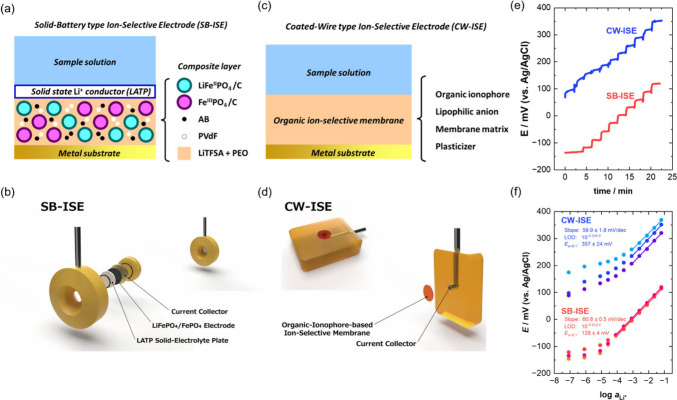 Figure 1
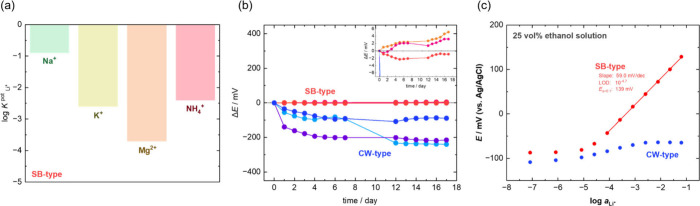 Figure 2
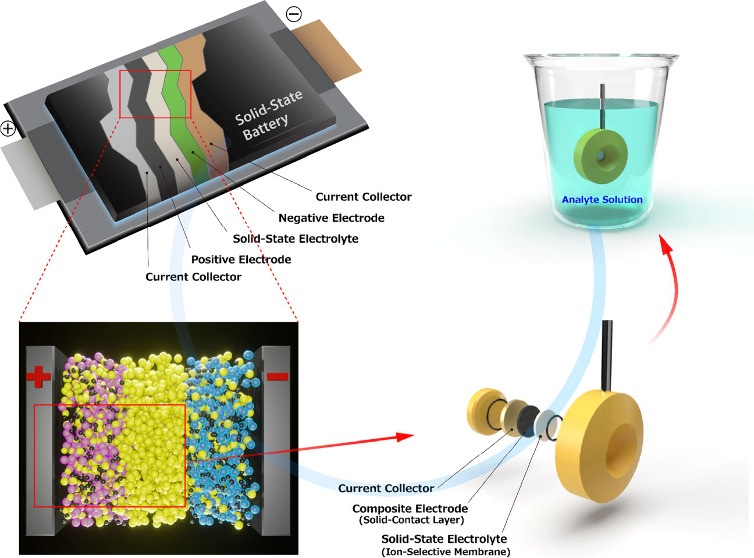 Figure 3
 Figure 4
 Figure 5
Peer Reviews
No public reviews on file for this paper yet. If you reviewed it on a platform where reviews are public (OpenReview, ICLR, NeurIPS, ICML), you can paste yours below so the community can read it here.
Videos
No videos yet. Explain this paper in a talk, walkthrough, or lecture? Add one.
Taxonomy
TopicsAnalytical Chemistry and Sensors · Gas Sensing Nanomaterials and Sensors · Advancements in Battery Materials