Effect of the TAAR1 Partial Agonist Ralmitaront on Presynaptic Dopamine Synthesis Capacity Measured Using [18F]DOPA PET in Naïve and Cocaine-Treated Mice
David R. Bonsall, Michelle Kokkinou, Els F. Halff, Grazia Rutigliano, Sac-Pham Tang, Mattia Veronese, Elaine E. Irvine, Dominic J. Withers, Lisa A. Wells, Sridhar Natesan, Irene Gerlach, Štefan Holiga, Marius C. Hoener, Oliver D. Howes

TL;DR
This study shows that ralmitaront, a TAAR1 partial agonist, reduces dopamine synthesis in mice, even when combined with cocaine.
Contribution
The novel finding is that ralmitaront reduces dopamine synthesis in both normal and cocaine-treated mice.
Findings
Ralmitaront reduced dopamine synthesis capacity by 44% in naïve mice.
Ralmitaront reduced dopamine synthesis capacity by 50% in mice treated with cocaine.
Cocaine alone did not increase dopamine synthesis capacity compared to controls.
Abstract
Elevated dopamine synthesis capacity is part of the pathophysiology of schizophrenia thought to underlie psychosis. Drugs that reduce this phenomenon could thus be potential treatments for these disorders. In this study, we evaluated the ability of the trace amine-associated receptor 1 (TAAR1) partial agonist ralmitaront to reduce presynaptic dopamine synthesis capacity. Ralmitaront (3 mg/kg, i.p.), a TAAR1 partial agonist, was evaluated using [18F]DOPA PET for its ability to modulate presynaptic dopamine synthesis capacity in naïve mice as well as mice in an induced hyperdopaminergic state following acute cocaine administration (20 mg/kg, i.p.). Cocaine treatment on its own did not induce elevated dopamine synthesis capacity when compared to the control group. Pretreatment with ralmitaront significantly reduced dopamine synthesis capacity when given either alone (44%) or in…
Genes, proteins, chemicals, diseases, species, mutations and cell lines named across the full text — each resolved to its canonical identifier and authoritative record.
Click any figure to enlarge with its caption.
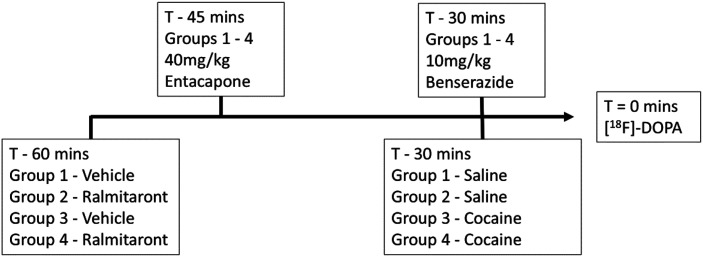 Figure 1
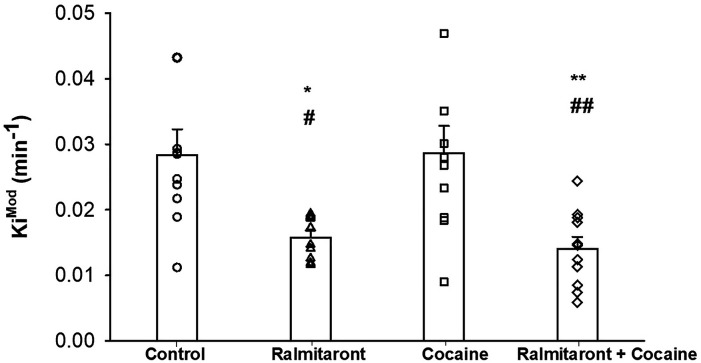 Figure 2
 Figure 3
Peer Reviews
No public reviews on file for this paper yet. If you reviewed it on a platform where reviews are public (OpenReview, ICLR, NeurIPS, ICML), you can paste yours below so the community can read it here.
Videos
No videos yet. Explain this paper in a talk, walkthrough, or lecture? Add one.
Taxonomy
TopicsNeurotransmitter Receptor Influence on Behavior · Receptor Mechanisms and Signaling · Neuroscience and Neuropharmacology Research