Establishment and application of a triplex real-time PCR assay for detection of porcine circoviruses
Ze Cheng, Zenglin Wang, Lizhu Quan, Zhendong Zhang, Wenqiang Wang, Wei Wen, Zhenbang Zhu, Xiangdong Li

TL;DR
This paper introduces a new triplex real-time PCR test to detect three types of porcine circoviruses, which helps track their spread and improve disease management in pigs.
Contribution
The study develops a novel triplex real-time PCR assay for simultaneous detection of PCV2, PCV3, and PCV4 with high accuracy and efficiency.
Findings
The triplex PCR assay demonstrated high specificity, sensitivity, and reproducibility with a detection limit of 4.8×10¹ copies/μL.
Application on 370 clinical samples revealed high prevalence of PCV2 and PCV3, with co-infection rates of 38.37%, but no PCV4 detected.
The assay showed complete consistency with commercial single-plex PCR kits, confirming its accuracy and reliability.
Abstract
Porcine circovirus disease represents a prevalent ailment that is principally manifested by a series of clinical symptoms, including reproductive disorders in sows and high mortality rates in piglets. It has brought huge economic losses upon the global swine industry. Furthermore, the symptoms triggered by different genotypes of porcine circovirus bear resemblance and difficult to distinguish. Therefore, it is essential to establish a rapid, accurate, time-efficient, and high-throughput triplex real-time PCR differential diagnosis assay for detecting PCV2, PCV3, and PCV4. In this study, specific primers and probes were designed based on the conserved sequences of ORF1 sequences of PCV2, PCV3, and PCV4. The triplex Real-Time PCR assay was established and optimized, which showed satisfactory specificity, sensitivity, repeatability, and reproducibility. The limit of detection (LOD) was…
Genes, proteins, chemicals, diseases, species, mutations and cell lines named across the full text — each resolved to its canonical identifier and authoritative record.
Click any figure to enlarge with its caption.
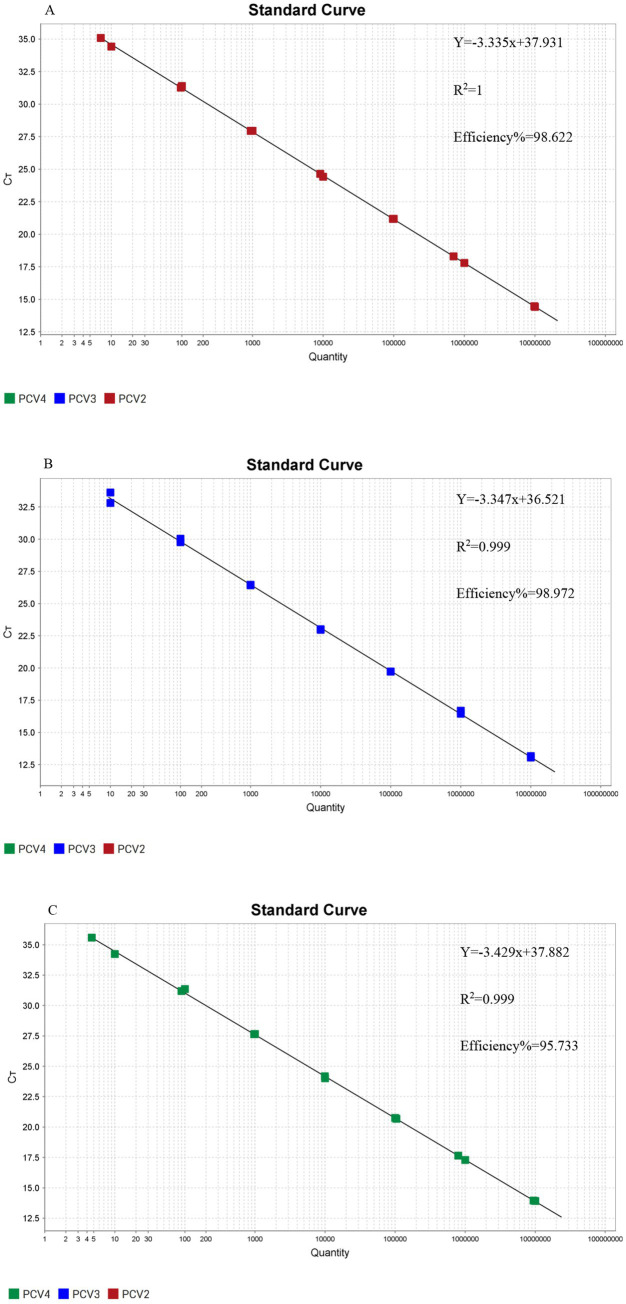 Figure 1
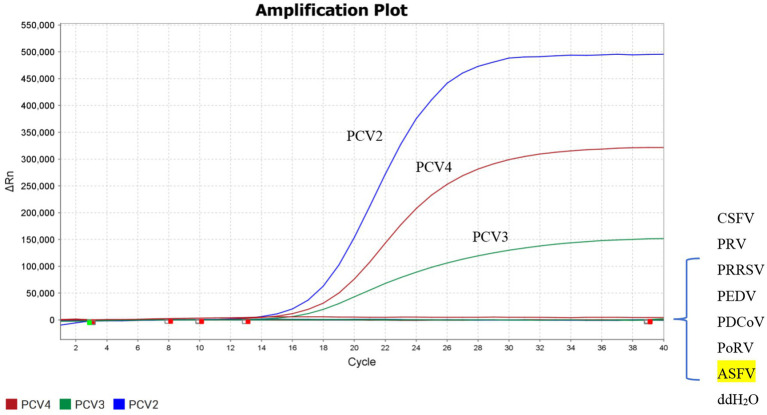 Figure 2
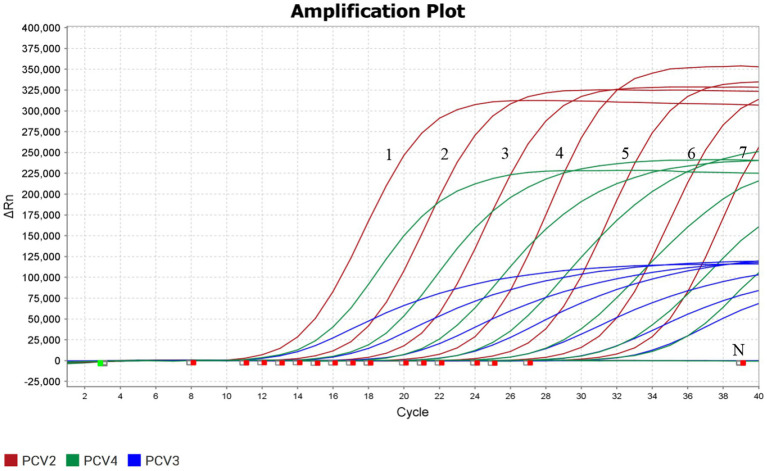 Figure 3
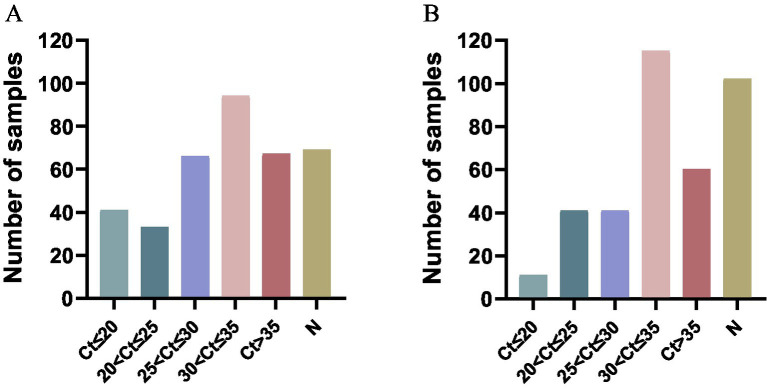 Figure 4
Peer Reviews
No public reviews on file for this paper yet. If you reviewed it on a platform where reviews are public (OpenReview, ICLR, NeurIPS, ICML), you can paste yours below so the community can read it here.
Videos
No videos yet. Explain this paper in a talk, walkthrough, or lecture? Add one.
Taxonomy
TopicsAnimal Virus Infections Studies · Viral Infections and Immunology Research · Viral gastroenteritis research and epidemiology