Correction: Absence of EpCAM in cervical cancer cells is involved in slug induced epithelial-mesenchymal transition
Xian Liu, Qian Feng, Yanru Zhang, PengSheng Zheng, Nan Cui

Abstract
Genes, proteins, chemicals, diseases, species, mutations and cell lines named across the full text — each resolved to its canonical identifier and authoritative record.
Click any figure to enlarge with its caption.
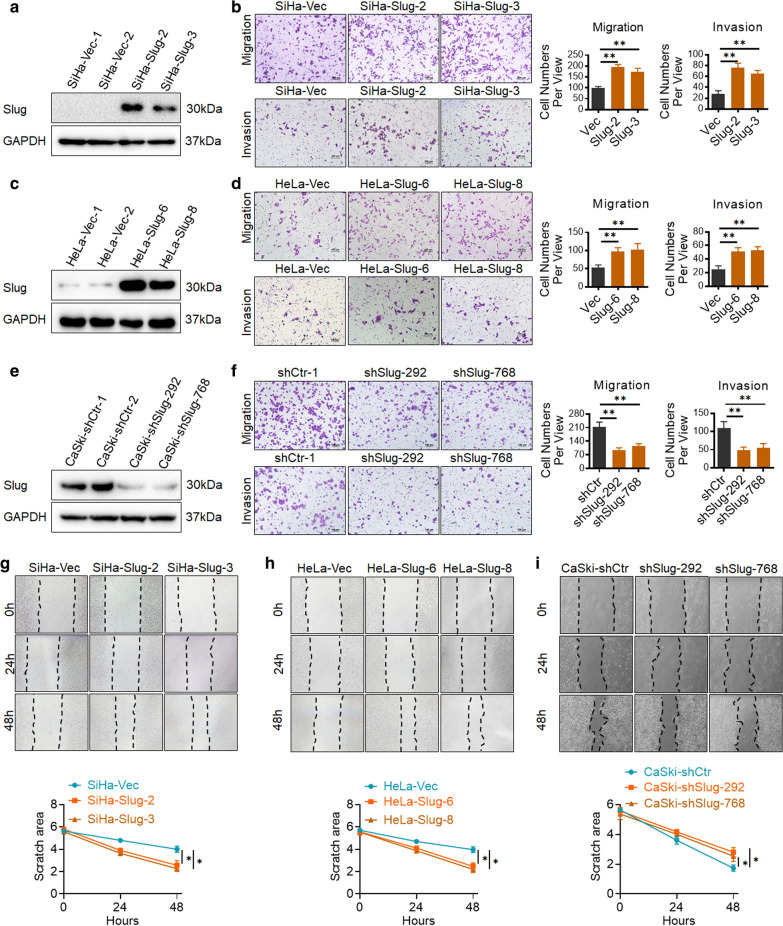 Figure 1
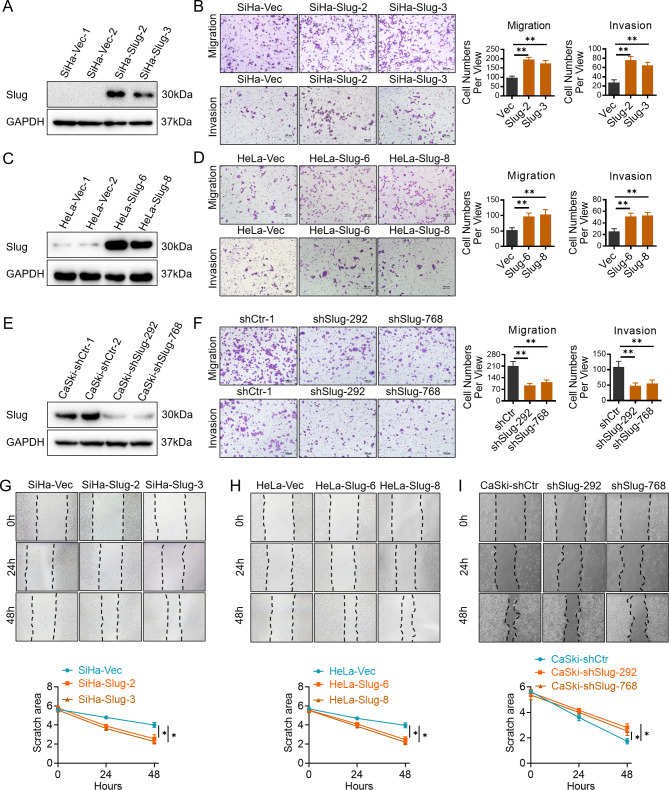 Figure 2
Peer Reviews
No public reviews on file for this paper yet. If you reviewed it on a platform where reviews are public (OpenReview, ICLR, NeurIPS, ICML), you can paste yours below so the community can read it here.
Videos
No videos yet. Explain this paper in a talk, walkthrough, or lecture? Add one.
Taxonomy
TopicsTissue Engineering and Regenerative Medicine · Cancer Cells and Metastasis
Correction to: Cancer Cell Int (2021) 21:163
10.1186/s12935-021-01858-3
In this article [1], there was an error in Fig. 1D, where the graph depicting HeLa-Slug-8 (invasion) contains inaccuracies due to an inadvertent omission in the data presentation. For completeness and transparency, the old incorrect Fig. 1 and the correct Fig. 1 are displayed below.
Incorrect Fig. 1.
Fig. 1. Slug promotes cell migration and invasion of cervical cancer cells in vitro. Slug-overexpressing (SiHa and HeLa) and Slug knockdown (CaSki) cells were identified by western blotting: a SiHa-Vec and SiHa-Slug cells; c HeLa-Vec and HeLa-Slug cells; and e CaSki-shControl and CaSki-shSlug cells. The migratory and invasive capacities of Slug-modified cells were analyzed by the transwell cell assay, and the number of migrated cells is shown (scale bar, 100 μm): b SiHa-Vec and SiHa-Slug cells; d HeLa-Vec and HeLa-Slug cells; and f CaSki-shControl and CaSki-shSlug cells. The migratory potential of Slug-modified cells was analyzed by wound-healing assays performed for 0, 24, and 48 h (scale bar, 200 μm): g SiHa-Vec and SiHa-Slug cells, and the quantitative analysis is shown; h HeLa-Vec and HeLa-Slug cells, and the quantitative analysis is shown; and i CaSki-shControl and CaSki-shSlug cells, and the quantitative analysis is shown
Correct Fig. 1.
Fig. 1. Slug promotes cell migration and invasion of cervical cancer cells in vitro. Slug-overexpressing (SiHa and HeLa) and Slug knockdown (CaSki) cells were identified by western blotting: a SiHa-Vec and SiHa-Slug cells; c HeLa-Vec and HeLa-Slug cells; and e CaSki-shControl and CaSki-shSlug cells. The migratory and invasive capacities of Slug-modified cells were analyzed by the transwell cell assay, and the number of migrated cells is shown (scale bar, 100 μm): b SiHa-Vec and SiHa-Slug cells; d HeLa-Vec and HeLa-Slug cells; and f CaSki-shControl and CaSki-shSlug cells. The migratory potential of Slug-modified cells was analyzed by wound-healing assays performed for 0, 24, and 48 h (scale bar, 200 μm): g SiHa-Vec and SiHa-Slug cells, and the quantitative analysis is shown; h HeLa-Vec and HeLa-Slug cells, and the quantitative analysis is shown; and i CaSki-shControl and CaSki-shSlug cells, and the quantitative analysis is shown
The reference list from the paper itself. Each links out to its DOI / PubMed record.