Reinke’s Oedema in Africa: A Scoping Review
Olorunleke M Arokoyo, Collins T Adeleye, Winifred U Hyacinth, Abdulahi Zubair, Abdulrahman Omodele, Frank Agada

TL;DR
This scoping review found no literature on Reinke’s oedema in Africa, highlighting a research gap linked to limited ENT services and low smoking rates among women.
Contribution
The study identifies a significant lack of research on Reinke’s oedema in Africa and suggests reasons for this gap.
Findings
No eligible articles on Reinke’s oedema in Africa were found in the literature search.
The lack of literature may be due to low ENT services and fewer female smokers in Africa.
The study highlights the need for further research on this condition in the African context.
Abstract
Reinke’s oedema is a benign pathology of the vocal fold characterised by polypoidal degeneration of its subepithelial space, with resulting dysphonia and in severe cases dyspnoea. It is more common among females and smoking is a strong risk factor. Multiple conditions of the larynx ranging from benign to malignant diseases, which can also present with voice changes and dyspnoea, need to be ruled out when evaluating a patient for Reinke’s oedema. The quality of evaluation can be directly influenced by the level of training and experience of the assessor and the diagnostic resources available. This can pose a challenge for the evaluation and management of Reinke’s oedema in Africa, as there is a significantly low ENT surgeon-to-patient ratio within the continent, and a lot of health settings are resource-constrained. This review aimed to examine the available literature on the…
Genes, proteins, chemicals, diseases, species, mutations and cell lines named across the full text — each resolved to its canonical identifier and authoritative record.
Click any figure to enlarge with its caption.
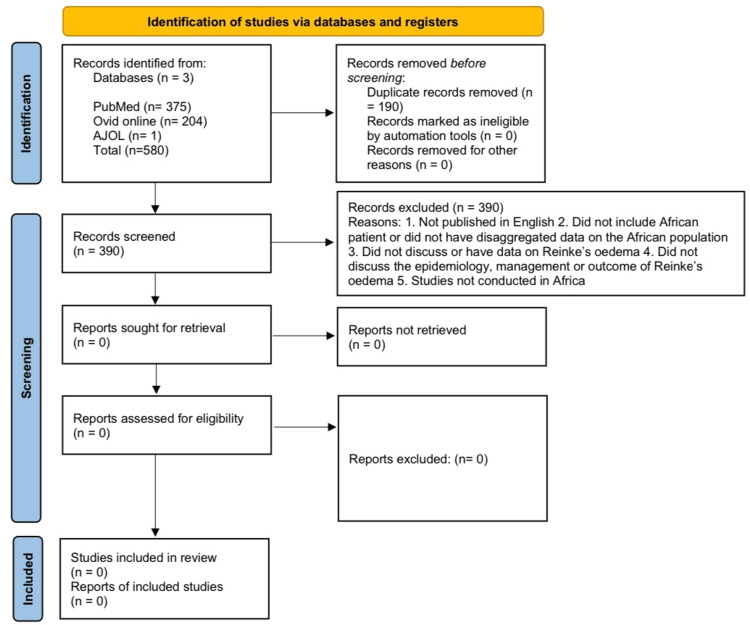 Figure 1
| Keywords | Database | Results |
| Reinke’s oedema | PubMed | 375 |
| Reinke’s oedema | Ovid online (all resources) | 204 |
| Reinke’s oedema | African Journal Online | 1 |
Peer Reviews
No public reviews on file for this paper yet. If you reviewed it on a platform where reviews are public (OpenReview, ICLR, NeurIPS, ICML), you can paste yours below so the community can read it here.
Videos
No videos yet. Explain this paper in a talk, walkthrough, or lecture? Add one.
Taxonomy
TopicsCleft Lip and Palate Research · Interpreting and Communication in Healthcare
Introduction and background
Reinke’s oedema is a benign pathology of the vocal fold characterised by polypoidal degeneration of its subepithelial space, with resulting dysphonia and in severe cases dyspnoea [1]. The mechanism by which the disease develops is not fully understood [2]. However, it is known that smoking is the strongest risk factor, with laryngopharyngeal reflux and vocal cord abuse documented as associated factors [3]. It has a significantly higher female preponderance [2,3].
Voice change or difficulty with breathing, which are presenting complaints of Reinke’s oedema, can be caused by multiple differential diagnoses ranging from malignant conditions of the larynx to benign conditions like polyps and infections. Hence, proper evaluation is required to diagnose Reinke’s oedema confidently. The quality of evaluation will therefore be influenced by the level of training and experience of the assessor as well as diagnostic resources available. These factors also affect the availability, choice, quality, and outcome of care after a diagnosis has been reached. Treatment is aimed at improving dysphonia and includes surgical options, such as microdebridement, CO_2_ laser excision, cold steel excision, and intralesional injection [4]. Also, ensuring smoking cessation and providing speech therapy is key to improving outcomes [3-6]. It is therefore imperative that the expertise and resources be available to achieve good outcomes given the relative rarity of the disease, despite its benign nature. This poses a challenge for evaluating and managing Reinke’s oedema in Africa, as many health settings are resource-constrained, with expertise outstretched by workload or unavailable. This likely explains why readily citable data on Reinke’s oedema are from studies done outside the continent. This review aims to examine the available literature on the epidemiology, management, and outcomes of Reinke’s oedema in Africa.
Review
Methods
This study was conducted using the Preferred Reporting Items for Systematic Reviews and Meta-Analyses extension for Scoping Reviews (PRISMA-ScR) checklist. A literature search was conducted with the following databases - PubMed, Ovid Online, and African Journal Online. Articles included in the search were limited to those published in English, regarding Reinke’s oedema from inception till date.
This study included full-text journal articles on Reinke’s oedema. There were no restrictions on the age of patients included or the date of publication. Articles with the following characteristics were excluded as they were outside the scope of this review: published in any other language than English language; did not include patients from Africa or did not have disaggregated data about the African population; did not discuss or have any data on Reinke’s oedema; did not discuss the epidemiology, management, or outcomes of patients with Reinke’s oedema; and studies not conducted in Africa.
The following article types were also excluded: abstracts, conference presentations, case reports, commentaries, letters to editors, reviews, and meta-analyses. The search strategy was jointly devised by the authors and is summarized below (Table 1). Two reviewers working in pairs screened titles and abstracts to limit bias, with any lack of consensus discussed with a third reviewer. The final search results were exported to Rayyan.ai (a systematic review website) for the removal of duplicates and screening of articles. Data on the prevalence, management, and outcomes were extracted into an Excel data sheet. No article satisfied the eligibility criteria used in this review.
The alternate keyword search with (Reinke’s oedema) AND (Africa) did not yield any results on the databases either.
Results
The search of databases yielded a total of 580 articles, and 190 duplicates were removed. After screening abstracts, no study made it to full-text screening as none satisfied the eligibility criteria for inclusion (Figure 1). Our findings reveal the dearth of literature regarding the epidemiology, management, and outcomes of Reinke’s oedema in Africa.
PRISMA 2020 flow diagram for new systematic reviews incorporating database and register searches onlyPRISMA: Preferred Reporting Items for Systematic Reviews and Meta-Analyses; AJOL: African Journal Online.
Discussion
The relatively low number of studies on the condition could be due to the rarity of Reinke’s oedema [7]. Reinke’s oedema has been strongly associated with smoking and it is much more common among females. Another factor that could be contributing to the low number of studies on this condition in Africa is the low prevalence of smoking among females in Africa (1.4%) compared to America (10.2%) and Europe (17.5%) [8]. The level of expertise and equipment required to successfully make a diagnosis after ruling out other conditions which could present similarly could also be contributing factors to the relatively low number of studies. This is particularly true on the African continent, as it is estimated that the majority of patients do not have access to much-needed ENT services, with training opportunities being very limited, in addition to very heavy demand on the available workforce (1.2 million patients per ENT surgeon in Sub Saharan Africa) [9-13]. Also, little progress has been made in mitigating these problems, despite the estimated population growth to 1.68 billion by 2030, from its 2015 estimate of 1.19 billion [11].
The dearth of literature established by this scoping review on Reinke’s oedema can be reflective of multiple factors, including the low level of ENT service available and the nature of health systems across the continent. Increased and prudent investment in equipment and workforce for ENT services, with increased reporting of ENT diseases encountered and treatment given, can help improve the current picture [12].
Limitations
Although this review was carried out through searches conducted on three databases, which put together, represent a robust resource, utilising additional databases could increase results.
Conclusions
This scoping review on Reinke’s oedema in Africa has established a dearth of literature, with a need for further research on its epidemiology, management, and outcomes through various study designs such as case-control studies and cohort studies.
The reference list from the paper itself. Each links out to its DOI / PubMed record.
- 1Phonosurgery of Reinke's edema with microdebrider Eur Arch Otorhinolaryngol Grigaliute E Fiamingo MN Albanese PG La Mantia I 405340592792022 http://dx.doi.org/10.1007/s 00405-022-07377-93540388510.1007/s 00405-022-07377-9PMC 9249694 · doi ↗ · pubmed ↗
- 2The morphology of vocal fold polyps and mucosa in Reinke's edema (Article in Russian)Arkh Patol Bykova VP Kochesokova EA Ivanchenko GF Rotova ID 303777201510.17116/patol 201577130-25868366 · doi ↗ · pubmed ↗
- 3Reinke Edema Jones NN Song SA Treasure Island (FL): Stat Pearls Publishing Stat Pearls [Internet]2025 https://pubmed.ncbi.nlm.nih.gov/37603666/37603666 · pubmed ↗
- 4Impact of the severity of Reinke's edema on the parameters of voice Turk Arch Otorhinolaryngol Barmak E Altan E Yılmaz Z Korkmaz MH Çadallı Tatar E 166174612023 http://dx.doi.org/10.4274/tao.2023.2023-8-103878495510.4274/tao.2023.2023-8-10PMC 11110086 · doi ↗ · pubmed ↗
- 5Exploring the pathophysiology of Reinke's edema: the cellular impact of cigarette smoke and vibration Laryngoscope Grossmann T Steffan B Kirsch A Grill M Gerstenberger C Gugatschka M 0541312021 http://10.1002/lary.2885510.1002/lary.28855 PMC 781842432569447 · doi ↗ · pubmed ↗
- 6Office-based treatment of vocal fold polyps and Reinke's edema: a rational comparison with suspension laryngoscopy Laryngoscope Filauro M Ioppi A Vallin A 266526721332023 http://dx.doi.org/10.1002/lary.305763664773310.1002/lary.30576 · doi ↗ · pubmed ↗
- 7Surgical and nonsurgical lines of treatment of Reinke's edema: a systematic literature review J Voice Khodeir MS Hassan SM El Shoubary AM Saad MNA 50250135202110.1016/j.jvoice.2019.10.01631761692 · doi ↗ · pubmed ↗
- 8National, regional, and global prevalence of cigarette smoking among women/females in the general population: a systematic review and meta-analysis Environ Health Prev Med Jafari A Rajabi A Gholian-Aval M Peyman N Mahdizadeh M Tehrani H 52620213341940810.1186/s 12199-020-00924-y PMC 7796590 · doi ↗ · pubmed ↗