The complete mitochondrial genome of Crocidura rapax Allen, 1923 and its phylogenetic analyses
Zhu Liu, Lu Miao, Qiu-Ying Guo, Mei-Feng Han

TL;DR
This paper reports the full mitochondrial genome of Crocidura rapax and uses it to understand its evolutionary relationships within the Crocidura genus.
Contribution
The study provides the first complete mitochondrial genome sequence of Crocidura rapax and confirms its phylogenetic position.
Findings
The complete mitogenome of C. rapax is 17,517 bp in length.
The genome includes 13 protein-coding genes, 22 tRNA genes, and other mitochondrial features.
Phylogenetic analysis confirms C. rapax's placement within the Crocidura genus.
Abstract
This study aimed to examine the complete mitogenome sequence of Crocidura rapax Allen, 1923 using polymerase chain reaction. The mitochondrial genome of C. rapax is a circular double-stranded structure with a complete length of 17,517 bp. The mitochondrial genome of C. rapax included 13 protein-coding genes, one control region, 22 tRNA genes, two rRNA genes, and one origin of L-strand replication. This study confirmed the phylogenetic position of C. rapax in the Crocidura genus at the molecular level. The mitochondrial genome is of significant importance for elucidating the genetic background of C. rapax.
Genes, proteins, chemicals, diseases, species, mutations and cell lines named across the full text — each resolved to its canonical identifier and authoritative record.
Click any figure to enlarge with its caption.
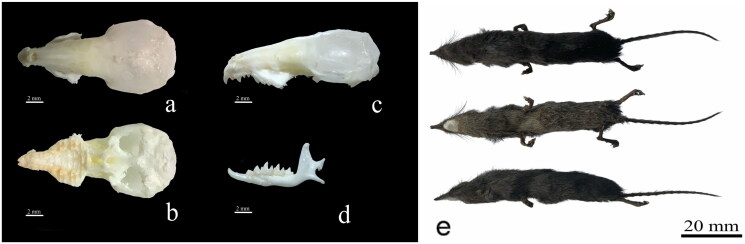 Figure 1
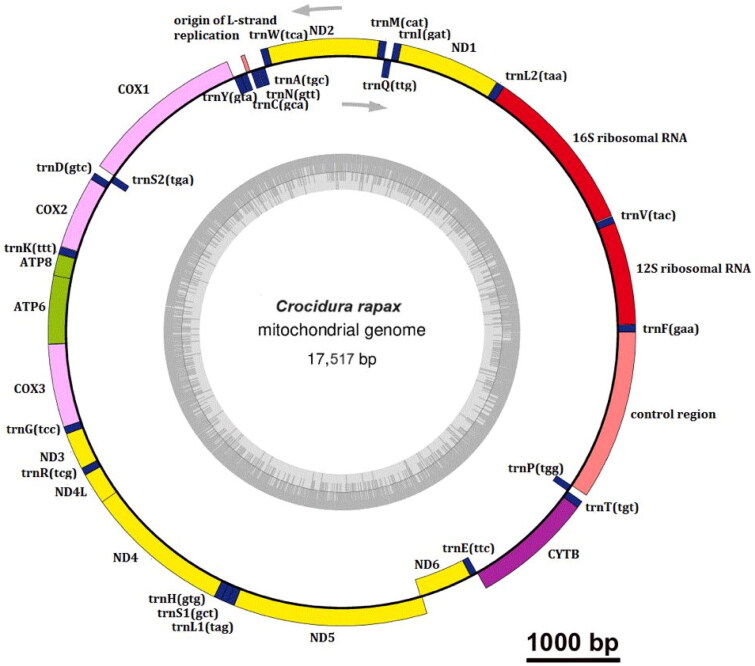 Figure 2
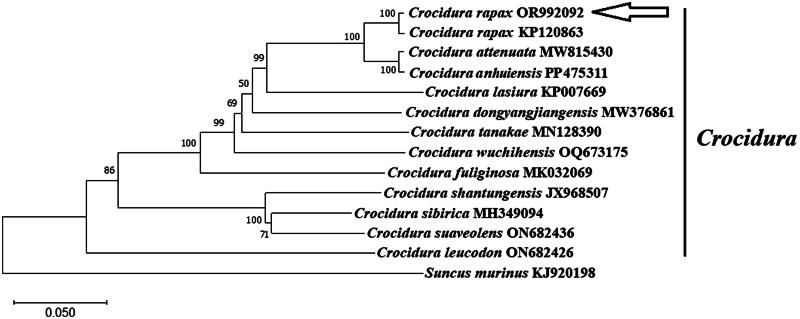 Figure 3
- —Heilongjiang Provincial Department of Education filing project
- —Heilongjiang Provincial Natural Funds
Peer Reviews
No public reviews on file for this paper yet. If you reviewed it on a platform where reviews are public (OpenReview, ICLR, NeurIPS, ICML), you can paste yours below so the community can read it here.
Videos
No videos yet. Explain this paper in a talk, walkthrough, or lecture? Add one.
Taxonomy
TopicsGenomics and Phylogenetic Studies · Genetic diversity and population structure · Molecular Biology Techniques and Applications
Introduction
Crocidura rapax Allen, 1923 belongs to the order Eulipotyphla, family Soricidae, genus Crocidura (Ellerman and Morrison-Scott 1951). Crocidura Wagler 1832 is the most speciose mammalian genus, comprising 198 species, about 45% of the species in the family Soricidae. It is found mainly in tropical and subtropical regions of Asia, Europe, and Africa, with a few species extending into the temperate zone (Burgin and He 2018). C. rapax was previously considered as a subspecies of C. russula (Ellerman and Morrison-Scott 1951). Later, it was elevated to a species according to molecular and morphological analyses (Jiang and Hoffmann 2001). The taxonomy and phylogeny of the Crocidura genus have been controversial. In this study, we report the mitochondrial genome of C. rapax under the correct species name (corrections to previously published articles; Chen, Chen, et al. 2016). The complete mitochondrial genome of C. rapax was sequenced, and the phylogenetic relationships within the Crocidura genus were analyzed.
Materials and methods
A C. rapax sample was collected from Liupanshui City (26°33′1″N, 104°57′18″E), Guizhou Province, China, in August 2023 (Figure 1). It was sampled in a dead state. C. rapax is not a protected animal in China. The Cyt b gene sequence of the specimen was blasted against the GenBank database. The sequence MW682360 was the most similar to the specimen from C. rapax (Song et al. 2021). The sample was stored at −75 °C before use and deposited at the Animal and Plant Herbarium of Mudanjiang Normal University (Liu Zhu, [email protected]) under the voucher number 2023LPS1. Genomic DNA was extracted from leg muscle of dead samples using the EasyPure genomic DNA kit (TransGen Biotech Co., Beijing, China). We designed 19 pairs of primers for polymerase chain reaction (PCR) based on the reported mitochondrial genome of Crocidura (Figures S1 and S2). The first-generation sequencing technology was used for sequencing in this study (ABI 3730 sequencer; Boshi Biotechnology Co. Ltd., Harbin, China). The sequences were assembled using DNAstar, analyzed, and adjusted manually. The annotation of the C. rapax mitochondrial genome was performed using web-based services MITOS (https://usegalaxy.eu) and software PhyloSuite v 1.2.2 (Zhang et al. 2020). The circular mitochondrial genome map of C. rapax was drawn using OGDRAW 1.3.1 (Greiner et al. 2019). In this study, the molecular phylogeny of C. rapax was investigated using the complete mitochondrial genomes of 12 species (Crocidura anhuiensis, Crocidura attenuata, Crocidura dongyangjiangensis, Crocidura fuliginosa, Crocidura lasiura, Crocidura leucodon, Crocidura rapax, Crocidura shantungensis, Crocidura sibirica, Crocidura suaveolens, Crocidura tanakae, and Crocidura wuchihensis) in the Crocidura genus deposited in the GenBank. The phylogenetic tree was constructed using 13 protein-coding genes of the complete mitochondrial genome through MEGA 11.0 software (Tamura et al. 2021). The phylogenetic tree was constructed using the Kimura 2-parameter model of maximum-likelihood method with 1000 bootstrap replications.
Pictures of external and skull morphologies (courtesy: Liu Zhu).
Circular mitochondrial genome map of C. rapax. The circle inside is the L strand, and the circle outside is H strand. Yellow, NADH gene; pink, COX gene; green, ATP gene; purple, other genes; blue, tRNA; red, rRNA; nude, origin of L-strand replication and control region.
Results
A circular double-stranded structure made up the mitochondrial genome of C. rapax (Figure 2). The length of the complete mitochondrial genome was 17,517 bp. The mitochondrial genome of C. rapax included 13 protein-coding genes, one control region, 22 tRNA genes, two rRNA genes, and one origin of L-strand replication (Figure 2). The total base composition of C. rapax mitochondrial genome was A (32.8%), T (31.9%), G (12.9%), and C (22.4%). We found significant A–T skew in base composition, especially in control regions and protein-coding genes. The ND6 gene and eight tRNA genes of C. rapax were encoded on the L strand. The other mitochondrial genes were encoded on the H strand (Figure 2). GenBank received the annotated mitochondrial genome sequences with accession number OR992092. The control region of the mitochondrial genome existed between the tRNA-Pro and tRNA-Phe (Figure 2). The control region had no structural genes but had only promoters and regulatory sequences for replication and transcription. The total length of 13 protein-coding gene sequences was 11,411 bp. The lengths of 22 tRNA genes were between 59 and 75 bp. The length of L-strand replication origin (OL) was 41 bp. The Cyt b gene sequences of C. attenuata (KP120863) and C. rapax (OR992092) were compared, up to 99.47% similar, and more distantly related to the cyt b sequences of C. attenuata as reported in several previous studies. This means that KP120863 is in fact a species identification error for C. rapax, but not C. attenuata. The phylogenetic tree (Figure 3) showed that the eight species (C. anhuiensis, C. attenuata, C. dongyangjiangensis, C. fuliginosa, C. lasiura, C. rapax, C. tanakae, and C. wuchihensis) and C. leucodon in the Crocidura genus each formed independent branches. C. shantungensis, C. sibirica, and C. suaveolens formed independent branches (Figure 3). C. rapax was supported by the bootstrap values of 100% (Figure 3). Our results indicated that C. anhuiensis, C. attenuata, and C. rapax had a closer phylogenetic relationship (Figure 3).
Phylogenetic tree was constructed using 13 protein-coding genes of the complete mitochondrial genome through MEGA 11.0 software, and also constructed using the Kimura 2-parameter model of maximum-likelihood method with 1000 bootstrap replications. Crocidura rapax (OR992092) is annotated and uploaded by this study. The following sequences were used: KP120863 (Chen, Chen, et al. 2016), MW815430 (Hinckley et al. 2022), PP475311 (unpublished), MW376861 (Li et al. 2021), MK032069 (Li et al. 2019), KR007669 (Kim et al. 2017), ON682426 (unpublished), JX968507 (Kim et al. 2013), MH349094 (Jiang et al. 2019), ON682436 (unpublished), MN128390 (Jin et al. 2019), and OQ673175 (Tu et al. 2023). The outgroup was KJ920198 (Chen, Wei, et al. 2016).
Discussion and conclusions
The arrangement of genes in C. rapax mitochondrial genome was consistent with that in other Crocidura genus species (Kim et al. 2013; Chen, Chen, et al. 2016; Kim et al. 2017; Jiang et al. 2019; Jin et al. 2019; Li et al. 2019, 2021; Tu et al. 2023). The Cyt b gene sequence is highly similar between C. attenuata KP120863 and C. rapax (OR992092), which is significantly different from the cyt b sequences of C. attenuata reported in several previous studies. This evidence supports the correct classification of KP120863 as C. rapax. For the first time, this study reports the mitochondrial genome of C. rapax under the correct species name, providing a widely recognized reference standard for this species. Moreover, it validates the phylogenetic position of C. rapax within the Crocidura genus at the molecular level, which is of significant importance to the genetic background of C. rapax.
Supplementary Material
PCR Primers.doc
The reference list from the paper itself. Each links out to its DOI / PubMed record.
- 1Burgin JE, He K. 2018. Family Soricidae (shrews). In: Wilson DE, Mittermeier RA, editors. Handbook of the mammals of the world. Insectivores, sloths and colugos. Vol. 8. Barcelona: Lynx Edicions; p. 332–551.
- 2Chen GY, Chen CL, Fu CK, Liu YC, Chen SD, Yong B. 2016. The complete mitogenome of Asian Gray Shrews, Crocidura attenuata (Soricidae). Mitochondrial DNA A DNA Mapp Seq Anal. 27(6):3966–3967. doi:10.3109/19401736.2014.989507.25541314 · doi ↗ · pubmed ↗
- 3Chen S, Wei H, Peng H, Yong B. 2016. The complete mitogenome of Asian House Shrews, Suncus murinus (Soricidae). Mitochondrial DNA A DNA Mapp Seq Anal. 27(2):1127–1128. doi:10.3109/19401736.2014.933332.24976048 · doi ↗ · pubmed ↗
- 4Ellerman JR, Morrison-Scott TCS. 1951. Checklist of Palaearctic and Indian mammals 1758 to 1946. London: The Trustees of the British Museum; p. 81.
- 5Greiner S, Lehwark P, Bock R. 2019. Organellar Genome DRAW (OGDRAW) version 1.3.1: expanded toolkit for the graphical visualization of organellar genomes. Nucleic Acids Res. 47(W 1):W 59–W 64. doi:10.1093/nar/gkz 238.30949694 PMC 6602502 · doi ↗ · pubmed ↗
- 6Hinckley A, Camacho-Sanchez M, Ruedi M, Hawkins MT, Mullon M, Cornellas A, Tuh Yit Yuh F, Leonard JA. 2022. Evolutionary history of Sundaland shrews (Eulipotyphla: Soricidae: Crocidura) with a focus on Borneo. Zool J Linn Soc. 194(2):478–501. doi:10.1093/zoolinnean/zlab 045. · doi ↗
- 7Jiang HJ, Li FJ, Wang XM, Zhang Q, Chen SD, Wang Q. 2019. The complete mitochondrial genome of the Siberian shrew, Crocidura sibirica (Mammalia, Soricidae). Mitochondrial DNA B Resour. 4(1):919–920. doi:10.1080/23802359.2018.1516118. · doi ↗
- 8Jiang XL, Hoffmann RS. 2001. A revision of the white-toothed shrews (Crocidura) of southern China. J Mammal. 82(4):1059–1079. doi:10.1644/1545-1542(2001)082<1059:AROTWT>2.0.CO;2. · doi ↗