BRCA2 Status Alters the Effect of the P53 Reactivator HO-3867 in Ovarian Cancer Cells
Eric J Devor, Ariane E Thomas, Brandon M Schickling

TL;DR
This study shows that BRCA2 mutations affect how well a p53 reactivator works in ovarian cancer cells with TP53 mutations.
Contribution
The study reveals that BRCA2 status influences the response to p53 reactivators in ovarian cancer cells with TP53 mutations.
Findings
BRCA2 status alters the effect of the p53 reactivator HO-3867 on p53 target loci.
Treated and untreated cells showed distinct responses based on BRCA2 status.
The results suggest BRCA2 status should be considered when using p53 reactivators in TP53-mutated ovarian tumors.
Abstract
The vast majority of ovarian cancers have a TP53 mutation. Among these, a substantial proportion also have a BRCA1 and/or a BRCA2 mutation. Given a rising interest in the therapeutic use of p53 reactivating agents, we assessed the effect that such BRCA mutants would have on the action of a p53 reactivator. As an initial tool to examine the effect of a BRCA mutation on the action of a p53 reactivator we chose to utilize a naturally occurring experimental model. The high grade serous ovarian cancer cell lines PEO1 and PEO4 were established from the same patient. Both cell lines have a missense TP53 mutation, G244D. However, PEO1 cells also have a nonsense BRCA2 mutation, Y1655ter, which is cancelled out by a second mutation, Y1655Y, that renders PEO4 cells BRCA2 wild-type. This makes these cell lines an ideal experimental platform to begin to assess the effect of a BRCA mutation on the…
Genes, proteins, chemicals, diseases, species, mutations and cell lines named across the full text — each resolved to its canonical identifier and authoritative record.
Click any figure to enlarge with its caption.
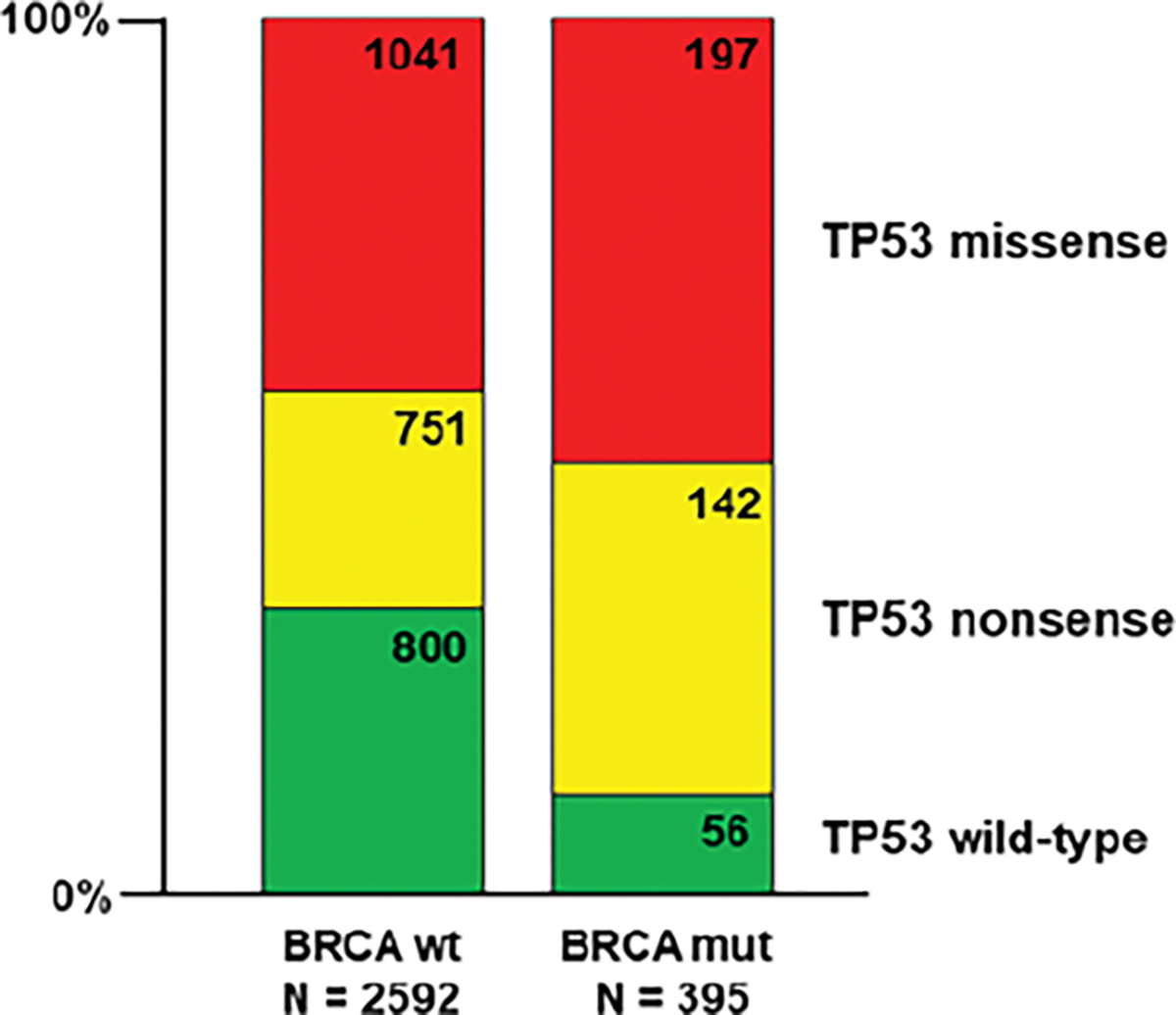 Figure 1
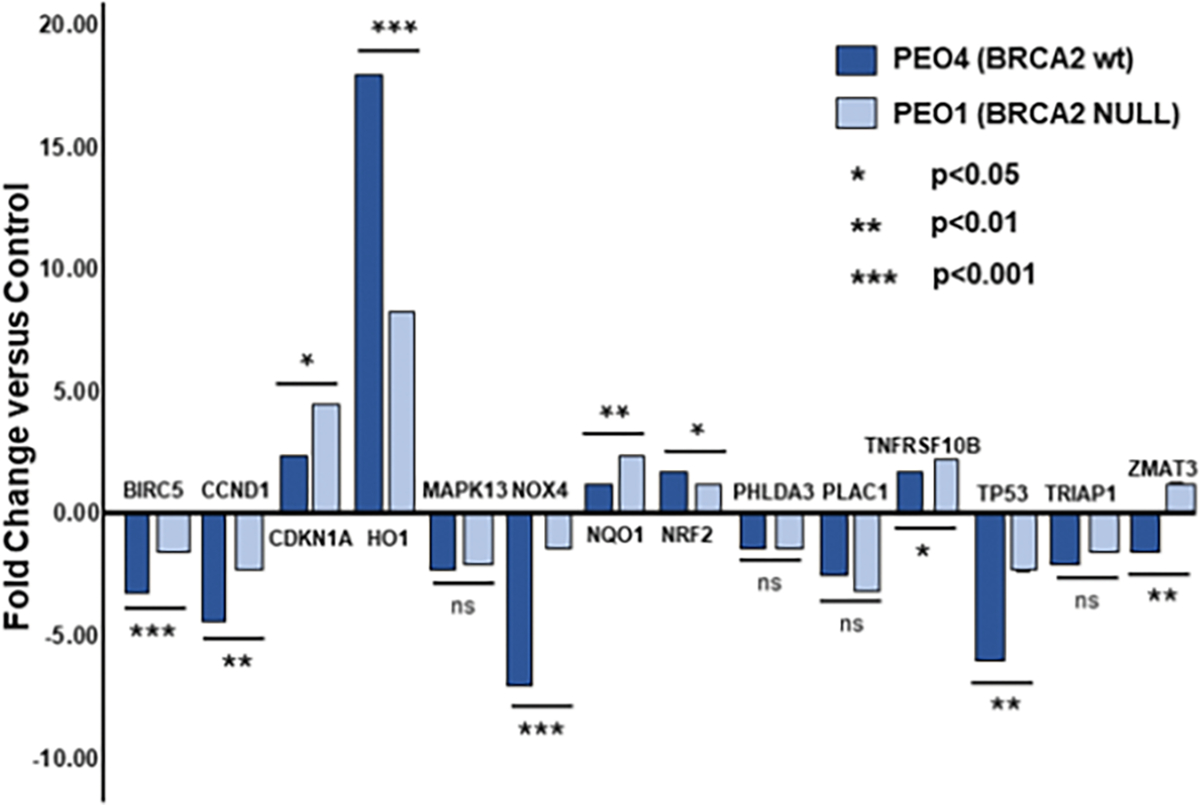 Figure 2
Peer Reviews
No public reviews on file for this paper yet. If you reviewed it on a platform where reviews are public (OpenReview, ICLR, NeurIPS, ICML), you can paste yours below so the community can read it here.
Videos
No videos yet. Explain this paper in a talk, walkthrough, or lecture? Add one.
Taxonomy
TopicsCancer-related Molecular Pathways · Virus-based gene therapy research · CRISPR and Genetic Engineering
Introduction
The tumor suppressor TP53 is widely regarded as the most mutated locus in human cancers [1]. Nowhere is this more true than in ovarian cancer where it is estimated that well over 90% of ovarian tumors harbor a TP53 mutation [2]. Of these, roughly two-thirds are missense mutants located primarily in the DNA binding-domain. Such mutations are attractive targets for the therapeutic application of so-called “p53 reactivators” which include PRIMA-1 and PRIMA-1met (APR246), arsenic trioxide (ATO) and the synthetic curcumin analog HO-3867 [3–6].
It is also well established that up to one-quarter of all high grade serous ovarian cancers (HGSOC) are home to a BRCA1 and/or BRCA2 mutation [7]. Moreover, in a study that examined 98 HGSOC tumors with a BRCA1 and/or BRCA2 mutation, nearly all of them (95) also had a TP53 mutation [8]. This could suggest that up to 25% of HGSOC tumors with a TP53 mutation will also contain a BRCA1 and/or a BRCA2 mutation. In order to determine if this is indeed the case, we searched the AACR Project GENIE database (aacr.org) and found that a significant proportion of ovarian tumors with a BRCA1 and/or a BRCA2 mutation also had a TP53 mutant compared with tumors that were BRCA1 and BRCA2 wild-type (85.9% versus 69.1% respectively, p<0.001). In both BRCA mutant and wild-type tumors, more than half had targetable TP53 missense mutants. Thus, in this context we wondered what effect BRCA status might exert on a p53 reactivator.
To begin to answer this question we chose to use a naturally occurring BRCA2/TP53 experimental model. Cell lines PEO1 and PEO4 were established from ascites effused nine months apart from a patient presenting with a poorly differentiated Stage III ovarian adenocarcinoma [9]. PEO1 cells have a G244D TP53 missense mutation and a Y1655ter BRCA2 mutant rendering these cells BRCA2 NULL. PEO4 cells retain the G244D TP53 missense mutation but a second mutation at Y1655 of BRCA2, Y1655Y, restores wild-type BRCA2 function [10]. This establishes the two cell lines as an ideal pair through which to examine the effect of BRCA2 status on reactivation of a TP53 missense mutant.
We have treated PEO1 and PEO4 cells with the p53 reactivator HO-3867 and herein report that BRCA2 status does in fact alter the effect of such exposure on a variety of loci including TP53 itself. Our results, while preliminary, suggest that BRCA status is a factor to consider in treating HGSOC patients with a p53 reactivator.
Materials and methods
GENIE database
2.1
A total of 3585 ovarian cancer entries were downloaded from the AACR Project GENIE database (aacr.org) in August of 2020. These cases were filtered for the presence of a BRCA1 and/or a BRCA2 mutation and/or a TP53 mutation which yielded a total of 2987 entries. These entries were then filtered for TP53 and BRCA mutations.
Cell culture
2.2
PEO1 (CVCL_2686) and PEO4 (CVCL_2690) cells were purchased from the European Collection of Authenticated Cell Cultures (ECACC), items numbered 10032308 and 10032309. Cells were grown in RPMI-1640 media supplemented with 10% fetal bovine serum (R&D systems FBS S11150) and 1% pen/strep antimicrobial (Thermo Fisher 15140122) at 37°C and 5% CO2. Cell line identities were confirmed by verifying the relevant BRCA2 and TP53 mutations via direct sequencing of gDNAs on an Applied Biosystems Model 3730xl capillary sequencer in the Genome Core of the Iowa Institute of Human Genetics (IIHG) and by CODIS panel typing at bioSynthesis (Lewisville, Texas).
HO-3867 p53 reactivator treatment
2.3
The synthetic curcumin analog HO-3867 was purchased from Cayman Chemical (Ann Arbor, Michigan, Item Number 21581). PEO1 and PEO4 cells were grown to 80% confluence in T75 vented flasks (Falcon 353136). Six-well culture dishes (Falcon 353046) were then seeded in RPMI-1640 media in triplicates at a density of 200,000 cells per well and incubated at 37°C, 5% CO_2_ for twenty-four hours. Following incubation, media was removed and replaced with fresh RPMI-1640 media containing either vehicle only or 5uM HO-3867. This dosage was chosen on the basis of our previous studies of this agent [11], which was subsequently supported by an independent study [12]. Cells were then incubated for 24 hours at 37°C, 5% CO_2_.
Treated and untreated control cells were collected, and total cellular RNA was purified using the QIAGEN RNeasy Plus Mini Kit (QIAGEN 74134) according to manufacturer’s recommendations. RNA yield and purity was determined using a NanoDrop spectrophotometer (Thermo Fisher).
A fixed mass of 100 ng of total RNA per assay was reverse transcribed in the presence of SuperScript III reverse transcriptase (Invitrogen First Strand SSIII Kit 18080–400). Quantitative PCR (qPCR) assays were then carried out in triplicate on an Applied Biosystems QuantStudio 5 platform in the presence of Applied Biosystems Power SYBR Green Master Mix (Thermo Fisher 437659) using the primers shown in Table 1. All primers were synthesized at Integrated DNA Technologies (Coralville, Iowa).
Raw Ct values for each qPCR assay were normalized (ΔCt) against 18S rRNA (Table 1) and fold changes between HO-3867 treated cells and controls for each assay were calculated using the standard ΔΔCt method [13,14]. Fold change significance was assessed via a two-tailed t-test with unequal variance [15]. A p-value of 0.05 was considered as significant.
Results
Wild-type p53 is significantly less common in BRCA mutated ovarian cancers
3.1
As noted, Boyarskikh et al. [8] reported that 95 of 98 HGSOC tumors containing a BRCA1 or BRCA2 mutation also had a TP53 mutation. More broadly, Dr. Elizabeth Swisher of the University of Washington noted that wild-type TP53 was virtually absent in ovarian cancers with BRCA mutations but relatively common, ~30%, in BRCA wild-type tumors (Personal Communication). We are able to confirm this tendency in our survey of nearly three thousand ovarian tumors culled from the AACR Project GENIE database (Figure 1). As can be seen, 56 of the 395 tumors with a BRCA1 and/or BRCA2 mutation were also TP53 wild-type (14%). By contrast, among the 2592 tumors that were BRCA wild-type, 800 were also TP53 wild-type (31%). However, among the two classes of TP53 mutation the proportion of missense versus nonsense mutants is an identical 58% to 42%. Therefore, the overall difference between the two BRCA classes is exclusively due to the relative dearth of wild-type TP53 in the BRCA mutant class (chi-square = 46.7, p<0.0001, df = 2). Given these data, it should be expected that ovarian tumors, especially HGSOC, harboring a BRCA mutation will also have a TP53 mutation. Conversely, as high as 20% - 25% of ovarian tumors, the vast majority of which will have a TP53 mutation, will also have a BRCA mutation. Of these, nearly 60% will be a targetable missense TP53 mutant.
BRCA status alters the effect of p53 reactivation by HO-3867
3.2
In order to assess the effect of BRCA2 status on p53 reactivation we carried out fourteen SYBR Green qPCR assays on PEO1 and PEO4 cells treated with HO-3867, a p53 reactivator that is also an antioxidant [16]. The loci selected for these assays consisted of several consensus p53 target genes including survivin (BIRC5), cyclin D1 (CCND1), p21 (CDKN1A), heme oxygenase 1 (HO-1), NAD(P)H quinone dehydrogenase 1 (NQO1), pleckstrin homology like domain family A member 3 (PHLDA3), placenta-specific protein 1 (PLAC1), TNF receptor superfamily member 10b (TNFRSF10B), TP53 regulated inhibitor of apoptosis 1 (TRIAP1) and zinc finger matrin-type 3 (ZMAT3) [17–23]. In addition, the co-regulated apoptosis pathway gene p38-delta (MAPK13) and two important redox genes NADPH oxidase 4 (NOX4) and NFE2 like BZIP transcription factor 2 (NRF2) were included. Finally, because TP53 is self-regulated via a well-known feedback loop it, too, was included [24].
The results of the 28 qPCR assays are presented in Table 2. First, only four of the 28 comparisons between HO-3867 treated and untreated cells failed to yield a statistically significant change in expression. Three of these, BIRC5, NRF2 and PHLDA3, were in the BRCA2 NULL PEO1 cells while the fourth was in the PEO4 cells for NQO1. With the sole exception of ZMAT3, which showed increased transcription in PEO1 cells and decreased transcription in PEO4 cells, the differences between PEO4 and PEO1 cells were a matter of degree rather than kind. That is, both cell lines displayed an increase in transcription (CDKN1A, HO-1, NQO1, NRF2, TNFRSF10B) or both cell lines displayed a decrease in transcription (BIRC5, CCND1, MAPK13, NOX4, PHLDA3, PLAC1, TP53, TRIAP1). In each case the responses were consistent with the expectation that loci known to be up-regulated by p53 displayed increased transcription and those known to be down-regulated by p53 displayed decreased transcription.
The relative effect of HO-3867 exposure in the PEO1 and PEO4 cells is shown graphically in Figure 2. As seen, the effect of HO-3867 treatment on transcription, whether positive or negative, was greater in the BRCA2 wild-type PEO4 cells in nine of the fourteen loci (BIRC5, CCND1, HO-1, MAPK13, NOX4, NRF2, PHLDA3, TP53, and TRIAP1) while it was less in only four of the fourteen loci (CDKN1A, NQO1, PLAC1 and TNFRSF10B). While some of the discrepancies are small, several of the loci show quite large and statistically significant effects. In particular, NOX4 shows five times the effect of HO-3867 exposure in the BRCA2 wild-type PEO4 cells compared with the BRCA2 NULL PEO1 cells (p<0.001). Similarly, HO-1 displays more than double the already high transcriptional response in PEO4 cells compared with PEO1 cells (p<0.001). Finally, PEO4 cells showed nearly two and one-half times the reduction in transcription of TP53 itself compared with PEO1 cells (p<0.01).
Conclusion
Consistent with a previous study [6], results presented here indicate that treatment with the p53 reactivator HO-3867 rescues p53 target gene transcription. We also show, using BRCA2 NULL PEO1 ovarian cancer cells and the revertant BRCA2 wild-type PEO1 cell line from the same patient, that such rescue is influenced by BRCA2 status. Clearly, our results are from a unique pair of cell lines and the true effect of BRCA1 and/or BRCA2 mutation status on the efficacy of p53 reactivators must be further studied. On the other hand, data from the Cancer Genome Atlas (TCGA) and other sources have shown that as high as 95% of ovarian cancers harbor a TP53 mutation [1,2]. Of these, roughly 60% are missense mutants that are targetable by a p53 reactivator. Further, depending upon histology, as much as one-fourth of these will also have a BRCA1 and/or a BRCA2 mutation. World-wide, more than 300,000 cases of ovarian cancer are diagnosed yearly [25]. The data above suggest that more than 180,000 of these cases will have a targetable TP53 missense mutation but also that nearly 50,000 of these cases will also have a BRCA1 and/or a BRCA2 mutation. This implies that, to be maximally effective, the use of a p53 reactivator should take both TP53 and BRCA1/2 status into account.
The reference list from the paper itself. Each links out to its DOI / PubMed record.
- 1Donehower LA, Soussi T, Korkut A, The Cancer Genome Atlas Network Integrated analysis of TP 53 gene and pathway alterations in The Cancer Genome. Cell Reports 28 (2019): 1370–1384.31365877 10.1016/j.celrep.2019.07.001PMC 7546539 · doi ↗ · pubmed ↗
- 2Cole AJ, Zhu Y, Dwight T, Comprehensive analysis of somatic TP 53 mutation in tumors with variable mutant frequency. Scientific Data 4 (2017): 170120.28872635 10.1038/sdata.2017.120PMC 5584393 · doi ↗ · pubmed ↗
- 3Lambert JMR, Gorzov P, Veprintsev DB, PRIMA-1 reactivates mutant p 53 by covalently binding to the core domain. Cancer Cell 15 (2009): 376–388.19411067 10.1016/j.ccr.2009.03.003 · doi ↗ · pubmed ↗
- 4Perdrix A, Najem A, Saussez S, PRIMA-1 and PRIMA-1met (APR-246): From mutant/wild type p 53 reactivation to unexpected mechanisms underlying their potent anti-tumor effect in combinatoric therapies. Cancers 9 (2017): 172.29258181 10.3390/cancers 9120172 PMC 5742820 · doi ↗ · pubmed ↗
- 5Chen S, Wu J-L, Liang Y, Arsenic trioxide rescues structural p 53 mutation through a cryptic allosteric site. Cancer Cell 39 (2021): 225–239.33357454 10.1016/j.ccell.2020.11.013 · doi ↗ · pubmed ↗
- 6Madan E, Parker TM, Bauer MR, The curcumin analog HO- 3867 selectively kills cancer cells by converting mutant p 53 protein to transcriptionally active wildtype p 53. Journal of Biological Chemistry 293 (2018): 4262–4276.29382728 10.1074/jbc.RA 117.000950 PMC 5868245 · doi ↗ · pubmed ↗
- 7Manchana T, Phoolcharoen N, Tantbirojn P. BRCA mutation in high grade epithelial ovarian cancers. Gynecologic Oncology Reports 29 (2019): 102–105.31467961 10.1016/j.gore.2019.07.007PMC 6710551 · doi ↗ · pubmed ↗
- 8Boyarskikh UA, Gulyaeva LF, Avdalyan AM, Spectrum of TP 53 mutations in BRCA 1/2 associated high grade serous ovarian cancer. Frontiers in Oncology 10 (2020): 1103.32766142 10.3389/fonc.2020.01103 PMC 7378769 · doi ↗ · pubmed ↗