Rapid Solidification of Plant Latices from Campanula glomerata Driven by a Sudden Decrease in Hydrostatic Pressure
Arne Langhoff, Astrid Peschel, Christian Leppin, Sebastian Kruppert, Thomas Speck, Diethelm Johannsmann

TL;DR
Campanula glomerata plant latex solidifies rapidly due to a sudden pressure drop, which triggers coagulation and phase separation.
Contribution
The paper introduces a novel mechanism of latex solidification driven by hydrostatic pressure changes and liquid–liquid phase separation.
Findings
Campanula glomerata latex solidifies faster than Euphorbia characias and technical latices.
Rapid solidification is caused by a pressure drop triggering serum influx and phase transition.
Cryo-SEM and QCM-D data support the role of liquid–liquid phase separation in solidification.
Abstract
By monitoring the solidification of droplets of plant latices with a fast quartz crystal microbalance with dissipation monitoring (QCM-D), droplets from Campanula glomerata were found to solidify much faster than droplets from Euphorbia characias and also faster than droplets from all technical latices tested. A similar conclusion was drawn from optical videos, where the plants were injured and the milky fluid was stretched (sometimes forming fibers) after the cut. Rapid solidification cannot be explained with physical drying because physical drying is transport-limited and therefore is inherently slow. It can, however, be explained with coagulation being triggered by a sudden decrease in hydrostatic pressure. A mechanism based on a pressure drop is corroborated by optical videos of both plants being injured under water. While the liquid exuded by E. characias keeps streaming away, the…
Genes, proteins, chemicals, diseases, species, mutations and cell lines named across the full text — each resolved to its canonical identifier and authoritative record.
Click any figure to enlarge with its caption.
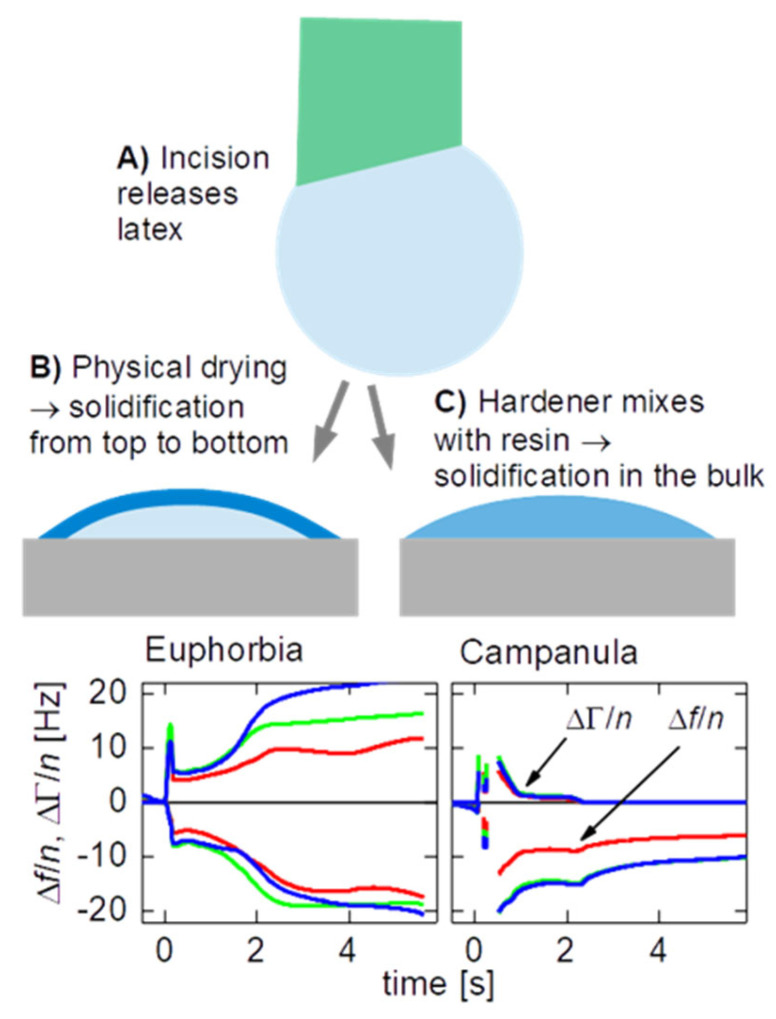 Figure 1
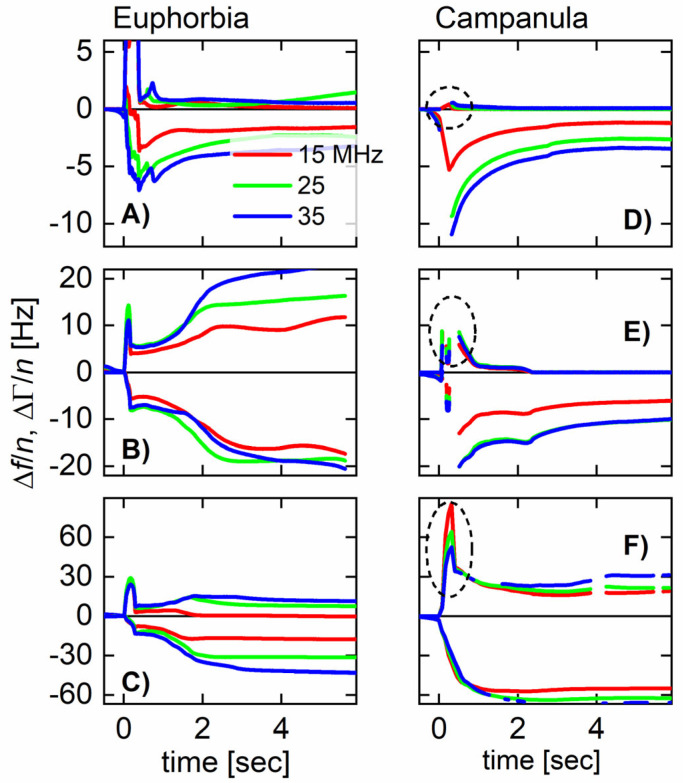 Figure 2
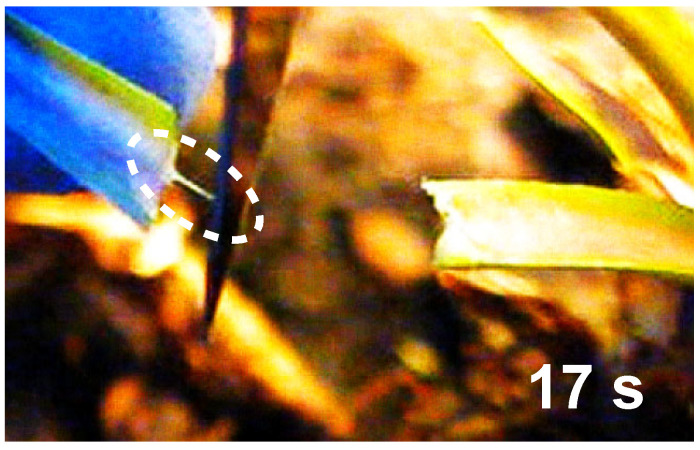 Figure 3
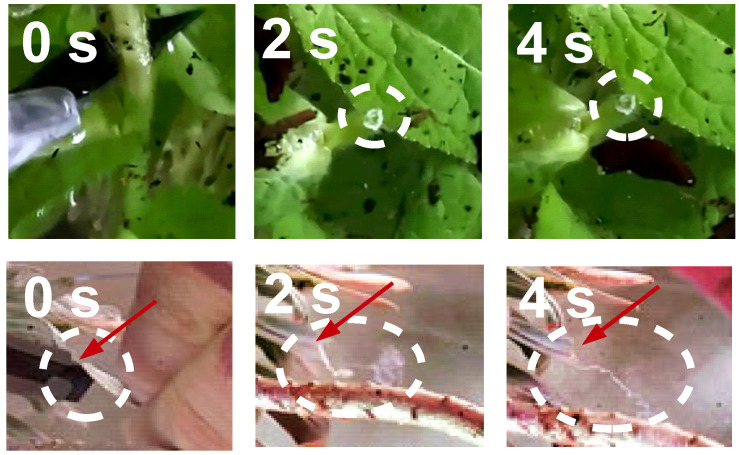 Figure 4
Peer Reviews
No public reviews on file for this paper yet. If you reviewed it on a platform where reviews are public (OpenReview, ICLR, NeurIPS, ICML), you can paste yours below so the community can read it here.
Videos
No videos yet. Explain this paper in a talk, walkthrough, or lecture? Add one.
Taxonomy
TopicsBiocrusts and Microbial Ecology · Botanical Research and Applications · Polysaccharides and Plant Cell Walls