A Focus on Personalized Care in Light of New Diagnostic and Therapeutic Pathways of Shoulder and Elbow Disease
Teresa Paolucci, Alice Cichelli, Massimiliano Mangone

Abstract
Genes, proteins, chemicals, diseases, species, mutations and cell lines named across the full text — each resolved to its canonical identifier and authoritative record.
Click any figure to enlarge with its caption.
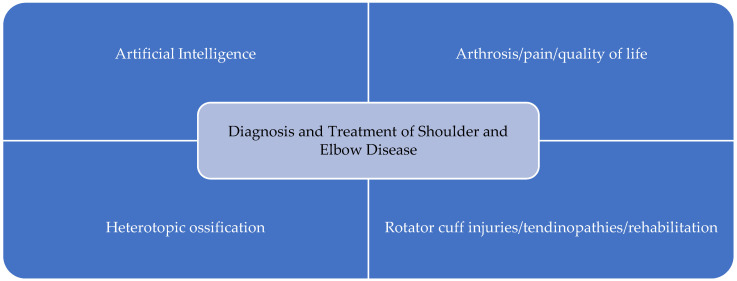 Figure 1
Peer Reviews
No public reviews on file for this paper yet. If you reviewed it on a platform where reviews are public (OpenReview, ICLR, NeurIPS, ICML), you can paste yours below so the community can read it here.
Videos
No videos yet. Explain this paper in a talk, walkthrough, or lecture? Add one.
Taxonomy
TopicsShoulder Injury and Treatment · Shoulder and Clavicle Injuries · Orthopedic Surgery and Rehabilitation
The shoulder is a complex system of functionally interconnected and coordinated joints. Together with the elbow joint and the hand, it guides and stabilizes the reaching movement of the upper limb. The functional role of the shoulder and elbow is twofold: to provide stability to the joint complex and to allow for a wide range of motion in the shoulder girdle and, through the elbow joint, to allow for quick and precise movements. These conditions—“stability”, “freedom of movement”, and “speed”—are lost if any of the numerous anatomical components are damaged by trauma, inflammation, or the peripheral or central nervous system.
Rotator cuff injuries, whether traumatic or due to functional overload, arthrosis, and heterotopic ossification, are the most common pathologies of the shoulder complex, while specific tendinopathies, with or without heterotopic ossification, are syndromes that specifically affect the elbow [1,2,3,4].
From these premises, the idea of promoting a Special Issue dedicated to “Diagnosis and Treatment of Shoulder and Elbow Disease” was born, which led to interesting reflections in light of the new diagnostic, surgical, and rehabilitative treatment proposals on this topic.
Eight papers were included in this Special Issue that address the topics presented in Figure 1.
There have been some insightful reflections on the use of Artificial Intelligence (AI) [5], in particular language models such as ChatGPT and Gemini, to support medical decision making in hand surgery. This underscores the importance of assessing the strengths and limitations of different models when incorporating them into clinical practice. However, more research is needed to evaluate the use and performance of additional AI tools (Pressman S.M. et al.). In addition, advances in arthroscopic techniques for repairing isolated subscapularis tendon tears [6] have become increasingly popular in recent years. Specifically, arthroscopic repair has been shown to achieve clinical and structural outcomes equivalent to the gold standard of open repair (Bartl C. et al.). Rehabilitation after rotator cuff repair is essential for functional recovery and to reduce the risk of retear [7,8]. The review by T. Paolucci et al. found that both early and delayed rehabilitation protocols after arthroscopic rotator cuff repair can provide adequate pain relief and functional recovery. However, early rehabilitation protocols generally result in better short-term improvements in range of motion and strength. These benefits may not last, and the risk of recurrence remains a concern with early rehabilitation, especially for major injuries. Clinicians should carefully evaluate each patient’s individual characteristics, injury severity, and specific therapy modalities to determine the most appropriate rehabilitation protocol following rotator cuff repair. Shoulder pain is a common musculoskeletal condition, accounting for approximately 1.3% of all primary care visits. When conservative and pharmacologic treatments fail, arthrodesis is typically considered a salvage procedure with limited functional goals. However, in “selected” patients, it can provide effective pain relief, stable motion, and satisfactory functional outcomes [9]. In the patient series by Sobhi, S. et al., shoulder arthrodesis demonstrated remarkable efficacy in pain reduction, high patient satisfaction, and acceptable functional outcomes with manageable complication rates. Considering that chronic shoulder pain can lead to significant functional disability and reduced psychosocial well-being, often exacerbated by kinesiophobia (Alito A. et al.), these findings highlight the potential benefits of this procedure in appropriately selected patients. Pathology of the long head of the biceps (LHBs) tendon is a common cause of anterior shoulder pain, including tendinitis, tenosynovitis, subluxation, dislocation, and tears [8]. In the pathogenesis of LHBs tendon instability, a shallow intertubercular groove morphology has been identified as a potential predisposing factor. Gerhardinger K. et al. suggested that the dimensions of the LHBs tendon may also influence instability, and they introduced the tendon-to-groove cross-sectional area ratio as a novel parameter to describe individual local anatomy. Heterotopic ossification (HO) after elbow trauma can result in significant motion restriction, depending on the size and location of the HO, as seen on radiographs [10]. On this specific topic, Leyder D. et al. introduced a novel classification that provides more detailed insights compared to previously established systems and aims to assist clinicians in making treatment decisions. Finally, Longo U.G. et al. proposed a minimal clinically important difference (MCID) for the 36-item Short-Form Health Survey (SF-36) questionnaire to assess patient-acceptable symptom status (PASS) during both preoperative evaluation and final follow-up after surgical shoulder repair.
We hope that you enjoy reading the articles published within this Special Issue.
The reference list from the paper itself. Each links out to its DOI / PubMed record.
- 1Mall N.A. Chahal J. Heard W.M. Bach B.R.Jr. Bush-Joseph C.A. Romeo A.A. Verma N.N. Outcomes of arthroscopic and open surgical repair of isolated subscapularis tendon tears Arthroscopy 2012281306131410.1016/j.arthro.2012.02.01822607828 · doi ↗ · pubmed ↗
- 2de Sire A. Agostini F. Bernetti A. Mangone M. Ruggiero M. Dinatale S. Chiappetta A. Paoloni M. Ammendolia A. Paolucci T. Non-Surgical and Rehabilitative Interventions in Patients with Frozen Shoulder: Umbrella Review of Systematic Reviews J. Pain Res.2022192449246410.2147/JPR.S 37151336016536 PMC 9397530 · doi ↗ · pubmed ↗
- 3Li L. Sun Y. Qin H. Zhou J. Yang X. Li A. Zhang J. Zhang Y. A scientometric analysis and visualization of kinesiophobia research from 2002 to 2022: A review Medicine 2023102 e 3587210.1097/MD.000000000003587237932995 PMC 10627652 · doi ↗ · pubmed ↗
- 4Heuts P.H. Vlaeyen J.W. Roelofs J. de Bie R.A. Aretz K. van Weel C. van Schayck O.C. Pain-related fear and daily functioning in patients with osteoarthritis Pain 200411022823510.1016/j.pain.2004.03.03515275772 · doi ↗ · pubmed ↗
- 5Miller R. Farnebo S. Horwitz M.D. Insights and trends review: Artificial intelligence in hand surgery J. Hand Surg. Eur. Vol.20234839640310.1177/1753193423115259236756841 · doi ↗ · pubmed ↗
- 6Nazari G. Mac Dermid J.C. Bryant D. Dewan N. Athwal G.S. Effects of arthroscopic vs. mini-open rotator cuff repair on function, pain & range of motion. A systematic review and meta-analysis P Lo S ONE 201914 e 02229533167110110.1371/journal.pone.0222953 PMC 6822715 · doi ↗ · pubmed ↗
- 7Littlewood C. Bateman M. Butler-Walley S. Bathers S. Bromley K. Lewis M. Funk L. Denton J. Moffatt M. Winstanley R. Rehabilitation following rotator cuff repair: A multi-centre pilot & feasibility randomised controlled trial (Ra Ce R)Clin. Rehabil.2021358298393330561910.1177/0269215520978859 PMC 8191146 · doi ↗ · pubmed ↗
- 8Van Deurzen D.F.P. Garssen F.L. Kerkhoffs G.M.M.J. Bleys R.L.A.W. Ten Have I. van den Bekerom M.P.J. Clinical relevance of the anatomy of the long head bicipital groove, an evidence-based review Clin. Anat.20213419920810.1002/ca.2361032379369 · doi ↗ · pubmed ↗