The Impact of Night Shifts, Tobacco Dependence, Health Awareness, and Depression Risk on Chronic Disease Risk Among Generation Z Overtime Workers During the COVID-19 Pandemic
Hui-Li Lin, Wen-Hsin Liu

TL;DR
This study finds that working overtime, tobacco use, and depression increase chronic disease risk among Gen Z workers during the pandemic.
Contribution
The study identifies tobacco dependence and depression risk as significant contributors to chronic disease risk among overtime-working Gen Z employees.
Findings
Overtime workers are 1.39 times more likely to develop chronic diseases.
Tobacco dependence and depression risk are significantly correlated with chronic disease risk.
Health awareness partially mediates the link between tobacco dependence and chronic disease risk.
Abstract
Background/Objectives: the COVID-19 pandemic accelerated the adoption of remote work, blurring the boundaries between professional and personal life. This shift resulted in longer working hours, negative emotional outcomes, and health issues, particularly among Generation Z employees. This study investigates the links between working overtime, tobacco dependence, night shifts, and chronic disease risk in Generation Z employees during the pandemic while also examining the roles of depression risk and health awareness. A quantitative research approach was used to administer a questionnaire and employ the chi-square test, t-test, and logistic regression analysis to compare overtime-related factors and chronic disease risks. Results: the overtime workers are 1.39 times more likely to develop chronic diseases than those who do not work overtime. The odds ratio (OR) for overtime workers is…
Genes, proteins, chemicals, diseases, species, mutations and cell lines named across the full text — each resolved to its canonical identifier and authoritative record.
Click any figure to enlarge with its caption.
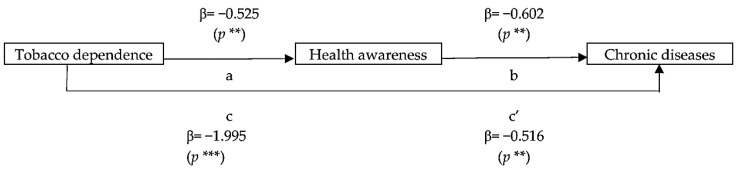 Figure 1
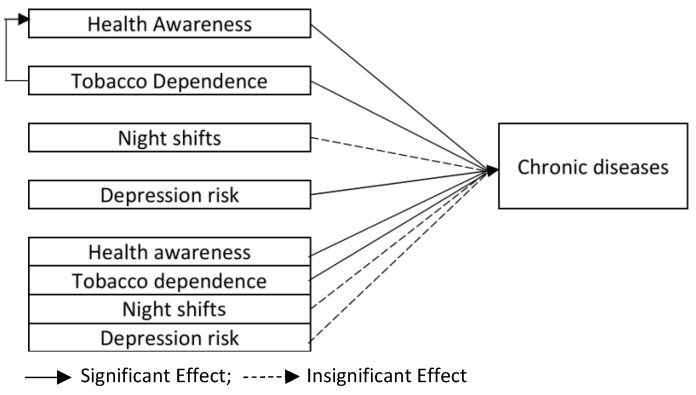 Figure 2
Peer Reviews
No public reviews on file for this paper yet. If you reviewed it on a platform where reviews are public (OpenReview, ICLR, NeurIPS, ICML), you can paste yours below so the community can read it here.
Videos
No videos yet. Explain this paper in a talk, walkthrough, or lecture? Add one.
Taxonomy
TopicsPsychological and Temporal Perspectives Research · Workplace Health and Well-being · Psychological Well-being and Life Satisfaction