Low-dose Spironolactone Combined with ACEIs/ARBs May Reduce Cardiovascular Events in Patients with CKD Stages 3b-5: A Nationwide Population-Based Cohort Study in Taiwan
Li-Nien Chien, Po-Jen Hsiao, Chih-Chien Chiu, Wan-Ting Chen, Chih-Jen Cheng, Leon Li-Ming Tsou, Yung-Hsi Kao, Chu-Lin Chou, Te-Chao Fang

TL;DR
Low-dose spironolactone combined with ACEIs/ARBs may reduce cardiovascular events in advanced CKD patients without increasing kidney or hyperkalaemia risks.
Contribution
Demonstrates that low-dose spironolactone can be safely used with ACEIs/ARBs in advanced CKD patients to reduce cardiovascular events.
Findings
Patients with high adherence to low-dose spironolactone had lower risks of MACEs, nonfatal MI, and heart failure hospitalization.
No significant increase in renal failure or hyperkalaemia risks was observed in the high adherence group.
Even moderate adherence to spironolactone showed reduced risks of MACEs and nonfatal MI.
Abstract
Background: ACE inhibitors (ACEIs) and angiotensin receptor blockers (ARBs) are commonly prescribed for hypertension and chronic kidney disease (CKD) management, but they can increase the risk of renal function deterioration and hyperkalaemia. Spironolactone, known for reducing cardiovascular events in CKD patients, faces limited use due to the risk of hyperkalaemia. This study evaluates the potential efficacy and complications of low-dose spironolactone as an adjunct therapy in patients with CKD stages 3b to 5 who are maintained on ACEIs or ARBs. Materials and methods: Hypertensive CKD patients (stages 3b-5) from Taiwan's National Health Insurance Research Database (2012-2016) were selected. Inverse probability treatment weighting (IPTW) was applied to balance baseline characteristics between patients treated with and without spironolactone. In this study, adherence to low-dose…
Genes, proteins, chemicals, diseases, species, mutations and cell lines named across the full text — each resolved to its canonical identifier and authoritative record.
Click any figure to enlarge with its caption.
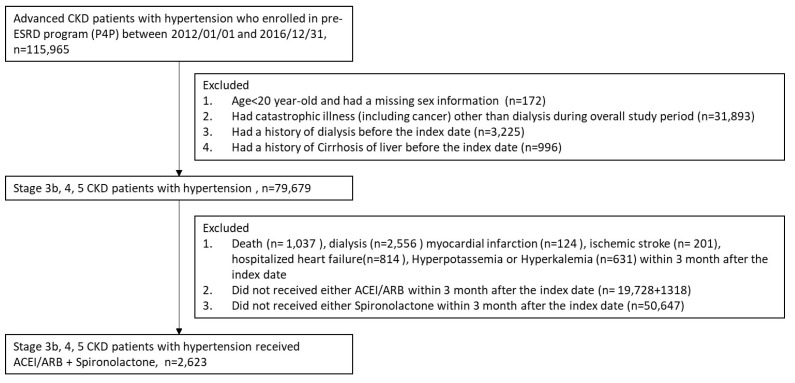 Figure 1
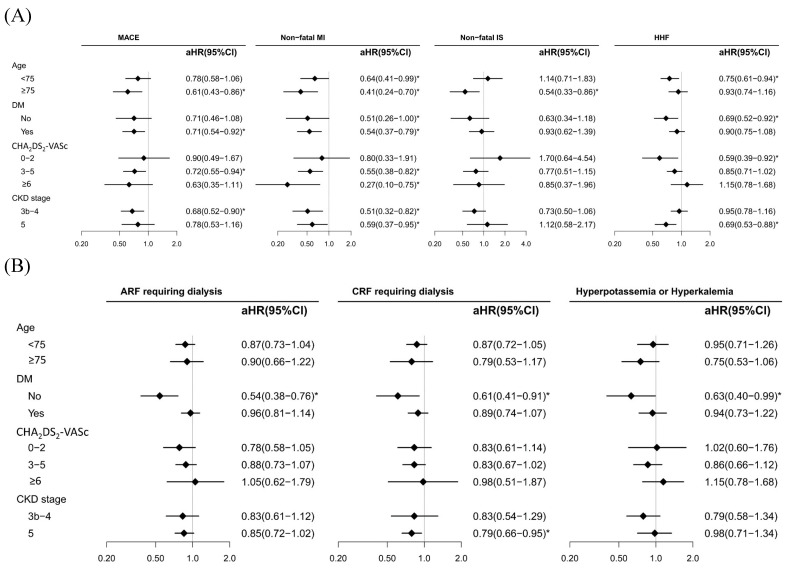 Figure 2
Peer Reviews
No public reviews on file for this paper yet. If you reviewed it on a platform where reviews are public (OpenReview, ICLR, NeurIPS, ICML), you can paste yours below so the community can read it here.
Videos
No videos yet. Explain this paper in a talk, walkthrough, or lecture? Add one.
Taxonomy
TopicsPotassium and Related Disorders · Heart Failure Treatment and Management · Electrolyte and hormonal disorders