Immune repertoire sequencing reveals differences in treatment response to camrelizumab plus platinum-based chemotherapy in advanced ESCC
Xiaoling Zhang, Wenqi Zhao, Yunyi Du, Fei Su, Yuexiang Zhang, Hui Wang, Yongai Li, Min Liu, Yangjun Gao, Linlin Cai, Tingting Feng, Mei Wang, Chunmei Yao, Ning Xu, Yu Wang, Guohua Song, Wenqing Hu, Jun Zhao

TL;DR
This study shows that combining camrelizumab with chemotherapy is effective for advanced esophageal cancer, and immune sequencing reveals differences in immune responses between responders and non-responders.
Contribution
The study introduces immune repertoire sequencing as a tool to understand treatment response mechanisms in ESCC patients receiving camrelizumab plus chemotherapy.
Findings
Camrelizumab plus chemotherapy achieved a 64.8% objective response rate in advanced ESCC patients.
Immune repertoire sequencing revealed significant differences in TCR and BCR CDR3 sequences between responders and non-responders.
Oligoclonal enrichment and specific V/J gene abundance differences were observed in TCR and BCR between groups.
Abstract
This study evaluated the efficacy and safety of camrelizumab combined with platinum-based chemotherapy (taxanes [T] or fluorouracil agents [F] plus platinum [P] drugs) as the first-line treatment in advanced esophageal squamous cell carcinoma (ESCC), using immune repertoire sequencing (IRS) to explore treatment response mechanism. In this multi-center, prospective cohort study, 88 patients received camrelizumab plus TP or FP, achieving a 1-year progression-free survival of 56.8% and overall survival of 68.2%. The objective response rate (ORR) was 64.8%, with a disease control rate of 91.1%. While most treatment-related adverse events were mild, 12.5% of patients experienced grade ≥3 toxicities. IRS showed significant differences in T-cell receptor (TCR) β-chain and immunoglobulin heavy chain between patients with (ORR group) or without ORR (non-ORR group), particularly in the…
Genes, proteins, chemicals, diseases, species, mutations and cell lines named across the full text — each resolved to its canonical identifier and authoritative record.
Click any figure to enlarge with its caption.
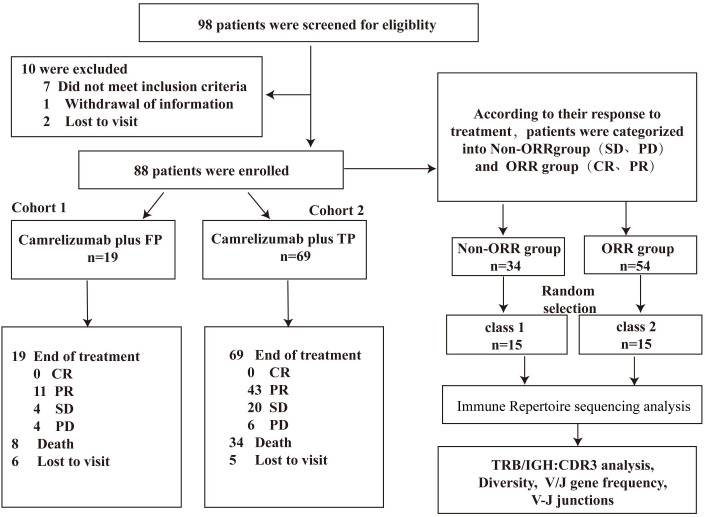 Figure 1
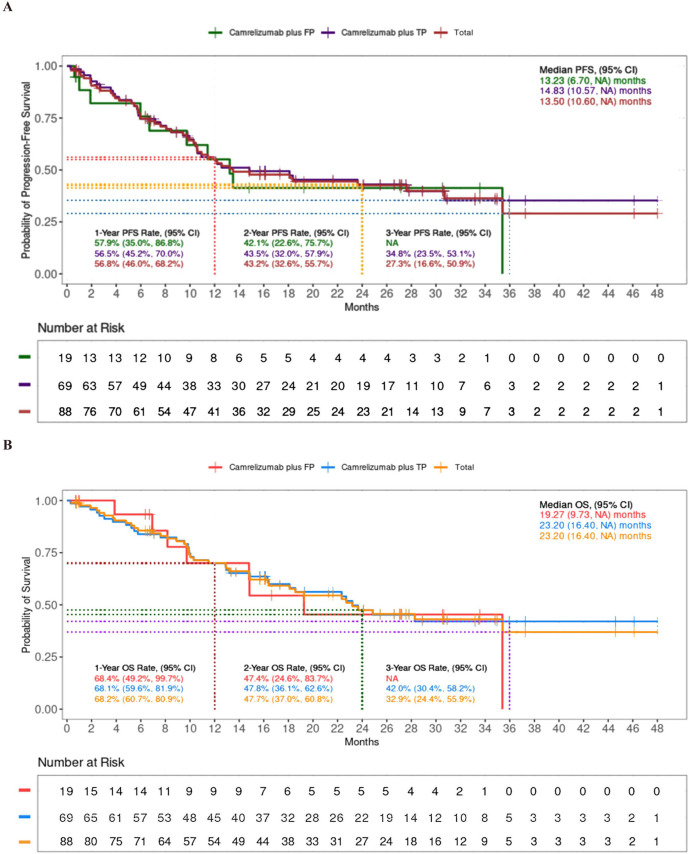 Figure 2
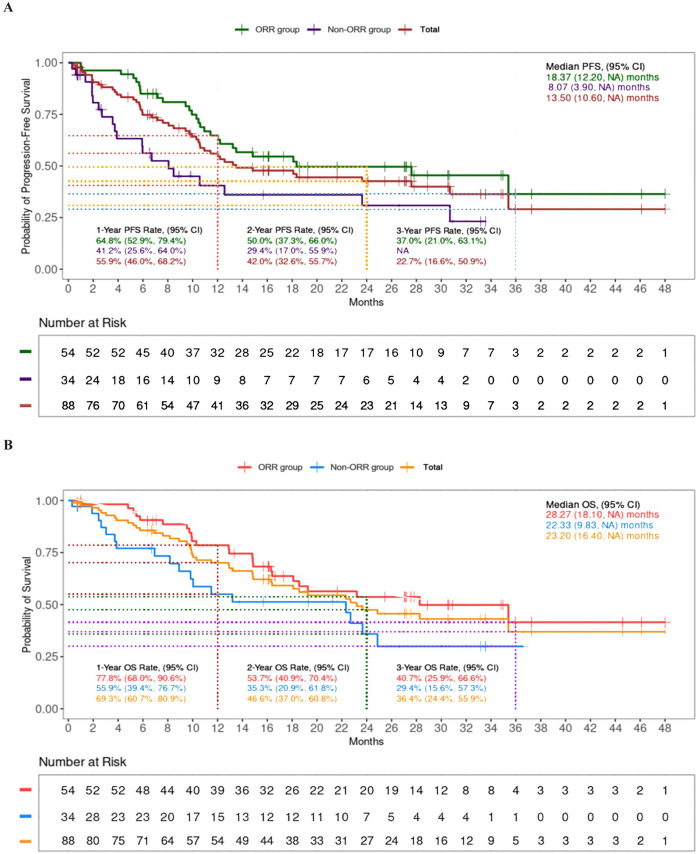 Figure 3
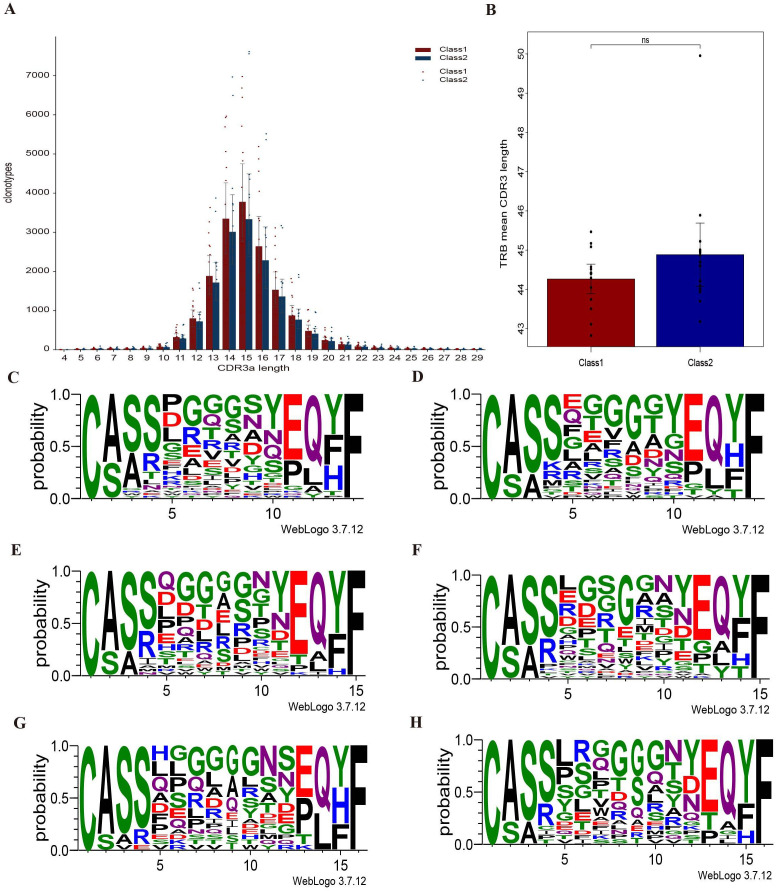 Figure 4
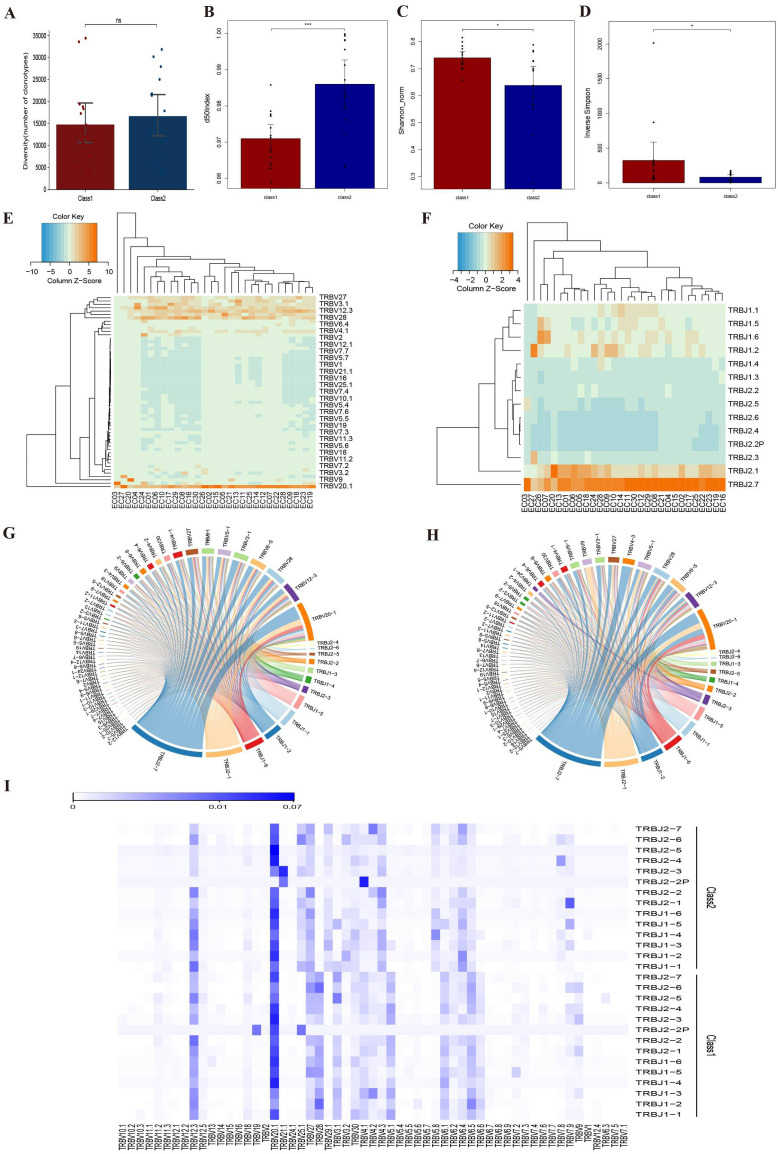 Figure 5
Peer Reviews
No public reviews on file for this paper yet. If you reviewed it on a platform where reviews are public (OpenReview, ICLR, NeurIPS, ICML), you can paste yours below so the community can read it here.
Videos
No videos yet. Explain this paper in a talk, walkthrough, or lecture? Add one.
Taxonomy
TopicsEsophageal Cancer Research and Treatment · Cancer Immunotherapy and Biomarkers · Pancreatic and Hepatic Oncology Research