Regulation of P suc , a sucrose-inducible promoter in Caulobacter crescentus
Erin NewRingeisen, Jacy Jordahl, Lisa Bowers

TL;DR
This paper studies how a specific promoter in Caulobacter crescentus responds to changes in sucrose levels.
Contribution
The study identifies P suc as a tunable and tightly regulated sucrose-inducible promoter in Caulobacter.
Findings
P suc is responsive to varying sucrose concentrations in the media.
The promoter remains active even when other carbon sources are present.
The promoter is tightly controlled and can be tuned for expression.
Abstract
In gram-negative bacteria, when nutrients are too large or too scarce to diffuse through outer membrane porins, TonB-dependent receptors (TBDRs) are utilized to actively translocate substrates across the outer membrane. Caulobacter crescentus is a gram-negative bacterium with a large set of TBDRs, many which have not been fully characterized. Previous studies identified SucA, a Caulobacter TBDR that transports sucrose. Our experiments further characterize the expression of sucA from the P suc promoter and we identify P suc as a tightly controlled, tunable promoter, responsive to changes in sucrose concentration with and without other carbon sources in the media.
Genes, proteins, chemicals, diseases, species, mutations and cell lines named across the full text — each resolved to its canonical identifier and authoritative record.
Click any figure to enlarge with its caption.
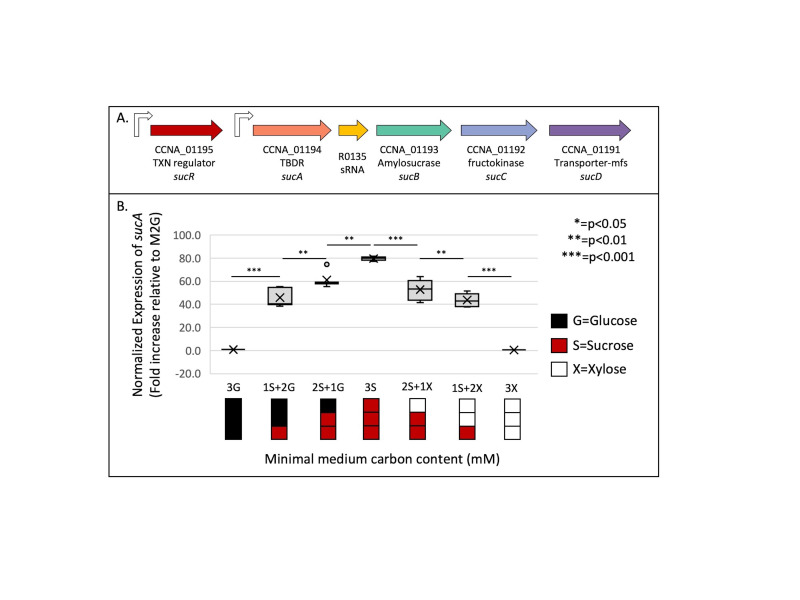 Figure 1
Peer Reviews
No public reviews on file for this paper yet. If you reviewed it on a platform where reviews are public (OpenReview, ICLR, NeurIPS, ICML), you can paste yours below so the community can read it here.
Videos
No videos yet. Explain this paper in a talk, walkthrough, or lecture? Add one.
Taxonomy
TopicsBacterial Genetics and Biotechnology · Bacterial biofilms and quorum sensing · Vibrio bacteria research studies