The disruptive influence of the Ala218Val variant on the ENG protein
Jared Truitt, Cynthia L Stenger, Luke Terwilliger, Michele Morris

TL;DR
This study examines how a specific genetic variant in the ENG gene disrupts artery development and causes bleeding in a disease called Hereditary Hemorrhagic Telangiectasia.
Contribution
The study provides computational evidence that the Ala218Val variant in the ENG protein is likely pathogenic.
Findings
The Ala218Val variant is located at a highly conserved and buried residue in the ENG protein.
Molecular dynamics simulations show the variant causes structural movement differences compared to the wild type.
The variant is predicted to be likely pathogenic based on computational and conservation analyses.
Abstract
Hereditary Hemorrhagic Telangiectasia (HHT) is an autosomal dominant disease that interferes with the formation of arteries. The ENG gene encodes for the protein endoglin which is used to properly develop and remodel arteries. The removal of endoglin forms telangiectasias that cause bleeding from the nose and vital organs. This study investigates the impact of one of the many variants of uncertain significance of ENG associated with HHT. The missense swap of alanine for valine at position 218 (Ala218Val) was characterized through computational metrics from in silico pathogenicity prediction tools, conservation analysis, and molecular dynamics simulation (MDS). The structural residue is highly conserved over multiple species and buried. The missense swap resulted in a difference in movement from the wild type according to MDS in a simulated aqueous environment. Therefore, it is predicted…
Genes, proteins, chemicals, diseases, species, mutations and cell lines named across the full text — each resolved to its canonical identifier and authoritative record.
Click any figure to enlarge with its caption.
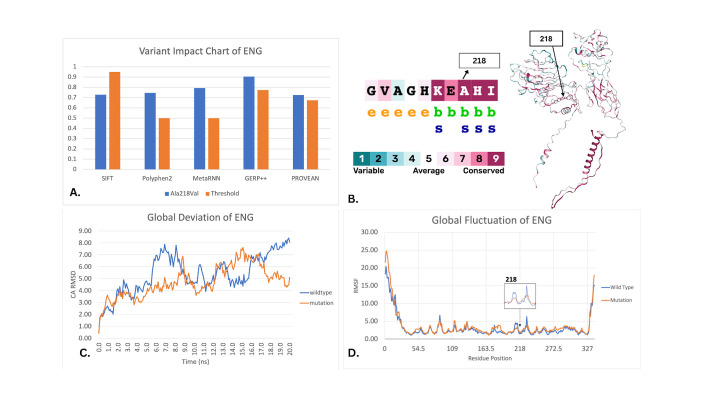 Figure 1
Peer Reviews
No public reviews on file for this paper yet. If you reviewed it on a platform where reviews are public (OpenReview, ICLR, NeurIPS, ICML), you can paste yours below so the community can read it here.
Videos
No videos yet. Explain this paper in a talk, walkthrough, or lecture? Add one.
Taxonomy
TopicsRenal and related cancers