When helping hurts: validating a measure of compulsive helping and exploring potential correlates
Katey Workman, Laura M. Padilla-Walker, Peter J. Reschke, Adam A. Rogers

TL;DR
This study introduces a new measure for compulsive helping, where helping behaviors actually harm the helper, and validates it among emerging adults.
Contribution
The paper introduces and validates a novel measure of compulsive helping, highlighting when prosocial behavior becomes harmful.
Findings
Confirmatory factor analysis showed convergent validity with all 10 items loading onto a single factor.
Compulsive helping was positively correlated with prosocial behavior and anxiety, and negatively with self-regulation.
The study suggests that harmful helping behaviors are not uncommon despite being infrequent.
Abstract
This cross-sectional study proposes and validates a new measure of compulsive helping: helping which harms the helper. Emerging Adults (N = 438; Mage = 20.29, SD = 1.04, 51.71% Female) reported on compulsive helping. Confirmatory factor analysis was used to assess construct validity, while bivariate correlations were used to assess convergent and discriminant validity. Confirmatory factor analysis suggested convergent validity with all 10 items loading onto a single factor, with factor loadings above 0.44. Model fit was acceptable. Convergent validity was demonstrated such that compulsive helping was positively correlated with prosocial behavior and anxiety. Discriminant validity was demonstrated such that compulsive helping was negatively associated with self-regulation. This new concept and measure of compulsive helping is a first step toward defining the limits of the adaptiveness…
Genes, proteins, chemicals, diseases, species, mutations and cell lines named across the full text — each resolved to its canonical identifier and authoritative record.
Click any figure to enlarge with its caption.
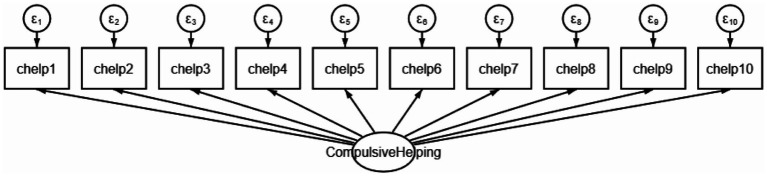 Figure 1
Peer Reviews
No public reviews on file for this paper yet. If you reviewed it on a platform where reviews are public (OpenReview, ICLR, NeurIPS, ICML), you can paste yours below so the community can read it here.
Videos
No videos yet. Explain this paper in a talk, walkthrough, or lecture? Add one.
Taxonomy
TopicsChild and Adolescent Psychosocial and Emotional Development · Attachment and Relationship Dynamics · Behavioral Health and Interventions