Neural responses to emotional displays by politicians: differential mu and alpha suppression patterns in response to in-party and out-party leaders
Maaike D. Homan, Mohammad Hamdan, Karlijn Hendriks, Diamantis Petropoulos Petalas

TL;DR
This study explores how people's brains respond differently to emotional expressions of politicians they support versus those they don't.
Contribution
The study reveals distinct neural patterns in response to emotional displays of in-party and out-party politicians.
Findings
Emotional displays by politicians increase mu-ERD compared to static neutral displays.
Out-party politicians, especially when angry, elicit the most mu-ERD.
Out-party happy expressions show the strongest alpha-ERD.
Abstract
The high levels of polarization raise concerns about individuals’ decreased ability to empathize and understand the representatives of political out-groups. As such, our political biases may lead us to misunderstand out-group politicians. In the current study, we examine the mu rhythm, a neural oscillation in the sensorimotor cortex related to the processing and understanding of other people’s actions, intentions and emotions. The mu rhythm is particularly responsive towards the emotional expressions of others and sensitive to social biases. Hence, we examine (1) whether the emotions displayed by politicians lead to more mu event-related-desynchronization (mu-ERD), (2) whether it matters which emotion (angry, happy, neutral) is displayed, and (3) whether neural responses differ when emotions are displayed by politicians we support (in-party politician) compared to politicians we do not…
Genes, proteins, chemicals, diseases, species, mutations and cell lines named across the full text — each resolved to its canonical identifier and authoritative record.
Click any figure to enlarge with its caption.
 Figure 1
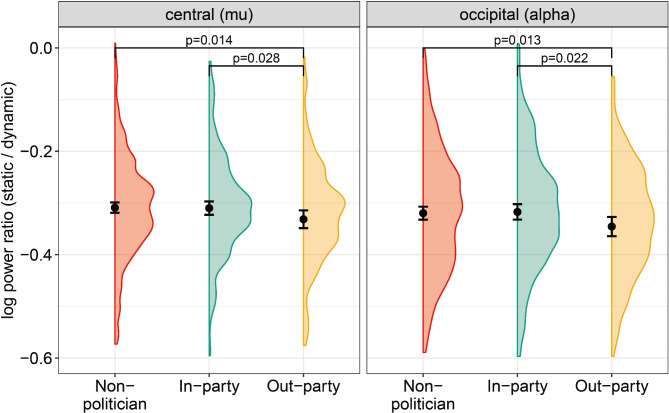 Figure 2
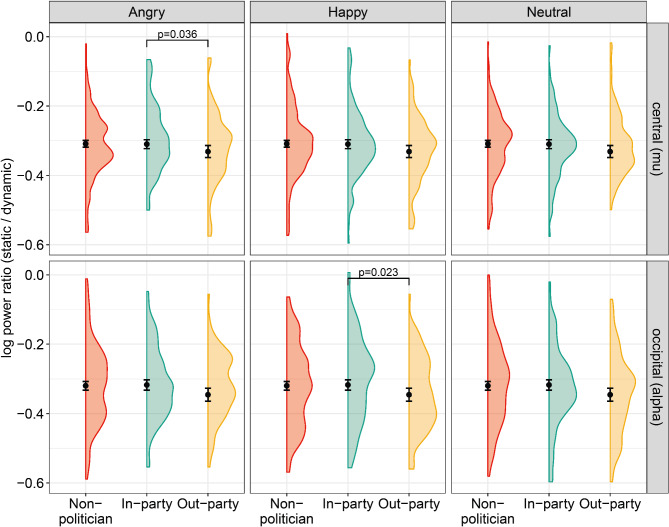 Figure 3
Peer Reviews
No public reviews on file for this paper yet. If you reviewed it on a platform where reviews are public (OpenReview, ICLR, NeurIPS, ICML), you can paste yours below so the community can read it here.
Videos
No videos yet. Explain this paper in a talk, walkthrough, or lecture? Add one.
Taxonomy
TopicsAction Observation and Synchronization · Neural dynamics and brain function · Neural and Behavioral Psychology Studies