Food for thought: the enhanced recall of metaphorical food sentences independent of hunger
Catherine Audrin, Géraldine Coppin

TL;DR
This study found that metaphorical food-related sentences are better remembered than literal ones, regardless of whether people are hungry.
Contribution
The study introduces a novel investigation into the memory advantage of metaphorical food sentences and their relation to hunger.
Findings
Metaphorical sentences were better remembered than literal ones.
Hunger did not significantly affect the recall of metaphorical or literal sentences.
Abstract
Metaphorical sentences are assumed to be related to more costly processes than their literal counterparts. However, given their frequent use in our daily lives, metaphorical sentences “must come with a benefit” (Noveck et al. Metaphor Symb 16:109–121. 10.1080/10926488.2001.9678889, 2001). In this paper, we investigated whether metaphorical sentences were better remembered than their literal counterparts. In addition, we were interested in assessing whether the relevance of the metaphors impacted this recall. Anchoring this hypothesis in the appraisal theory, we hypothesized that food-related metaphorical sentences may be particularly relevant when one is hungry, and consequently, be better remembered in that particular physiological state. Participants were presented with randomized metaphorical sentences and their literal counterparts and were later asked to remember the missing word…
Genes, proteins, chemicals, diseases, species, mutations and cell lines named across the full text — each resolved to its canonical identifier and authoritative record.
Click any figure to enlarge with its caption.
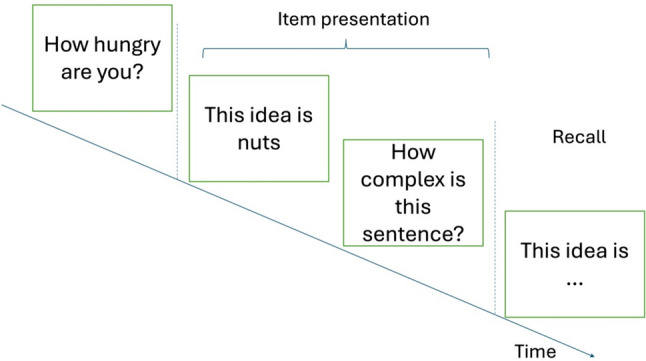 Figure 1
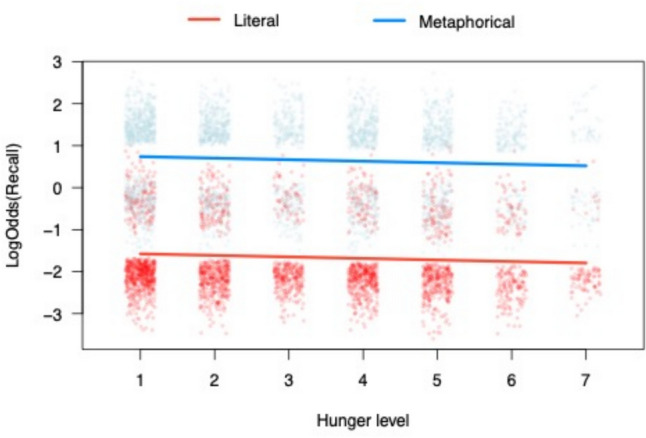 Figure 2
Peer Reviews
No public reviews on file for this paper yet. If you reviewed it on a platform where reviews are public (OpenReview, ICLR, NeurIPS, ICML), you can paste yours below so the community can read it here.
Videos
No videos yet. Explain this paper in a talk, walkthrough, or lecture? Add one.
Taxonomy
TopicsLanguage, Metaphor, and Cognition · Humor Studies and Applications · Action Observation and Synchronization