Assessment of chest CT abnormalities and pulmonary function at 6-month and 1-year after hospital discharge in Chinese patients of COVID-19 pneumonia at the turn of 2022–2023
Xingyu Fang, Jialin Li, Yijun Zhang, Wei Lv, Lin Liu, Yun Feng, Li Liu, Feng Pan, Jinping Zhang

TL;DR
This study tracked lung CT scans and function in Chinese patients recovering from COVID-19 pneumonia over one year, finding that lung abnormalities decreased but fibrosis increased and affected lung function.
Contribution
The study provides longitudinal data on CT abnormalities and pulmonary function in post-COVID-19 patients during the 2022–2023 China epidemic.
Findings
Pulmonary abnormalities decreased from 100% to 37.8% over one year, while fibrotic changes increased.
Fibrotic changes were strongly correlated with reduced diffusion capacity of the lung for carbon monoxide (DLCO).
DLCO was significantly lower in patients with fibrotic changes compared to those without.
Abstract
This study aimed to assess chest CT abnormalities and pulmonary function at 6-month and 1-year follow-ups in coronavirus disease 2019 (COVID-19) pneumonia patients of the China epidemic in the turn of 2022–2023. A total of 156 hospitalized patients with COVID-19 pneumonia admitted between 29 November 2022 and 10 February 2023 were prospectively assessed at 6-month and 1-year follow-ups. Characteristics and CT scores of pulmonary abnormalities and pulmonary function were compared between different follow-up time points. The correlation of CT abnormalities and pulmonary function at 1-year were evaluated. Over 1 year, the proportion of pulmonary abnormalities gradually decreased (initial, 100%, 156/156; 6-month, 57.1%, 89/156; and 1-year, 37.8%, 59/156; P < 0.001), whereas fibrotic changes increased (initial, 6.4%, 10/156; 6-month, 14.1%, 22/156; and 1-year, 14.7%, 23/56; P < 0.001).…
Genes, proteins, chemicals, diseases, species, mutations and cell lines named across the full text — each resolved to its canonical identifier and authoritative record.
Click any figure to enlarge with its caption.
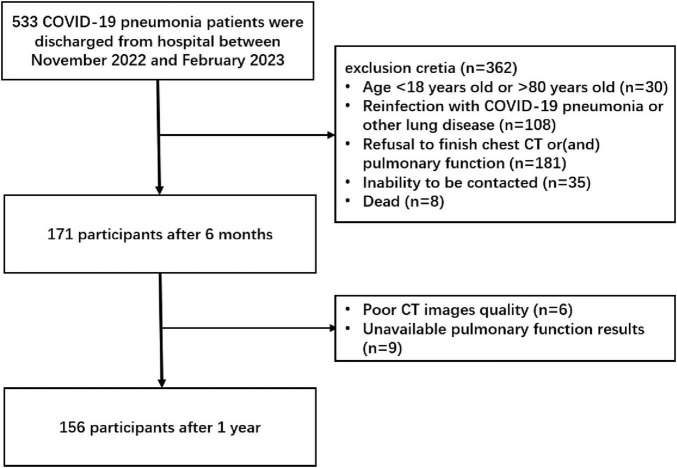 Figure 1
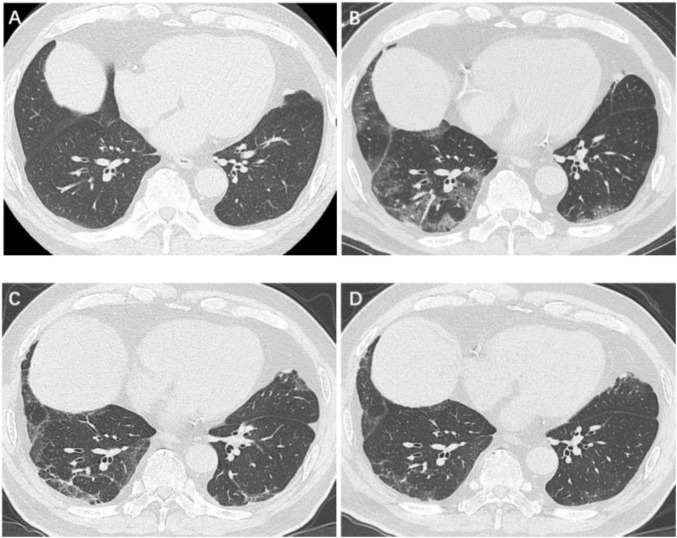 Figure 2
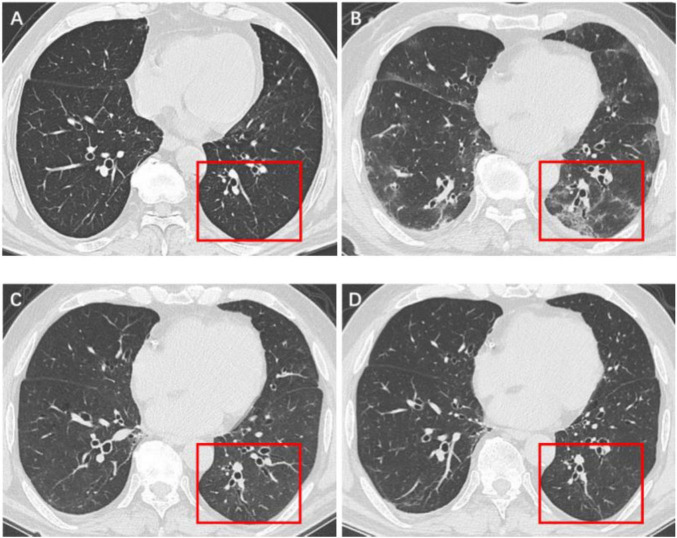 Figure 3
Peer Reviews
No public reviews on file for this paper yet. If you reviewed it on a platform where reviews are public (OpenReview, ICLR, NeurIPS, ICML), you can paste yours below so the community can read it here.
Videos
No videos yet. Explain this paper in a talk, walkthrough, or lecture? Add one.
Taxonomy
TopicsCOVID-19 Clinical Research Studies · Long-Term Effects of COVID-19 · COVID-19 diagnosis using AI