Successful intraoperative radiation therapy for a rapidly recurrent smooth muscle tumor of uncertain malignant potential
Yu‐Hsuan Chung, Peir‐In Liang, Feng‐Hsiang Tang

Abstract
Genes, proteins, chemicals, diseases, species, mutations and cell lines named across the full text — each resolved to its canonical identifier and authoritative record.
Click any figure to enlarge with its caption.
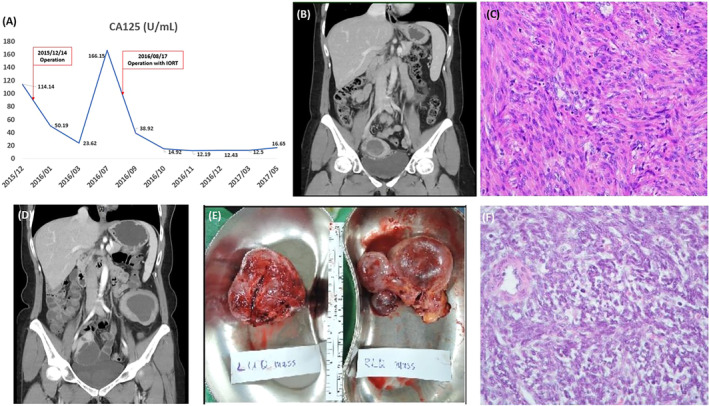 Figure 1
Peer Reviews
No public reviews on file for this paper yet. If you reviewed it on a platform where reviews are public (OpenReview, ICLR, NeurIPS, ICML), you can paste yours below so the community can read it here.
Videos
No videos yet. Explain this paper in a talk, walkthrough, or lecture? Add one.
Taxonomy
TopicsSarcoma Diagnosis and Treatment · Neurofibromatosis and Schwannoma Cases · Soft tissue tumor case studies
Smooth muscle tumors of uncertain malignant potential (STUMPs) represent a group of rare uterine neoplasms whose morphological features are between those of leiomyoma and leiomyosarcoma.1 STUMP recurrence poses a major challenge because no gold standard for treatment has been established. The present case highlights the effective use of intraoperative radiotherapy (IORT) as a salvage technique in a patient with twice recurrent STUMP, with the treatment resulting in more than 5 years of disease‐free survival.
A 46‐year‐old woman presented with large myoma and compression symptoms and underwent laparoscopic myomectomy. Her pathology report revealed STUMPs requiring laparoscopic hysterectomy. Six months postoperation, the patient visited our outpatient department for dull intermittent right‐lower‐quadrant abdominal pain. Laboratory data revealed elevated C‐reactive protein (58.5 mg/dL) and CA‐125 levels (Figure 1A). Transabdominal sonography revealed a right adnexal mass measuring 5.44 × 5.29 cm^2^ with complex echogenicity. Abdominal computed tomography (CT) revealed a large cystic lesion in the right adnexa (Figure 1B). Therefore, laparoscopic surgery was performed, revealing multiple peritoneal nodules, a few bloody ascites, and a lesion on the right fallopian tube. Hence, peritoneal tumor excision, right salpingo‐oophorectomy, and ascites collection were performed. Cytological analysis of the ascites revealed no malignant cells. However, histopathological analysis of the peritoneal tumor and right fallopian tube revealed STUMPs (Figure 1C). No subsequent events were observed throughout the patient's outpatient follow‐up. However, 7 months postoperation, outpatient sonography revealed left‐upper‐ and right‐lower‐quadrant abdominal masses with complex echogenicity. Therefore, abdominal CT was performed to confirm STUMP recurrence resulting in ileus (Figure 1D). Midline laparotomic tumor excision with IORT (20 Gy/1 fx) and seromuscular layer repair of the descending colonic wall were performed (Figure 1E). Histopathology again confirmed recurrent STUMPs (Figure 1F). After the operation, the patient regularly received outpatient ultrasound and CT scan follow‐up and has remained recurrence‐free for more than 7 years.
Although the clinical manifestations of STUMPs are similar to those of leiomyomas, approximately 0%–36% of patients with STUMPs experience recurrence,2 with the most common sites of distant recurrence being the lungs and abdomen.3 Reports regarding the time interval of STUMP recurrence vary considerably in the literature. A study reported the median interval for STUMP recurrence to be 34 months.4 Over the past decade, only seven cases of STUMP recurrence within 1 year following initial mass excision have been documented, with no study reporting patients experiencing recurrence twice within a year. In contrast to radiotherapy, the value of which in recurrent STUMP treatment remains unclear, hormone therapy was reported to be a successful salvage treatment, presumably because of the positive estrogen and progesterone receptors involved in the majority of cases of STUMPs.5 Among all published studies, radiotherapy has been used for only three patients, and no studies have used IORT for STUMP recurrence.
To our knowledge, this is the first case report of a patient who experienced rapid STUMP recurrence twice and underwent IORT as a salvage treatment after the second recurrence with disease‐free survival for more than 7 years. Our findings indicate the importance of considering the possibility of rapid STUMP recurrence. They also indicate the potential of IORT as a therapeutic option for STUMP recurrence. Further research is required to validate the clinical efficacy of IORT for STUMP treatment.
CONFLICT OF INTEREST STATEMENT
All authors declare no conflict of interest.
The reference list from the paper itself. Each links out to its DOI / PubMed record.
- 1WHO Classification of Tumors Editorial Board . Female genital tumors: WHO classification of tumors. Vol 4. 5th ed. Lyon, France: IARC; 2020.
- 2Gadducci A , Zannoni GF . Uterine smooth muscle tumors of unknown malignant potential: a challenging question. Gynecol Oncol. 2019;154(3):631–637.31326137 10.1016/j.ygyno.2019.07.002 · doi ↗ · pubmed ↗
- 3Di Giuseppe J , Grelloni C , Giuliani L , Delli Carpini G , Giannella L , Ciavattini A . Recurrence of uterine smooth muscle tumor of uncertain malignant potential: a systematic review of the literature. Cancers (Basel). 2022;14(9):2323.35565452 10.3390/cancers 14092323 PMC 9104240 · doi ↗ · pubmed ↗
- 4Liu HT , Wong CN , Wong CN , Liu FS . Uterine smooth muscle tumor of uncertain malignant potential: a review of current knowledge. Taiwan J Obstet Gynecol. 2022;61(6):935–940.36427995 10.1016/j.tjog.2022.08.003 · doi ↗ · pubmed ↗
- 5Zhang Q , Kanis MJ , Ubago J , Liu D , Scholtens DM , Strohl AE , et al. The selected biomarker analysis in 5 types of uterine smooth muscle tumors. Hum Pathol. 2018;76:17–27.29258902 10.1016/j.humpath.2017.12.005PMC 6065267 · doi ↗ · pubmed ↗