Metagenome-assembled genomes (MAGs) of the emerging pathogen Shewanella algae from enrichment of coastal seawater, sediment, and algae at St. John’s Island, Singapore
Jia Yee Ho, Dalong Hu, Rebecca J. Case, Yann F. Boucher

TL;DR
Researchers assembled genomes of the emerging pathogen Shewanella algae from coastal samples in Singapore.
Contribution
The study provides 29 metagenome-assembled genomes representing Shewanella algae from diverse coastal environments.
Findings
29 metagenome-assembled genomes were identified as Shewanella algae.
Samples were collected from coastal water, sediment, and algae in Singapore.
Metagenomic sequencing was used to analyze DNA from enrichment cultures.
Abstract
Coastal water, sediment, and algae samples were collected from St. John’s Island, Singapore, and enriched in either broth or agar. Metagenomic sequencing was carried out on DNA from these enrichments and analyzed. A total of 29 metagenome-assembled genomes had been successfully asserted to be a close representation of Shewanella algae.
Genes, proteins, chemicals, diseases, species, mutations and cell lines named across the full text — each resolved to its canonical identifier and authoritative record.
Click any figure to enlarge with its caption.
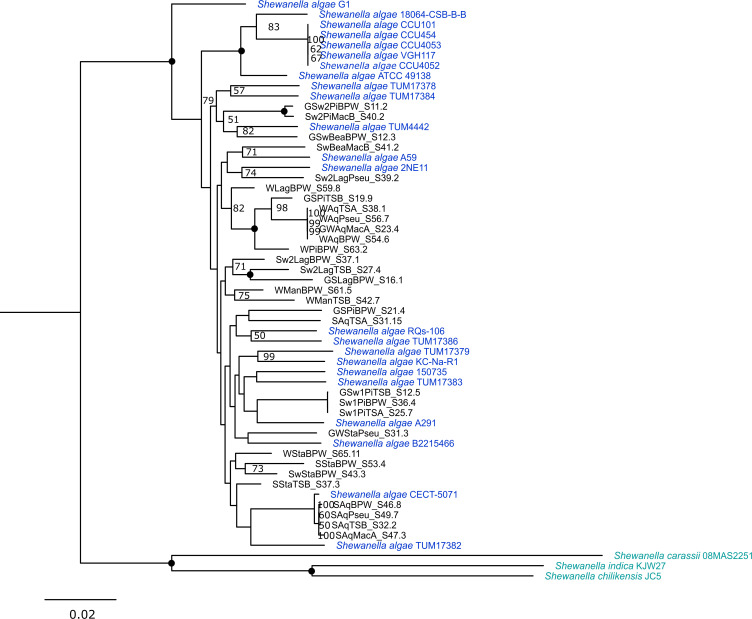 Fig 1
Fig 1| MAGs | Completion (%) | Contamination (%) | G + C content (%) | Genome size (bp) | No. of contigs > 300 bp (accession number) | No. of CDSs | No. of tRNA | No. of rRNA | AMR genes | Predicted AMR phenotype | |
|---|---|---|---|---|---|---|---|---|---|---|---|
| GSLagBPW_S16 | 96.72 | 0.72 | 53 | 4,992,910 | 93,949 | 193 | 4,365 | 59 | 4 | blaOXA-SHE, qnrA3 | Ampicillin, ciprofloxacin |
| GSPiBPW_S21 | 97.37 | 0.54 | 53.1 | 4,684,716 | 92,622 | 104 | 4,097 | 55 | 1 | blaOXA-SHE, qnrA3 | Ampicillin, ciprofloxacin |
| GSPiTSB_S19 | 96.83 | 0.888 | 53.6 | 4,421,557 | 30,049 | 256 | 4,020 | 44 | 2 | blaOXA-55, qnrA3 | Ampicillin, ciprofloxacin |
| GSw1PiTSB_S12 | 96.91 | 0.694 | 53.1 | 4,664,281 | 71,950 | 121 | 4,120 | 47 | 3 | blaOXA-SHE, qnrA4 | Ampicillin, ciprofloxacin |
| GSw2PiBPW_S11 | 100 | 0.617 | 53.2 | 4,691,866 | 110,785 | 94 | 4,145 | 68 | 2 | qnrA3 | Ciprofloxacin |
| GSwBeaBPW_S12 | 98.42 | 0.617 | 53.1 | 4,781,714 | 94,943 | 120 | 4,181 | 88 | 3 | mcr-4.3 | Colistin |
| GWAqMacA_S23 | 98.03 | 1.853 | 53 | 4,833,651 | 94,937 | 112 | 4,243 | 63 | 2 | blaOXA-55, qnrA7 | Ampicillin, ciprofloxacin |
| GWStaPseu_S31 | 98.82 | 1.428 | 53.2 | 4,681,258 | 50,800 | 162 | 4,188 | 50 | 1 | blaOXA-SHE, qnrA4 | Ampicillin, ciprofloxacin |
| SAqBPW_S46 | 98 | 0.54 | 53.1 | 4,849,128 | 73,622 | 125 | 4,337 | 68 | 2 | blaOXA-SHE, qnrA3 | Ampicillin, ciprofloxacin |
| SAqMacA_S47 | 95.21 | 0.888 | 53.3 | 4,487,869 | 26,645 | 284 | 4,013 | 44 | 0 | blaOXA-SHE, qnrA3 | Ampicillin, ciprofloxacin |
| SAqPseu_S49 | 93.96 | 0.617 | 53.4 | 4,427,647 | 63,853 | 134 | 3,902 | 54 | 1 | blaOXA-SHE, qnrA3 | Ampicillin, ciprofloxacin |
| SAqTSA_S31 | 96.29 | 1.081 | 53.5 | 4,556,579 | 56,337 | 176 | 4,059 | 55 | 1 | blaOXA-SHE, qnrA3 | Ampicillin, ciprofloxacin |
| SAqTSB_S32 | 100 | 0.617 | 53.1 | 4,814,062 | 53,692 | 142 | 4,277 | 46 | 0 | blaOXA-SHE, qnrA3 | Ampicillin, ciprofloxacin |
| SStaBPW_S53 | 96.47 | 0.735 | 53.4 | 4,449,683 | 61,882 | 158 | 3,983 | 57 | 2 | blaOXA-SHE, qnrA3 | Ampicillin, ciprofloxacin |
| SStaTSB_S37 | 99.43 | 1.158 | 53.4 | 4,778,220 | 58,976 | 210 | 4,320 | 57 | 3 | blaOXA-SHE, qnrA3 | Ampicillin, ciprofloxacin |
| Sw1PiBPW_S36 | 100 | 0.617 | 53.1 | 4,765,173 | 170,219 | 66 | 4,148 | 88 | 3 | blaOXA-SHE, qnrA4 | Ampicillin, ciprofloxacin |
| Sw1PiTSA_S25 | 97.37 | 0.54 | 53.1 | 4,735,696 | 188,601 | 76 | 4,123 | 68 | 4 | blaOXA-SHE, qnrA4 | Ampicillin, ciprofloxacin |
| Sw2LagBPW_S37 | 99.72 | 0.617 | 53.6 | 4,542,580 | 36,415 | 195 | 4,022 | 46 | 1 | blaOXA-SHE, qnrA3 | Ampicillin, ciprofloxacin |
| Sw2LagPseu_S39 | 96.57 | 1.954 | 53.5 | 4,385,340 | 21,534 | 425 | 4,035 | 43 | 1 | qnrA4 | Ciprofloxacin |
| Sw2LagTSB_S27 | 90.74 | 1.338 | 53.6 | 4,337,359 | 8,574 | 681 | 4,265 | 28 | 0 | blaOXA-SHE, qnrA3 | Ampicillin, ciprofloxacin |
| Sw2PiMacB_S40 | 92.16 | 0.873 | 53.3 | 4,414,790 | 17,925 | 423 | 4,077 | 38 | 2 | blaOXA-SHE, qnrA3 | Ampicillin, ciprofloxacin |
| SwBeaMacB_S41 | 96.83 | 0.54 | 53.5 | 4,496,375 | 35,776 | 231 | 4,056 | 46 | 1 | qnrA3 | Ciprofloxacin |
| SwStaBPW_S43 | 99.18 | 0.617 | 53.5 | 4,563,608 | 41,985 | 202 | 4,055 | 66 | 4 | blaOXA-SHE, qnrA3 | Ampicillin, ciprofloxacin |
| WAqBPW_S54 | 100 | 0.617 | 53 | 4,773,274 | 134,150 | 57 | 4,168 | 60 | 2 | blaOXA-55, qnrA7 | Ampicillin, ciprofloxacin |
| WAqPseu_S56 | 96.83 | 0.54 | 52.9 | 4,858,153 | 170,597 | 58 | 4,243 | 62 | 4 | blaOXA-55, qnrA7 | Ampicillin, ciprofloxacin |
| WAqTSA_S38 | 98.91 | 1.698 | 53 | 4,875,049 | 77,346 | 126 | 4,276 | 75 | 8 | blaOXA-55, qnrA7 | Ampicillin, ciprofloxacin |
| WLagBPW_S59 | 98.55 | 0.617 | 53.7 | 4,623,295 | 49,923 | 202 | 4,100 | 50 | 2 | qnrA3 | Ciprofloxacin |
| WManBPW_S61 | 95.75 | 1.158 | 53.6 | 4,414,174 | 29,454 | 318 | 3,978 | 44 | 0 | qnrA3 | Ciprofloxacin |
| WStaBPW_S65 | 97.01 | 0.99 | 53.7 | 4,480,059 | 41,561 | 225 | 4,015 | 51 | 1 | blaOXA-SHE, qnrA7 | Ampicillin, ciprofloxacin |
- —Singapore's One Health National Strategic Action Plan
Peer Reviews
No public reviews on file for this paper yet. If you reviewed it on a platform where reviews are public (OpenReview, ICLR, NeurIPS, ICML), you can paste yours below so the community can read it here.
Videos
No videos yet. Explain this paper in a talk, walkthrough, or lecture? Add one.
Taxonomy
TopicsMicrobial Community Ecology and Physiology · Genomics and Phylogenetic Studies · Aquaculture disease management and microbiota
ANNOUNCEMENT
Shewanella spp. is an Alteromonadales bacterium that can be ubiquitously found in soil, freshwater, and marine environments. Recently, there has been an increasing trend of human infections and antibiotic resistance associated with Shewanella algae being reported (1–5). These range from chronic otitis and infection of skin and soft tissue to bacteremia (6). Water, sediment, and algae samples were collected from six different locations around St. John’s Island, Singapore (August 2022). The samples were enriched overnight at 37°C in either broth, MacConkey, buffered peptone water, and tryptic soy broth, or on agar, MacConkey, Pseudomonas, and tryptic soy agar. All bacterial colonies grown on the agar after overnight incubation were harvested by scraping them into 1.5 mL of brain-heart infusion broth, and 0.5 mL was used for DNA extraction. For broth enrichments, 1.8 mL of the cell suspension was aliquoted from the broth after overnight incubation and used for DNA extraction (QIAamp PowerFecal Pro DNA Kit). The sequencing library was prepared using Illumina TruSeq Nano DNA with dual barcoded TruSeq DNA UD Indexes. The library was then sequenced on Illumina HiSeqX version 2.5, 150 × 150 bp. A total of 98 samples were sequenced, and a total of 3 billion reads were generated, with an average of 20–40 million reads per sample.
For the recovery of metagenome-assembled genomes (MAGs), the Kneaddata pipeline version 0.7.7 (https://github.com/biobakery/kneaddata) was first used to remove low-quality reads, and the initial assembly was then generated using metaSPAdes version 3.15.5 (7). The metaWRAP pipeline version 1.3 (8) was then used for reads’ binning, with the threshold for bins set to >50% completeness and <10% contamination rate. The bins were then annotated using Prokka version 1.14.5 (9). The Genome Taxonomy Database and associated taxonomic classification toolkit (10) were used for a more accurate taxonomic identification, where the classify workflow was utilized. The core genome was identified utilizing Roary version 3.11.2 (11). RAxML-NG (12) was used to build the maximum likelihood tree under the GTR + G model with 1,000 bootstrap replicates. The detection of antimicrobial resistance (AMR) genes in the MAGs was done using Staramr (13). The Pathosystems Resource Integration Center (PATRIC) was utilized to detect virulence factors (14).
Thirty-one MAGs were identified as S. algae, of which 29 met the SeqCode standard (Table 1) (15). Their sizes and GC content are consistent with known S. algae characteristics (16, 17). A maximum-likelihood tree was reconstructed using 987 core genes from representative S. algae genomes (n = 23) and its close relatives (n = 3). The MAGs clustered with S. algae reference genomes, confirming their identification (Fig. 1). AMR genes detected in our MAGs are displayed in Table 1. Virulence factor genes curated in PATRIC for S. algae were screened using BLASTN (18). Notably, all MAGs carried OmpR, a known regulator for flagellum expression, biofilm formation, and virulence, as well as type VI secretion system (T6SS), including hcp, suggesting T6SS as a potential virulence factor in S. algae (19, 20).
Maximum-likelihood tree of 987 core genes among 26 Shewanella spp. Blue text denotes Shewanella algae type strains, cyan text denotes outgroup of Shewanella spp. (Shewanella carassii, Shewanella indica, and Shewanella chilikensis), and black text denotes our MAGs. The scale bar indicates 0.02 nucleotide substitution per site. Nodes denote 100% bootstrap (Felsenstein’s bootstrap).
This study demonstrates the utility of culture-enriched metagenomics for generating high-quality MAGs of human pathogens found at low abundance in the environment.
The reference list from the paper itself. Each links out to its DOI / PubMed record.
- 1Bernshteyn M, Ashok Kumar P, Joshi S. 2020. Shewanella algae - a novel organism causing bacteremia: a rare case and literature review. Cureus 12:e 10676. doi:10.7759/cureus.1067633133842 PMC 7592632 · doi ↗ · pubmed ↗
- 2Ng WW-S, Shum H-P, To KK-W, Sridhar S. 2022. Emerging infections due to Shewanella spp.: a case series of 128 cases over 10 years. Front Med (Lausanne) 9:850938. doi:10.3389/fmed.2022.85093835573023 PMC 9100594 · doi ↗ · pubmed ↗
- 3Yan Y, Chai X, Chen Y, Zhang X. 2022. The fulminating course of infection caused by Shewanella algae: a case report. Infect Drug Resist 15:1645–1650. doi:10.2147/IDR.S 35718135422640 PMC 9005229 · doi ↗ · pubmed ↗
- 4Yousfi K, Bekal S, Usongo V, Touati A. 2017. Current trends of human infections and antibiotic resistance of the genus Shewanella. Eur J Clin Microbiol Infect Dis 36:1353–1362. doi:10.1007/s 10096-017-2962-328299457 · doi ↗ · pubmed ↗
- 5Chen Y-J, Tung K-C, Hong Y-K, Chen S-Y, Huang Y-T, Liu P-Y. 2019. Genome sequence of colistin-resistant bacteremic Shewanella algae carrying the beta-lactamase gene bla OXA-55. Can J Infect Dis Med Microbio 2019:3840563. doi:10.1155/2019/3840563 PMC 659058631281553 · doi ↗ · pubmed ↗
- 6Holt HM, Gahrn-Hansen B, Bruun B. 2005. Shewanella algae and Shewanella putrefaciens: clinical and microbiological characteristics. Clin Microbiol Infect 11:347–352. doi:10.1111/j.1469-0691.2005.01108.x 15819859 · doi ↗ · pubmed ↗
- 7Nurk S, Meleshko D, Korobeynikov A, Pevzner PA. 2017. meta SP Ades: a new versatile metagenomic assembler. Genome Res 27:824–834. doi:10.1101/gr.213959.11628298430 PMC 5411777 · doi ↗ · pubmed ↗
- 8Uritskiy GV, Di Ruggiero J, Taylor J. 2018. Meta WRAP—a flexible pipeline for genome-resolved metagenomic data analysis. Microbiome 6:158. doi:10.1186/s 40168-018-0541-130219103 PMC 6138922 · doi ↗ · pubmed ↗