Complete genome sequence of the unique Rhizobium johnstonii strain NaPi
Evgenii A. Kirichek, Alexey M. Afonin, Pyotr G. Kusakin, Viktor E. Tsyganov

TL;DR
This paper presents the complete genome sequence of a Rhizobium johnstonii strain that forms efficient root nodules on pea plants.
Contribution
The study provides the first complete genome sequence of the Rhizobium johnstonii strain NaPi.
Findings
Strain NaPi forms large pink nodules on pea mutants lacking the Sym40 gene.
The complete genome sequence of NaPi has been determined.
The genetic basis for its nodulation efficiency remains to be identified.
Abstract
In contrast to Rhizobium johnstonii strain 3841, R. johnstonii strain NaPi is able to form large pink nodules on the roots of pea (Pisum sativum L.) mutants in the gene Sym40. The genetic determinants underlying such efficiency have not been discovered yet. In this study, we report the complete genome sequence of the strain NaPi.
Genes, proteins, chemicals, diseases, species, mutations and cell lines named across the full text — each resolved to its canonical identifier and authoritative record.
Click any figure to enlarge with its caption.
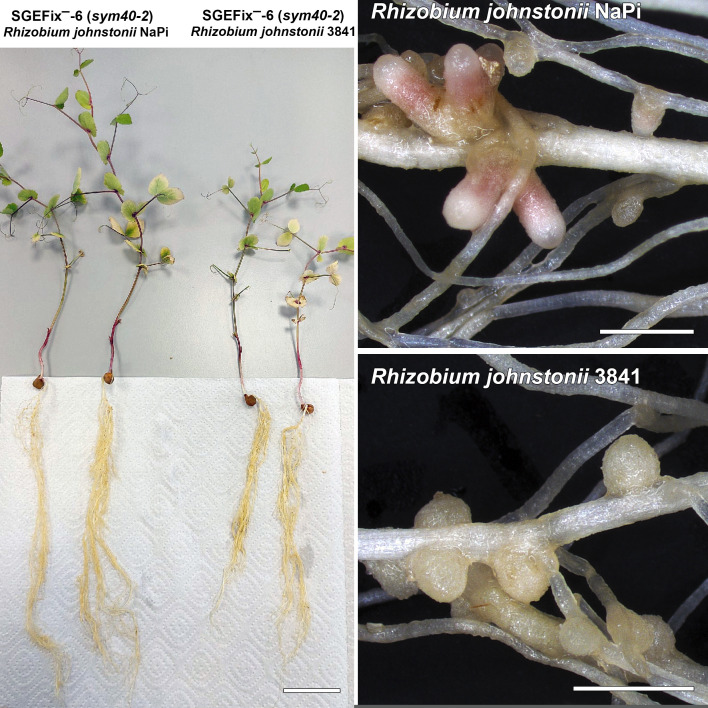 Fig 1
Fig 1- —Ministry of Science and Higher Education of the Russian Federation (Minobrnauki of Russia)
Peer Reviews
No public reviews on file for this paper yet. If you reviewed it on a platform where reviews are public (OpenReview, ICLR, NeurIPS, ICML), you can paste yours below so the community can read it here.
Videos
No videos yet. Explain this paper in a talk, walkthrough, or lecture? Add one.
Taxonomy
TopicsLegume Nitrogen Fixing Symbiosis · Plant nutrient uptake and metabolism · Plant Micronutrient Interactions and Effects
ANNOUNCEMENT
Active use of symbiotic nitrogen fixation leads to a reduction in the application of nitrogen fertilizers. For this purpose, it is necessary to identify and study effective rhizobia strains. Rhizobium johnstonii strain 3841 (1) is widely used in studies of legume-rhizobial symbiosis (2–4). R. johnstonii strain NaPi has been shown to form large pink nodules on the roots of sym40 pea symbiotic mutants ([Fig. 1](#F1 F1)), compared to the typically smaller white nodules associated with the sym40 genotype (5). The pea Sym40 gene is an ortholog of the Medicago truncatula EFD gene (6) encoding a negative regulator of cytokinin response (7).
SGEFix–-6 (sym40-2) pea plants (left) and corresponding nodules (right) after inoculation with Rhizobium johnstonii NaPi or Rhizobium johnstonii 3841. Bars indicate 2 cm for plant photos or 2 mm for nodule photos.
During laboratory experiments, a spontaneous pink nodule was found on the pea plant mutant SGEFix^–^−1 (sym40-1), which was grown in sterile vermiculite and inoculated with R. johnstonii strain 3841. Rhizobium strain was isolated from that pink nodule on plates containing tryptone-yeast extract (TY) medium, and incubated for a week at 28°C according to Vincent (8). Strain was named NaPi and preserved in TY medium with 40% glycerol at −80°C. For DNA isolation, strain was revived on a solid TY medium and incubated for 72 h at 28°C. DNA was isolated using the phenol-chloroform method (9) without size selection.
Long-read sequencing was performed using a MinION with flow cell R.9.4.1; the SQK-LSK109 kit with EXP-NBD104 and EXP-NBD114 was used to prepare the library according to the manufacturer’s instructions skipping the DNA-shearing step. The reads were base called and demultiplexed using Guppy v.3.3.0 (high accuracy model) with default parameters. 92,680 nanopore reads with a total length of 1,032,198,719 bp, N50 = 20,059, and estimated coverage of 133× were obtained. The de novo assembler Flye (10) v.2.6 was used to assemble raw reads. The assembly was corrected four times using Racon (11) v.1.3.2 (with -m 8 x -6 g -8 w 500 options), and polished with medaka (12) v.0.10.0 using long reads.
Short-read sequencing was carried out on an Illumina HiSeq X Ten with the TruSeq DNA PCR-Free kit according to the manufacturer’s recommendations. In total, 4,415,831 sequence reads of 2 × 150 bp were generated. The reads were quality trimmed and adapters were removed as described (13); the expected coverage was about 166×. The short reads were used to polish the assembled genome using Pilon (14) v.1.22. Default parameters were used for all listed software unless otherwise noted.
The genome consists of seven assembled fragments, including one chromosome and six plasmids with a total length of 7,753,359 bp, assembly N50 = 5,059,001, and an average GC content of 60.86%. Complete genome was deposited at GenBank and annotated using the NCBI Prokaryotic Genome Annotation Pipeline (PGAP) (15) v.6.8. Overall, 7,440 CDSs and 65 RNAs were annotated.
The circularity of all assembled fragments was verified by mapping the long reads to the assembled fragments using Minimap2 (16), with the map-ont mapping mode, and inspecting the coverage uniformity. The chromosome was rotated, the dnaA gene was placed at the start of the sequence; for plasmids, a repABC operon was placed at the start of the sequence.
The reference list from the paper itself. Each links out to its DOI / PubMed record.
- 1Young JPW, Jorrin B, Moeskjær S, James EK. 2023. Rhizobium brockwellii sp. nov., Rhizobium johnstonii sp. nov. and Rhizobium beringeri sp. nov., three genospecies within the Rhizobium leguminosarum species complex. Int J Syst Evol Microbiol 73. doi:10.1099/ijsem.0.00597937486744 · doi ↗ · pubmed ↗
- 2Cheng G, Karunakaran R, East AK, Munoz-Azcarate O, Poole PS. 2017. Glutathione affects the transport activity of Rhizobium leguminosarum 3841 and is essential for efficient nodulation. FEMS Microbiol Lett 364:fnx 045. doi:10.1093/femsle/fnx 04528333211 PMC 5407991 · doi ↗ · pubmed ↗
- 3Serova TA, Kusakin PG, Kitaeva AB, Seliverstova EV, Gorshkov AP, Romanyuk DA, Zhukov VA, Tsyganova AV, Tsyganov VE. 2023. Effects of elevated temperature on Pisum sativum nodule development: I-detailed characteristic of unusual apical senescence. Int J Mol Sci 24:17144. doi:10.3390/ijms 24241714438138973 PMC 10742560 · doi ↗ · pubmed ↗
- 4Li X, Li Z, Wei Y, Chen Z, Xie S. 2024. Identification and characterization of the Tet R family transcriptional regulator Nff T in Rhizobium johnstonii . Appl Environ Microbiol Appl Environ Microbiol 90:e 0185123. doi:10.1128/aem.01851-23PMC 1095253938426790 · doi ↗ · pubmed ↗
- 5Tsyganov VE, Morzhina EV, Stefanov SY, Borisov AY, Lebsky VK, Tikhonovich IA. 1998. The pea (Pisum sativum L.) genes sym 33 and sym 40 control infection thread formation and root nodule function. Mol Gen Genet 259:491–503. doi:10.1007/s 0043800508409790580 · doi ↗ · pubmed ↗
- 6Tsyganov VE, Tsyganova AV. 2020. Symbiotic regulatory genes controlling nodule development in Pisum sativum L. Plants 9:1741. doi:10.3390/plants 912174133317178 PMC 7764586 · doi ↗ · pubmed ↗
- 7Vernié T, Moreau S, de Billy F, Plet J, Combier J-P, Rogers C, Oldroyd G, Frugier F, Niebel A, Gamas P. 2008. EFD is an ERF transcription factor involved in the control of nodule number and differentiation in Medicago truncatula. Plant Cell 20:2696–2713. doi:10.1105/tpc.108.05985718978033 PMC 2590733 · doi ↗ · pubmed ↗
- 8Vincent JM. 1970. The cultivation, isolation and maintenance of rhizobia, p 1–13. In Vincent JM (ed), A Manual for the Practical Study of Root Nodule Bacteria. Blackwell Scientific, Oxford.