Complete genome sequences of AZ Arthrobacter phages Wildwest and Sue2
Isabella E. Cloud, Ava N. Ortega, Angelina M. Spencer, Varsha Upadhyayulla, Tamarah L. Adair

TL;DR
This paper announces the complete genome sequences of two soil-isolated bacteriophages, Wildwest and Sue2, which infect Arthrobacter atrocyaneus.
Contribution
The study provides new insights into the AZ1 cluster phages through the genomic analysis of Wildwest and Sue2.
Findings
The complete genome sequences of Wildwest and Sue2 were determined.
The phages exhibit unique genomic features that contribute to understanding the AZ1 cluster.
Abstract
This announcement reports the complete genome sequences of two bacteriophages isolated from soil samples using the host Arthrobacter atrocyaneus Strain NRRL B-2883. These findings enhance our understanding of AZ1 cluster phages, particularly Wildwest and Sue2, with their unique genomic features.
Genes, proteins, chemicals, diseases, species, mutations and cell lines named across the full text — each resolved to its canonical identifier and authoritative record.
Click any figure to enlarge with its caption.
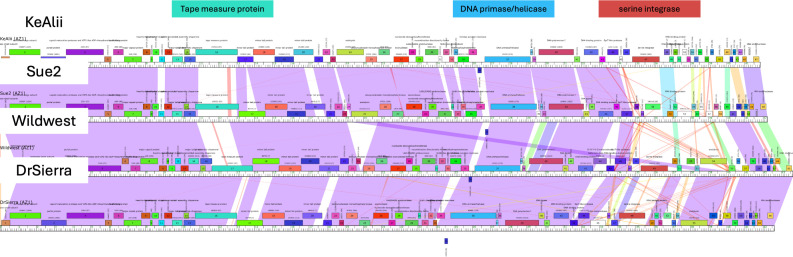 Fig 1
Fig 1| Phage descriptions | Wildwest | Sue2 |
|---|---|---|
| Isolation location | St. Charles, Missouri | Elmhurst, Illinois |
| ICTV taxonomy ( | Duplodnaviria; Heunggongvirae; Uroviricota; Caudoviricetes; subfamily Azeevirinae, Genus Manhattanvirus | Duplodnaviria; Heunggongvirae; Uroviricota; Caudoviricetes; subfamily Azeevirinae, Genus Manhattanvirus |
| Genome size (base pairs) | 43,653 | 42,245 |
| % GC | 66.9 | 66.6 |
| Number of reads | 566,827 | 226,930 |
| Coverage | 1,849× | 772× |
| Number of predicted genes | 65 | 67 |
| NCBI BLASTn % identity with | 90.96 | 80.61 |
| NCBI BLASTn % identity with | 81.52 | 82.68 |
| NCBI BLASTn % identity between Wildwest and Sue2 | 81.99 | 81.99 |
Peer Reviews
No public reviews on file for this paper yet. If you reviewed it on a platform where reviews are public (OpenReview, ICLR, NeurIPS, ICML), you can paste yours below so the community can read it here.
Videos
No videos yet. Explain this paper in a talk, walkthrough, or lecture? Add one.
Taxonomy
TopicsBacteriophages and microbial interactions · Genomics and Phylogenetic Studies · RNA and protein synthesis mechanisms
ANNOUNCEMENT
Bacteriophage genome annotation contributes to understanding the role of phages in their environment, the discovery of genes with unknown functions, and aspects of host-viral interactions. Arthrobacter is a common environmental organism. It is a member of the Family Micrococcaceae and Class Actinobacteria, known to survive in numerous stressful environments (1–3). Arthrobacter atrocyaneus Strain NRRL B-2883 was used in this study. As of November 2024, only eight phages isolated on A. atrocyaneus have been sequenced (4), all assigned to the AZ1 subcluster. This genome report enhances the understanding of AZ phages (5, 6).
BLASTn identifies the top match for Wildwest as Manhattanvirus drsierra (7) and for Sue2, Manhattanvirus kealli (8), placing both in the Genus Manhattanvirus, as described by the International Committee on the Taxonomy of Viruses (9) (Table 1).
Wildwest and Sue2 were isolated from washed soil samples (Table 1). Soil extracts were filtered through a 0.22 µm filter and plated with A. atrocyaneus using Peptone-Yeast-Calcium (4.5 mM) Dextrose (0.1%) top agar (0.4%) and incubated at 32°C for 24–48 hours, as described (10). Purification utilized three rounds of plaque assays, followed by amplification. Phage lysates were collected using webbed plates with final concentrations over 10^9^ pfu/mL. Images of plaques and Siphoviridae virion size and morphology for Sue2 and Wildwest may be seen on PhagesDB (4).
Genomic DNA was isolated using the Wizard DNA Clean-Up Kit (Promega) and sequenced by the Pittsburgh Bacteriophage Institute on an Illumina MiSeq. The NEB Ultra II Library Kit (v3 Reagents) was used with raw read lengths of 150-base single-end reads. Reads were assembled using Newbler 2.9 (11) and Consed 29 (12). Genomic termini were determined as previously described (13).
Auto-annotation was performed using DNAMaster v5.23.6–5.0.2 (14) and PECAAN v.1.2-v2024030 (15), with Glimmer v3.02 (16) and Genmark v3.40 (17) used to predict coding regions. Phamerator v1.2 (18) and Starterator v1.2 (19) verified probable start sites and enabled comparative analysis. HHPred v2.0.13 (20) and BLASTp v2.14-v2.15 (21) were used in the prediction of putative gene functions. Aragorn v1.2.41 (22) and tRNAscan-Se v2.0 (23) were used to detect tRNA genes. Transmembrane proteins were predicted using DeepTmHmm v2.0 (24) and TOPCONS 2.0 (25). All software was used with default settings.
Genome characteristics and read counts are in Table 1. Both phages possess a 3’ sticky overhang genome end. Protein coding genes were predicted using BLASTp (21), Phamerator (18), and PhagesDB (4), revealing varying levels of conservation, as seen in the genome alignment (Fig. 1) between Sue2 and Wildwest and their most similar BLASTn matches, KeAlli and DrSierra, respectively. Darker colors between genomes indicate higher nucleotide similarity, and colored boxes mark conserved “phamilies” (phams) based on similarities between protein sequences, illustrating genetic diversity and the mosaic nature of even closely related phages. Three examples are noted. (i) Tape measure protein: conserved pham but variable nucleotide sequence, (ii) DNA primase/helicase: conserved, and (iii) serine integrase: diverse nucleotide sequence, conserved pham, and absent in Sue2. One Trp tRNA was detected within Sue2, but not Wildwest.
Genome alignment of Sue2 and Wildwest and their closest matches.
The reference list from the paper itself. Each links out to its DOI / PubMed record.
- 1Mukhia S, Khatri A, Acharya V, Kumar R. 2021. Comparative genomics and molecular adaptational analysis of Arthrobacter from Sikkim Himalaya provided insights into its survivability under multiple high-altitude stress. Genomics 113:151–158. doi:10.1016/j.ygeno.2020.12.00133279649 · doi ↗ · pubmed ↗
- 2Lipski A, Mc Namara JP. 2022. Arthrobacter spp. in milk and milk productsp 10–16. In Mc Sweeney PLH, Mc Namara JP (ed), Encyclopedia of dairy sciences, 3rd ed. Academic Press, Oxford. https://www.sciencedirect.com/science/article/pii/B 9780081005965010295.
- 3Sutthiwong N, Fouillaud M, Valla A, Caro Y, Dufossé L. 2014. Bacteria belonging to the extremely versatile genus Arthrobacter as novel source of natural pigments with extended hue range. Food Res Int 65:156–162. doi:10.1016/j.foodres.2014.06.024 · doi ↗
- 4Russell DA, Hatfull GF. 2017. Phages DB: the actinobacteriophage database. Bioinformatics 33:784–786. doi:10.1093/bioinformatics/btw 71128365761 PMC 5860397 · doi ↗ · pubmed ↗
- 5Elezi E, Sellers E, Abdulla A, De Ciucis MA, Lynch BR, Nowak M, Outlaw J, Ramos C, Ramos-Arvelo J, Rokas S, Torres-Cintrón Y, Uka S, Uka S, Vargas LD, Edgington NP. 2022. Genome sequences of Elezi, Asa 16, and niobe, three cluster AZ phages isolated using Arthrobacter globiformis B-2979. Microbiol Resour Announc 11:e 0036822. doi:10.1128/mra.00368-2235943260 PMC 9476940 · doi ↗ · pubmed ↗
- 6Beyer AR, Hatke Hughes HL, Flowers JS, Bullock J, Daniels DT, Drew M, Lee-Mayes Q, Marshall BM, Remson V, Thomas M. 2023. Genome and characteristics of Arthrobacter globiformis AZ cluster phage London. Microbiol Resour Announc 12:e 0081923. doi:10.1128/MRA.00819-2337906022 PMC 10652945 · doi ↗ · pubmed ↗
- 72023. Arthrobacter phage Dr Sierra, complete genome. Available from: http://www.ncbi.nlm.nih.gov/nuccore/MN 908689.1. Retrieved 7 Nov 2024.
- 82023. Arthrobacter phage Ke Alii, complete genome. Available from: http://www.ncbi.nlm.nih.gov/nuccore/OK 040777.1. Retrieved 7 Nov 2024.