Complete genome sequence of an enterotoxigenic Bacteroides fragilis strain 86-5443-2-2 from a piglet
Eunbi Lee, Jinki Yeom

TL;DR
This paper reports the full genome sequence of a Bacteroides fragilis strain from a piglet, including details about its genetic makeup and toxin-producing capabilities.
Contribution
The study provides a complete genome sequence of a Bacteroides fragilis strain with two copies of a pathogenic island linked to enterotoxin production.
Findings
The genome is a single contig of 5.4 million base pairs with 43.5% GC content.
The strain contains two copies of a pathogenic island associated with enterotoxin production.
The genome encodes 4,480 genes.
Abstract
This study presents the genome sequence of Bacteroides fragilis strain 86-5443-2-2, isolated from a piglet. The genome of this strain forms a single contig spanning 5.4 million base pairs with a 43.5% GC content and 4,480 genes. Notably, this bacterium possesses two copies of a pathogenic island capable of producing enterotoxins.
Genes, proteins, chemicals, diseases, species, mutations and cell lines named across the full text — each resolved to its canonical identifier and authoritative record.
Click any figure to enlarge with its caption.
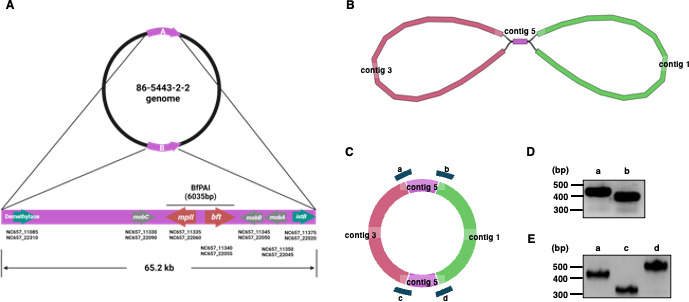 Fig 1
Fig 1- —National Research Foundation of Korea (NRF)
- —Seoul National University Bundang Hospital (SNUH)
- —Seoul National University (SNU)
- —Korea Health Industry Development Institute (KHIDI)
Peer Reviews
No public reviews on file for this paper yet. If you reviewed it on a platform where reviews are public (OpenReview, ICLR, NeurIPS, ICML), you can paste yours below so the community can read it here.
Videos
No videos yet. Explain this paper in a talk, walkthrough, or lecture? Add one.
Taxonomy
TopicsBacterial Identification and Susceptibility Testing · Microbial infections and disease research · Gut microbiota and health
ANNOUNCEMENT
The enterotoxigenic Bacteroides fragilis (ETBF) strain 86-5443-2-2, isolated from a piglet’s stool in 1996 by Dr. C. Sears’s group (1), is known for its high virulence due to substantial toxin production (2). Prior to this research, the genome of this strain remained at contig level (GenBank ID: LIDS00000000). Our study marks the complete genome sequencing of the ETBF strain 86-5443-2-2.
ETBF strain 86-5443-2-2, obtained as a gift from Dr. C. Sears (1), was stored at −80°C in 20% glycerol stock in our laboratory. For preparation sample, strain was incubated in 30 mL BHI medium (Difco, 237500) supplemented with 5 mg/mL yeast extract, 5 µg/mL hemin, 0.5 µg/mL vitamin K, 200 µg/mL gentamicin, and 0.5 mg/mL L-cysteine in an anaerobic chamber (Whitley DG250, 10% H_2_, 10% CO_2_, and 80% N_2_) at 37°C for 48 hours (3). Genomic DNA was isolated with QIAamp DNA Minikit (Qiagen) following the manufacturer’s protocol. For PacBio sequencing library preparation, 3 µg of DNA was used for 12 kb library preparation. For DNA with a size range of less than 17 kb, FemtoPulse (Agilent) was used to determine the actual size distribution. DNA was sheared with Megaruptor3 (Diagenode) and purified using AMPure PB magnetic beads (PacBio) if the apparent size exceeded 40 kb. A total of 10 µL library was prepared using PacBio SMRTbell Express Template Prep Kit 2.0 (PacBio, PN 100-938-900). For Illumina sequencing library preparation, the TruSeq Nano DNA Kit (Illumina, cat #FC-121-9010DOC) was used following the TruSeq Nano DNA Sample Preparation Guide (Part #15041110 Rev.D). Illumina sequencing was conducted using HiseqXten with a 150 bp read length. The same genomic DNA was used for both PacBio Sequel and Illumina platform sequencing (Table 1).
TABLE 1: Sequencing data and genomic features of ETBF strain 86-5443-2-2
Using default software parameters for genome assembly, we initially created a draft using long reads (NCBI SRR27792686) from PacBio Sequel with FLYE v.2.6 (4) (Fig. 1B). The draft wasn't circular, leading to our hypothesis of a single node between contig 1 and contig 3 (Fig. 1B). To verify this, we amplified the fragment using PCR primers (Fig. 1D and E) and then sequenced it to confirm the sequences between contigs (https://doi.org/10.6084/m9.figshare.28140293.v1). After PCR confirmation, we obtained the final genome draft (Fig. 1C). To enhance the sequence’s accuracy, a polishing process was undertaken, incorporating short reads (NCBI SRR27792687) from the Illumina platform using Polypolish v0.5.0 (5), with the final genome draft (Fig. 1C) serving as the template for these long-read sequences. The comprehensive genome is 5,369,373 base pairs long with 43.5% GC content. Annotation using the NCBI Prokaryotic Genome Annotation Pipeline (PGAP, version 6.4) (6, 7) revealed 4,465 genes and 4,310 proteins. The complete sequencing data is available in GenBank (CP098482).
The genome structure of ETBF strain 86-5443-2-2 with two B. fragilis pathogenicity island (BfPAI) fragments. (A) The two fragments are positioned opposite each other. We indicate some genes located in the fragment. The green arrows are the first and the last gene of the fragment except hypothetical protein. The gray arrows are the mobilization genes located on both sides of BfPAI. Red arrows are the toxin genes, bft and mpII, located on BfPAI. (B) Diagram of the draft for ETBF strain 86-5443-2-2 genome resulting from FLYE v2.6 program. There are three contigs, two contigs (contigs 1 and 3) and one node (contig 5). (C) Diagram of the potential genome structure with two fragments. Target regions of polymerase chain reaction (PCR) to verify the genome structure (A–D). (D–E) Agarose gel electrophoresis of PCR products was obtained using specific primers for the contig 5 from panel C (A–D). PCR was performed with an initial denaturation at 95°C for 2 minutes, followed by denaturation cycles at 95°C for 30 seconds, annealing cycles at 65°C for 1 minute, extension cycles at 72°C for 10 minutes, and a final extension at 72°C for 5 minutes during 25 cycles. The PCR reaction mixture composition included colony of ETBF strain 86-5443-2-2, 25 uL Pfu Master Mix (BioFACT, cat#PD301-50h), 2 uL forward primer (5 pmole/uL), 2 uL reverse primer (5 pmole/uL), and 21 uL DEPC water.
Notably, the ETBF strain 86-5443-2-2’s genome contains two identical 65.2 kb fragments (Fig. 1A), initially thought to be a single node (Fig. 1B). PCR confirmed both copies of contig 5, positioned in opposite directions (Fig. 1C through E) using a forward primer from contig 1 or 3 and a reverse primer from contig 5. These fragments house the B. fragilis pathogenicity island (BfPAI) (8), featuring toxin genes bft and mpII (Fig. 1A), possibly related to increased virulence in ETBF strain 86-5443-2-2 (9).
The reference list from the paper itself. Each links out to its DOI / PubMed record.
- 1Mundy LM, Sears CL. 1996. Detection of toxin production by Bacteroides fragilis: assay development and screening of extraintestinal clinical isolates. Clin Infect Dis 23:269–276. doi:10.1093/clinids/23.2.2698842262 · doi ↗ · pubmed ↗
- 2Pierce JV, Bernstein HD. 2016. Genomic diversity of enterotoxigenic strains of Bacteroides fragilis. P Lo S ONE 11:e 0158171. doi:10.1371/journal.pone.015817127348220 PMC 4922554 · doi ↗ · pubmed ↗
- 3Dejea CM, Fathi P, Craig JM, Boleij A, Taddese R, Geis AL, Wu X, De Stefano Shields CE, Hechenbleikner EM, Huso DL, Anders RA, Giardiello FM, Wick EC, Wang H, Wu S, Pardoll DM, Housseau F, Sears CL. 2018. Patients with familial adenomatous polyposis harbor colonic biofilms containing tumorigenic bacteria. Science 359:592–597. doi:10.1126/science.aah 364829420293 PMC 5881113 · doi ↗ · pubmed ↗
- 4Kolmogorov M, Yuan J, Lin Y, Pevzner PA. 2019. Assembly of long, error-prone reads using repeat graphs. Nat Biotechnol 37:540–546. doi:10.1038/s 41587-019-0072-830936562 · doi ↗ · pubmed ↗
- 5Wick RR, Holt KE. 2022. Polypolish: short-read polishing of long-read bacterial genome assemblies. P Lo S Comput Biol 18:e 1009802. doi:10.1371/journal.pcbi.100980235073327 PMC 8812927 · doi ↗ · pubmed ↗
- 6Li W, O’Neill KR, Haft DH, Di Cuccio M, Chetvernin V, Badretdin A, Coulouris G, Chitsaz F, Derbyshire MK, Durkin AS, Gonzales NR, Gwadz M, Lanczycki CJ, Song JS, Thanki N, Wang J, Yamashita RA, Yang M, Zheng C, Marchler-Bauer A, Thibaud-Nissen F. 2021. Ref Seq: expanding the Prokaryotic Genome Annotation Pipeline reach with protein family model curation. Nucleic Acids Res 49:D 1020–D 1028. doi:10.1093/nar/gkaa 110533270901 PMC 7779008 · doi ↗ · pubmed ↗
- 7Tatusova T, Di Cuccio M, Badretdin A, Chetvernin V, Nawrocki EP, Zaslavsky L, Lomsadze A, Pruitt KD, Borodovsky M, Ostell J. 2016. NCBI prokaryotic genome annotation pipeline. Nucleic Acids Res 44:6614–6624. doi:10.1093/nar/gkw 56927342282 PMC 5001611 · doi ↗ · pubmed ↗
- 8Moncrief JS, Duncan AJ, Wright RL, Barroso LA, Wilkins TD. 1998. Molecular characterization of the fragilysin pathogenicity islet of enterotoxigenic Bacteroides fragilis. Infect Immun 66:1735–1739. doi:10.1128/IAI.66.4.1735-1739.19989529104 PMC 108111 · doi ↗ · pubmed ↗