Description of the genome sequence of Corynebacterium species (Marseille-Q4381)
Manon Boxberger, Stéphanie Rivoire, Lorlane Le Targa, Valérie Cenizo, Bernard La Scola

TL;DR
This paper presents the genome sequence of a Corynebacterium strain isolated from healthy skin.
Contribution
The study provides a new genome sequence and annotation for a Corynebacterium species.
Findings
A Corynebacterium strain, Marseille-Q4381, was isolated from healthy skin in 2020.
The genome sequence and its annotation characteristics are described in detail.
Abstract
In 2020, we isolated a Corynebacterium strain, Marseille-Q4381, from healthy skin. We describe herein its genome sequence and annotation characteristics.
Genes, proteins, chemicals, diseases, species, mutations and cell lines named across the full text — each resolved to its canonical identifier and authoritative record.
Click any figure to enlarge with its caption.
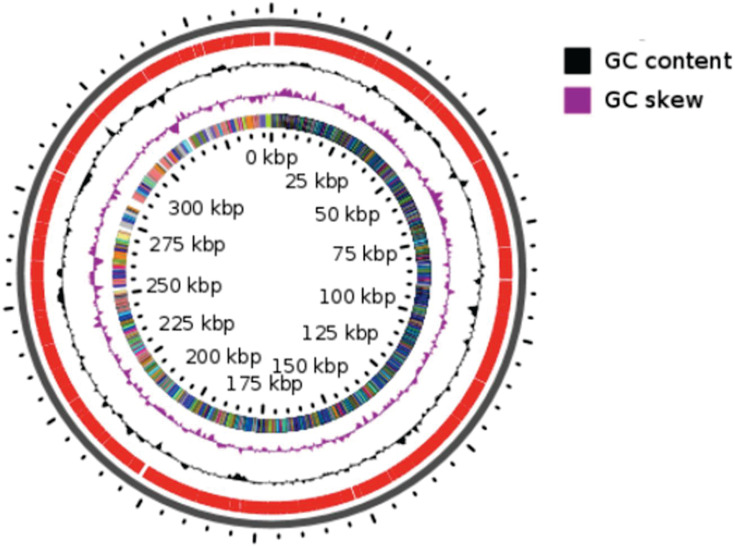 Fig 1
Fig 1| Species name | No. Base pairs | Percent G + C | No. proteins | dDDH (d4, in %) compared with | C.I. (d4, in %) | G + C content difference (in %) with | Bioproject accession reference |
|---|---|---|---|---|---|---|---|
| 2,326,687 | 64.85 | 2,171 | 20.7 | [18.5–23.1] | 0.38 |
| |
| 2,255,535 | 68.02 | 2,147 | 21.4 | [19.1–23.8] | 2.78 |
| |
|
|
|
|
|
|
|
|
|
| 2,568,936 | 61.32 | 2,419 | 20.7 | [18.5–23.1] | 3.92 |
| |
| 2,357,034 | 65.04 | 2,305 | 21.3 | [19.1–23.7] | 0.2 |
| |
| 2,521,298 | 65.65 | 2,235 | 20.9 | [18.7–23.3] | 0.41 |
| |
| 2,679,199 | 65.18 | 2,362 | 20.7 | [18.5–23.1] | 0.06 |
| |
| 2,578,128 | 65.28 | 2,331 | 21.2 | [18.9–23.6] | 0.04 |
| |
| 2,472,125 | 67.22 | 2,341 | 21.7 | [19.4–24.1] | 1.98 |
| |
| 2,180,241 | 65.49 | 2,028 | 20.5 | [18.3–22.9] | 0.25 |
| |
| 2,519,232 | 60.43 | 2,283 | 20.2 | [18.0–22.6] | 4.81 |
| |
| 2,310,902 | 68.65 | 2,173 | 20.5 | [18.3–22.9] | 3.42 |
| |
| 2,633,085 | 66.62 | 2,470 | 19.7 | [17.5–22.1] | 1.62 |
| |
| 2,551,022 | 66.86 | 2,376 | 19.8 | [17.6–22.2] | 1.38 |
| |
| 2,232,117 | 59.42 | 2,073 | 21.5 | [19.3–24.0] | 5.82 |
| |
| 2,328,188 | 65.01 | 1,922 | 21 | [18.8–23.4] | 0.23 |
|
- —Agence Nationale de la Recherche (ANR)
Peer Reviews
No public reviews on file for this paper yet. If you reviewed it on a platform where reviews are public (OpenReview, ICLR, NeurIPS, ICML), you can paste yours below so the community can read it here.
Videos
No videos yet. Explain this paper in a talk, walkthrough, or lecture? Add one.
Taxonomy
TopicsDiphtheria, Corynebacterium, and Tetanus · Bacterial Identification and Susceptibility Testing · Mycobacterium research and diagnosis
ANNOUNCEMENT
In 2020, a novel bacterial strain named Marseille-Q4381 was isolated from the forehead skin swab of a healthy 60-year-old woman. Despite efforts, matrix-assisted desorption ionization–time of flight mass spectrometry (MALDI-TOF MS) failed to identify the isolate. Subsequent analysis of the 16S rRNA and genome-to-genome comparison revealed that the taxon belonged to a bacterium within the family Corynebacteriaceae, in the phylum Actinobacteria.
Sampling adhered to the protocol approved by the ethics committee Sud-Est IV (ID-RCB: 2019-A01508-49). Routine subcultures were done on Columbia Agar with 5% sheep blood at 31°C. MALDI-TOF MS protein analysis was conducted using a Microflex spectrometer.
Genomic DNA (gDNA) extraction involved mechanical and chemical pretreatment with 0.5 mm Silica glass beads, acid washed, and a FastPrep-24 5G Grinder, followed by lysozyme incubation and extraction using the EZ1 biorobot with the EZ1 DNA tissues kit (Qiagen). Sequencing and barcoding were performed using MiSeq Technology with the Nextera XT DNA sample prep kit, and read length and paired-end reads were generated from MiSeq. The quality control was conducted using Trimmomatic software v0.36 (1), yielding 959,380 reads before sorting and 922,736 after sorting.
Genome assembly with Spades v 3.10 (2) produced 20 contigs with a coverage value of 26.4× and a N50 = 187,76 Kb, Annotation via the PGAP v6,4 pipeline (3) identified 2,112 protein-coding sequences (CDS), the genome contains 60 RNA genes, including 4 rRNAs (1 complete 5S, 1 complete 16S, and 1 complete 23S), with 3 partial 5S rRNAs, 51 tRNAs, and 3 ncRNAs. The circular map of the genome was generated using the CG View server online tool (4). The genome, spanning 2,197,730 base pairs, had a GC content of 65.24% (Fig. 1). All the software tools were used with their default parameters.
Circular genome map for Corynebacterium sp. strain Marseille-Q4381.
To confirm taxonomic position, the 16S rRNA sequence was blasted (BLASTN v2.13.0) against the nr database, and genome sequence data were uploaded to the Type (Strain) Genome Server (TYGS) (5) for taxonomic analysis. Closely related type strains were determined using the MASH algorithm and 16S rRNA gene sequences, with phylogenomic inference conducted through pairwise comparisons and digital DNA-DNA hybridization (dDDH) values calculated. Detailed comparison information is summarized in Table 1.
The reference list from the paper itself. Each links out to its DOI / PubMed record.
- 1Bolger AM, Lohse M, Usadel B. 2014. Trimmomatic: a flexible trimmer for Illumina sequence data. Bioinformatics 30:2114–2120. doi:10.1093/bioinformatics/btu 17024695404 PMC 4103590 · doi ↗ · pubmed ↗
- 2Bankevich A, Nurk S, Antipov D, Gurevich AA, Dvorkin M, Kulikov AS, Lesin VM, Nikolenko SI, Pham S, Prjibelski AD, Pyshkin AV, Sirotkin AV, Vyahhi N, Tesler G, Alekseyev MA, Pevzner PA. 2012. SP Ades: a new genome assembly algorithm and its applications to single-cell sequencing. J Comput Biol 19:455–477. doi:10.1089/cmb.2012.002122506599 PMC 3342519 · doi ↗ · pubmed ↗
- 3Tatusova T, Di Cuccio M, Badretdin A, Chetvernin V, Nawrocki EP, Zaslavsky L, Lomsadze A, Pruitt KD, Borodovsky M, Ostell J. 2016. NCBI prokaryotic genome annotation pipeline. Nucleic Acids Res 44:6614–6624. doi:10.1093/nar/gkw 56927342282 PMC 5001611 · doi ↗ · pubmed ↗
- 4Grant JR, Stothard P. 2008. The CG View Server: a comparative genomics tool for circular genomes. Nucleic Acids Res 36:W 181–W 184. doi:10.1093/nar/gkn 17918411202 PMC 2447734 · doi ↗ · pubmed ↗
- 5Meier-Kolthoff JP, Göker M. 2019. TYGS is an automated high-throughput platform for state-of-the-art genome-based taxonomy. Nat Commun 10:2182. doi:10.1038/s 41467-019-10210-331097708 PMC 6522516 · doi ↗ · pubmed ↗