Draft genome of Enterococcus faecium CV167, a bacteriocinogenic strain isolated from raw milk in Minas Gerais, Brazil
Yasmin Neves Vieira Sabino, Joice Fátima Moreira Silva, Bruna Vieira Alonso, Isabela Vieira Barbosa, Paula Aparecida Azevedo Almeida, Claudia Oliveira Pinto, Humberto Moreira Hungaro, Marcio Roberto Silva, Guilherme Nunes de Souza, Geraldo Marcio Costa, Heloisa Carneiro

TL;DR
This paper presents the draft genome of a bacteria strain from Brazilian raw milk that can fight pathogens.
Contribution
The study provides a high-completeness draft genome of a novel antimicrobial-producing Enterococcus faecium strain.
Findings
The genome is 99.3% complete with 2,736,418 base pairs.
It encodes 2,554 proteins and has a 37.93% GC content.
The strain shows antimicrobial activity against various pathogens.
Abstract
Here, we describe the draft genome sequence of Enterococcus faecium CV167, a strain isolated from raw milk in Brazil that exhibits antimicrobial activity against various pathogens. The draft genome has a completeness index of 99.3%, spans 2,736,418 base pairs, has a guanine–cytosine content of 37.93%, and encodes 2,554 proteins.
Genes, proteins, chemicals, diseases, species, mutations and cell lines named across the full text — each resolved to its canonical identifier and authoritative record.
Click any figure to enlarge with its caption.
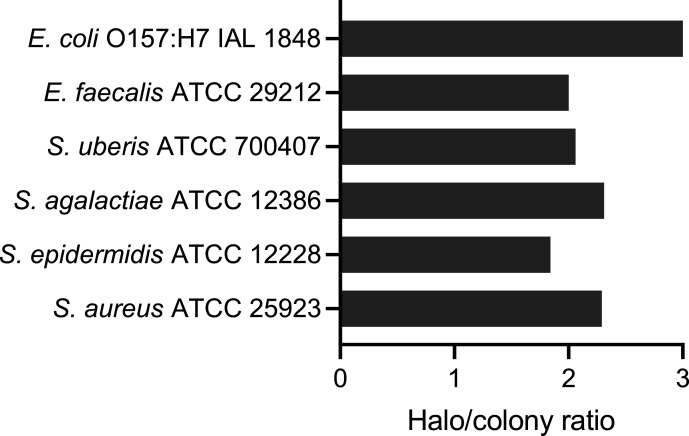 Fig 1
Fig 1| Genomic features | |
|---|---|
| Genome size | 2,736,418 bp |
| Number of contigs | 61 |
| GC content | 37.93% |
| N50 | 156,530 |
| Protein-coding genes | 2,544 |
| Bacteriocin-encoding cluster (antiSMASH) | 1 |
| Bacteriocin-encoding cluster (BAGEL4) | 3 |
Peer Reviews
No public reviews on file for this paper yet. If you reviewed it on a platform where reviews are public (OpenReview, ICLR, NeurIPS, ICML), you can paste yours below so the community can read it here.
Videos
No videos yet. Explain this paper in a talk, walkthrough, or lecture? Add one.
Taxonomy
TopicsGenomics and Phylogenetic Studies · Microbial infections and disease research · Milk Quality and Mastitis in Dairy Cows
ANNOUNCEMENT
Given the increasing selection of antibiotic-resistant strains in nature, the search for alternative antimicrobial strategies has become increasingly important. Enterococcus faecium CV167, the strain highlighted in this announcement, has demonstrated in vitro activity against a variety of pathogens, including Staphylococcus aureus, Staphylococcus epidermidis, Streptococcus agalactiae, Streptococcus uberis, Enterococcus faecalis, and Escherichia coli. The results of the inhibitory activity using the spot-on-lawn assay (1) are shown in Fig. 1. This bacterium was isolated from a raw milk sample stored in a bulk milk tank at a dairy farm in Coronel Xavier Chaves, Minas Gerais, Brazil in February 2022. For bacterial isolation, 1 mL aliquots of milk samples were serially diluted (10⁻¹ to 10⁻³) in phosphate-buffered solution (pH 6.2; Merck, Germany), and 100 µL was plated onto M17 agar (Sigma-Aldrich, USA). After incubation at 35°C for 48 h, isolated bacterial colonies were streaked onto fresh M17 agar for purification. The isolate designated CV167 was identified as a Gram-positive coccus with no catalase activity. The DNA of the bacteria was then extracted using the phenol–chloroform method (2). DNA quantity and quality were evaluated using NanoDrop 1000 UV/Vis (Thermo Scientific, Massachusetts, EUA), and the sequencing library was prepared with the Illumina DNA Prep Kit. The DNA was sequenced using 300 bp paired-end sequencing on the Illumina NextSeq 2000 platform, generating a sequence depth of 1,169×. FastQC 0.12.1 (3) was initially used to assess the quality of the sequencing data, which generated a total of 11,863,824 reads. These reads were trimmed using Trimmomatic 0.39 (4) with the following parameters: trailing: 10; leading: 10; sliding window: 4:20; and a minimum length of 50 bp. The trimming process resulted in the removal of only 1.37% of the reads. De novo assembly of the short reads into contigs was performed using SPAdes 3.15.4 (5), with the coverage parameter set to “auto” and k-mers of 21, 33, 55, 77, 99, and 127. Contigs shorter than 500 bp were excluded from the final assembly. The assembly quality was evaluated using QUAST 5.2.0 (6). A total of 61 contigs were generated, with a combined length of 2,736,418 bp, a guanine–cytosine (GC) content of 37.93%, and an N50 of 156,530. Genome completeness was assessed using BUSCO 5.5.0 (7), revealing 99.3% completeness for the Bacilli class. To confirm the taxonomic assignment, the assembled genome was analyzed using JSpeciesWS 4.2.1 (8) and Enterococcus faecium SRR24 as the reference genome (GenBank accession number GCA_009734005.2). The analysis revealed 99.45% nucleotide identity and a tetra score of 0.99745. Genome annotation performed using the NCBI Prokaryotic Genome Annotation Pipeline (9) identified 2,554 protein-coding sequences, 11 rRNAs, and 62 tRNAs. Further analysis using BAGEL4 (10) and antiSMASH v6 (11) to assess the potential synthesis of antimicrobial compounds uncovered several clusters encoding secondary metabolites, including enterocin variants. The main genomic features are summarized in Table 1. The draft genome sequence of Enterococcus faecium CV167 provides valuable insights into the molecular mechanisms underlying pathogen inhibition. This information is crucial for advancing genetic manipulation techniques and exploring potential industrial applications.
Antimicrobial activity of Enterococcus faecium CV167 against Gram-negative and Gram-positive bacteria. The inhibitory activity was evaluated using the spot-on-low technique and expressed as the halo/colony ratio.
The reference list from the paper itself. Each links out to its DOI / PubMed record.
- 1Tagg JR, Dajani AS, Wannamaker LW. 1976. Bacteriocins of gram-positive bacteria. Bacteriol Rev 40:722–756. doi:10.1128/br.40.3.722-756.1976791239 PMC 413978 · doi ↗ · pubmed ↗
- 2Oliveira SD, Santos LR, Schuch DMT, Silva AB, Salle CTP, Canal CW. 2002. Detection and identification of salmonellas from poultry-related samples by PCR. Vet Microbiol 87:25–35. doi:10.1016/s 0378-1135(02)00028-712079744 · doi ↗ · pubmed ↗
- 3Andrews S. 2010. Fast QC: a quality control tool for high throughput sequence data. Available from: https://github.com/s-andrews/Fast QC
- 4Bolger AM, Lohse M, Usadel B. 2014. Trimmomatic: a flexible trimmer for illumina sequence data. Bioinformatics 30:2114–2120. doi:10.1093/bioinformatics/btu 17024695404 PMC 4103590 · doi ↗ · pubmed ↗
- 5Bankevich A, Nurk S, Antipov D, Gurevich AA, Dvorkin M, Kulikov AS, Lesin VM, Nikolenko SI, Pham S, Prjibelski AD, Pyshkin AV, Sirotkin AV, Vyahhi N, Tesler G, Alekseyev MA, Pevzner PA. 2012. SP Ades: a new genome assembly algorithm and its applications to single-cell sequencing. J Comput Biol 19:455–477. doi:10.1089/cmb.2012.002122506599 PMC 3342519 · doi ↗ · pubmed ↗
- 6Gurevich A, Saveliev V, Vyahhi N, Tesler G. 2013. QUAST: quality assessment tool for genome assemblies. Bioinformatics 29:1072–1075. doi:10.1093/bioinformatics/btt 08623422339 PMC 3624806 · doi ↗ · pubmed ↗
- 7Simão FA, Waterhouse RM, Ioannidis P, Kriventseva EV, Zdobnov EM. 2015. BUSCO: assessing genome assembly and annotation completeness with single-copy orthologs. Bioinformatics 31:3210–3212. doi:10.1093/bioinformatics/btv 35126059717 · doi ↗ · pubmed ↗
- 8Richter M, Rosselló-Móra R, Oliver Glöckner F, Peplies J. 2016. J Species WS: a web server for prokaryotic species circumscription based on pairwise genome comparison. Bioinformatics 32:929–931. doi:10.1093/bioinformatics/btv 68126576653 PMC 5939971 · doi ↗ · pubmed ↗