Public Awareness of Dupuytren’s Contracture in Saudi Arabia
Yosra F Buhiliga, Hussam F Alkhars, Abdullah Alkhars, Abdullah AlAlwan, Ali F Alkhars

TL;DR
This study finds that awareness of Dupuytren’s Contracture is low in Saudi Arabia, with gaps in understanding risk factors and treatment options.
Contribution
The study provides the first assessment of public awareness of Dupuytren’s Contracture in Saudi Arabia and identifies key demographic factors associated with knowledge levels.
Findings
Only 32.4% of participants had heard of Dupuytren’s Contracture.
Fewer than 30% recognized diabetes or finger immobility as risk factors or symptoms.
Postgraduate education and Central Region residency were strongly associated with better awareness.
Abstract
Introduction Dupuytren’s contracture (DC) is a progressive and irreversible fibroproliferative disorder affecting the palmar fascia. Restricting hand mobility can significantly impact an individual’s quality of life. This study aims to assess public awareness of DC in Saudi Arabia and identify factors associated with awareness levels to inform prevention and management strategies. Materials and methods A cross-sectional study was conducted from January to October 2024 among Saudi nationals aged 18 years and older. Data were collected via a Google Forms (Google LLC, Mountain View, CA, USA) survey distributed on social media platforms. The questionnaire was validated using the Lawshe method, and knowledge of DC symptoms, risk factors, and treatment options was assessed. Statistical analyses were performed using SPSS Statistics version 26.0 (IBM Corp. Released 2019. IBM SPSS Statistics…
Genes, proteins, chemicals, diseases, species, mutations and cell lines named across the full text — each resolved to its canonical identifier and authoritative record.
Click any figure to enlarge with its caption.
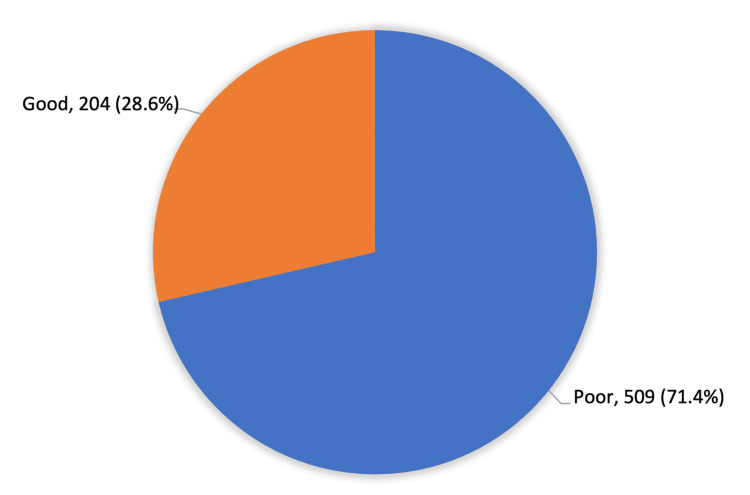 Figure 1
| Sociodemographic data | N | Percentage | |
| Residence region | Central region | 184 | 25.8% |
| Northern region | 113 | 15.8% | |
| Eastern region | 166 | 23.3% | |
| Western region | 172 | 24.1% | |
| Southern region | 78 | 10.9% | |
| Age in years | 18-25 | 97 | 13.6% |
| 26-35 | 178 | 25.0% | |
| 36-45 | 169 | 23.7% | |
| 46-55 | 175 | 24.5% | |
| >55 | 94 | 13.2% | |
| Gender | Male | 378 | 53.0% |
| Female | 335 | 47.0% | |
| Educational level | Not educated | 68 | 9.5% |
| General education | 68 | 9.5% | |
| Diploma | 126 | 17.7% | |
| University graduate | 154 | 21.6% | |
| Postgraduate degree | 297 | 41.7% | |
| Work status | Not working | 171 | 24.0% |
| Student | 164 | 23.0% | |
| Employee | 378 | 53.0% | |
| Monthly income | <5000 SR | 119 | 16.7% |
| 5000-10000 SR | 215 | 30.2% | |
| 10000-20000 SR | 246 | 34.5% | |
| >20000 SR | 133 | 18.7% | |
| Marital status | Single | 242 | 33.9% |
| Married | 352 | 49.4% | |
| Divorced/widowed | 119 | 16.7% | |
| Domain | Knowledge items | Answer | N | Percentage |
| Previous knowledge | Have you ever heard of DC? | Yes | 231 | 32.4% |
| No | 482 | 67.6% | ||
| Risk factors | Which of the following age groups increases the risk of developing DC? | 1-20 years | 112 | 15.7% |
| 21-30 years | 206 | 28.9% | ||
| 31-50 years | 233 | 32.7% | ||
| >50 years | 162 | 22.7% | ||
| Which of the following is the risk of developing DC increased? | Male | 360 | 50.5% | |
| Female | 353 | 49.5% | ||
| People with diabetes are more likely to develop DC. | Yes | 202 | 28.3% | |
| No | 218 | 30.6% | ||
| I don't know | 293 | 41.1% | ||
| The risk of developing DC increases if there is a family medical history. | Yes | 192 | 26.9% | |
| No | 243 | 34.1% | ||
| I don't know | 278 | 39.0% | ||
| People who use tobacco and alcohol are more likely to develop DC. | Yes | 219 | 30.7% | |
| No | 215 | 30.2% | ||
| I don't know | 279 | 39.1% | ||
| Symptoms | One of the symptoms of DC is a hard lump in the palm that strongly pulls the fingers toward it. | Yes | 196 | 27.5% |
| No | 191 | 26.8% | ||
| I don't know | 326 | 45.7% | ||
| One of the symptoms of DC is the inability to move the fingers and their sticking toward the palm. | Yes | 203 | 28.5% | |
| No | 192 | 26.9% | ||
| I don't know | 318 | 44.6% | ||
| DC usually affects the two fingers furthest from the thumb. | Yes | 164 | 23.0% | |
| No | 167 | 23.4% | ||
| I don't know | 382 | 53.6% | ||
| Management | DC can be treated with physical therapy and acupuncture. | Yes | 210 | 29.4% |
| No | 208 | 29.2% | ||
| I don't know | 295 | 41.4% | ||
| DC can be treated with cortisone and collagenase injections. | Yes | 175 | 24.5% | |
| No | 158 | 22.2% | ||
| I don't know | 380 | 53.3% | ||
| DC can be treated surgically. | Yes | 201 | 28.2% | |
| No | 162 | 22.7% | ||
| I don't know | 350 | 49.1% |
| Factors | Overall knowledge and awareness level | P-valuea | ||||
| Poor | Good | |||||
| N | % | N | % | |||
| Residence region | Central region | 107 | 58.2% | 77 | 41.8% | 0.00001* |
| Northern region | 97 | 85.8% | 16 | 14.2% | ||
| Eastern region | 129 | 77.7% | 37 | 22.3% | ||
| Western region | 123 | 71.5% | 49 | 28.5% | ||
| Southern region | 53 | 67.9% | 25 | 32.1% | ||
| Age in years | 18-25 | 75 | 77.3% | 22 | 22.7% | 0.000343* |
| 26-35 | 136 | 76.4% | 42 | 23.6% | ||
| 36-45 | 101 | 59.8% | 68 | 40.2% | ||
| 46-55 | 120 | 68.6% | 55 | 31.4% | ||
| >55 | 77 | 81.9% | 17 | 18.1% | ||
| Gender | Male | 259 | 68.5% | 119 | 31.5% | 0.072 |
| Female | 250 | 74.6% | 85 | 25.4% | ||
| Educational level | Not educated | 56 | 82.4% | 12 | 17.6% | 0.000646* |
| General education | 53 | 77.9% | 15 | 22.1% | ||
| Diploma | 103 | 81.7% | 23 | 18.3% | ||
| University graduate | 105 | 68.2% | 49 | 31.8% | ||
| Postgraduate degree | 192 | 64.6% | 105 | 35.4% | ||
| Work status | Not working | 134 | 78.4% | 37 | 21.6% | 0.00398* |
| Student | 125 | 76.2% | 39 | 23.8% | ||
| Employee | 250 | 66.1% | 128 | 33.9% | ||
| Monthly income | <5000 SR | 92 | 77.3% | 27 | 22.7% | 0.002741* |
| 5000-10000 SR | 151 | 70.2% | 64 | 29.8% | ||
| 10000-20000 SR | 187 | 76.0% | 59 | 24.0% | ||
| >20000 SR | 79 | 59.4% | 54 | 40.6% | ||
| Marital status | Single | 202 | 83.5% | 40 | 16.5% | 0.00001* |
| Married | 243 | 69.0% | 109 | 31.0% | ||
| Divorced/widowed | 64 | 53.8% | 55 | 46.2% | ||
| Have you ever heard of DC? | Yes | 48 | 20.8% | 183 | 79.2% | 0.00001* |
| No | 461 | 95.6% | 21 | 4.4% | ||
Peer Reviews
No public reviews on file for this paper yet. If you reviewed it on a platform where reviews are public (OpenReview, ICLR, NeurIPS, ICML), you can paste yours below so the community can read it here.
Videos
No videos yet. Explain this paper in a talk, walkthrough, or lecture? Add one.
Taxonomy
TopicsDupuytren's Contracture and Treatments · Nail Diseases and Treatments · Chemotherapy-related skin toxicity
Introduction
Dupuytren’s contracture (DC), also known as Dupuytren's disease, was first described in 1614 by Felix Platter, according to Peimer et al. [1]. It is classified as a fibroproliferative disorder characterized by developing collagen fibers in the palmar fascia [1-3]. DC is a slowly progressive and irreversible condition. Fibrotic changes typically begin in the palm and extend to the fingers, most commonly affecting the ring finger, followed by the little finger [4]. Although not painful, the disease causes progressive restriction of movement in the affected digits as it advances [4,5].
The exact cause of DC remains unclear. However, immune cells in affected areas suggest a possible link to the immune system [5]. Numerous studies have also identified significant associations with environmental and genetic factors [4,6]. Environmental risk factors include smoking, alcohol consumption, hand and finger injuries, and vigorous physical activities involving the hands [7,8]. Although not considered life-threatening, DC can significantly impact an individual’s quality of life, affecting daily activities such as washing, picking up, and holding objects [9,10].
Research exploring public awareness and understanding of this condition is limited. Gaining insight into community perceptions and knowledge of DC is essential for improving patient outcomes and public awareness. This study aims to address this gap by investigating the knowledge and understanding of DC among the Saudi Arabian population.
Materials and methods
Study design
We conducted a community-based cross-sectional study from January to October 2024 in all regions of Saudi Arabia.
Population and sample size
The study targeted the entire population of Saudi Arabia. Using an online Raosoft sample size calculator (http://www.raosoft.com/samplesize.html), the required sample size was calculated to be 385 with an interval of confidence at 95%, a rate of response at 50%, and a 5% margin of error.
Inclusion and exclusion criteria
The inclusion criteria encompassed Saudi Arabian inhabitants aged 18 years and older. The exclusion criteria included those not residing in Saudi Arabia.
Data collection
The study’s questionnaire was initially designed in English and subsequently translated into Arabic to facilitate participation and comprehension. The questionnaire’s validity was assessed using the Lawshe method. A panel of 12 experts in the field reviewed the questionnaire, and the content validity ratio (CVR) was calculated. Items with a CVR below 0.99 were removed. Reliability was evaluated through a pilot study involving 211 participants; data from the pilot study were excluded from the final analysis. Participant privacy was safeguarded throughout the study. Ethical approval was obtained from the Research Ethics Committee of King Faisal University (reference code: KFU-REC-2024-NOV-ETHICS2921).
We used a non-probability convenience sampling to invite participants who met the inclusion and exclusion criteria. The online questionnaire was distributed via all social media platforms as a Google Form (Google LLC, Mountain View, CA, USA). The distributed questionnaire was written in Arabic for better understanding and clarity for the Saudi participants and was divided into two subscales. The first subscale focused on the demographic data of the participants. The second subscale focused on the participant's general awareness and knowledge of DC, including previous knowledge, risk factors, symptoms, and management options.
Data was collected using a Google Forms survey distributed via social media platforms. For initial organization, responses were compiled in Microsoft Excel (Microsoft Corporation, Redmond, WA, USA).
Statistical analysis
Statistical analyses were performed using SPSS Statistics version 26.0. (IBM Corp. Released 2019. IBM SPSS Statistics for Windows, Version 26.0. Armonk, NY: IBM Corp.). Categorical variables were summarized as frequencies and percentages to describe sample characteristics. A knowledge score was created by awarding one point for each correct answer to knowledge-related questions. Participants were categorized into two groups: those with “poor” knowledge (scoring less than 60%) and those with “good” knowledge (scoring 60% or higher). The Chi-square test was used to test the associations between these categorical variables and the knowledge level (poor vs. good). A p-value of less than 0.05 was considered statistically significant.
Results
Sociodemographic characteristics
Table 1 presents the sociodemographic characteristics of the study participants (n=713). Participants were fairly distributed across regions, with the Central Region (184 participants, 25.8%) and the Western Region (172 participants, 24.1%) having the highest representation. The Southern Region had the smallest proportion (78 participants, 10.9%). Regarding age distribution, most participants were in the 26-35 years (178 participants, 25.0%) and 46-55 years (175 participants, 24.5%) age groups. More than half of the participants were men (378 participants, 53.0%), while 335 (47.0%) were women.
In terms of educational attainment, 297 participants (41.7%) held postgraduate degrees and 154 (21.6%) were university graduates. Employment status data revealed that 378 participants (53.0%) were employed, 171 (24.0%) were not working, and 164 (23.0%) were students. Monthly income distribution indicated that most participants fell within the middle-income category, with 246 participants (34.5%) earning 10,000-20,000 Saudi Riyals (SR) and 215 (30.2%) earning 5,000-10,000 SR. Additionally, 119 participants (16.7%) reported incomes of less than 5,000 SR, while 133 (18.7%) earned more than 20,000 SR. Regarding marital status, nearly half of the participants (352 participants, 49.4%) were married, while 242 (33.9%) were single, and 119 (16.7%) were divorced or widowed.
Public knowledge and awareness
Table 2 summarizes the public knowledge and awareness of DC among participants in Saudi Arabia (n=713). Overall, 231 participants (32.4%) reported prior awareness of DC. However, knowledge of specific risk factors was limited, with 202 participants (28.3%) recognizing diabetes as a risk factor and 219 (30.7%) linking tobacco and alcohol use to the condition. Additionally, 192 participants (26.9%) knew that a medical history could increase the risk of DC.
Awareness of symptoms was also low; only 196 participants (27.5%) correctly identified a hard lump in the palm pulling the fingers, and 203 participants (28.5%) recognized finger immobility as a characteristic feature. Furthermore, only 164 participants (23.0%) knew that DC most commonly affects the ring finger, followed by the little finger. Regarding treatment options, 201 participants (28.2%) identified surgery as a treatment, while 210 (29.4%) and 175 (24.5%) were aware of physical therapy and collagenase injections, respectively. Most participants (509 participants, 71.4%) demonstrated poor knowledge and awareness of DC, while only 204 participants (28.6%) exhibited good knowledge.
Overall public knowledge and awareness
Regarding the overall knowledge and awareness level (Figure 1), the vast majority of the participants (509, 71.4%) had an overall poor knowledge and awareness of DC, and only 204 (28.6%) had a good knowledge level.
Overall public knowledge and awareness of DC in Saudi Arabia (n=713)The data are represented as (N) and (%) for the overall score of both categories.DC: Dupuytren’s contracture
Factors associated with knowledge and awareness
Table 3 outlines factors associated with knowledge and awareness of DC. Participants from the Central Region demonstrated the highest proportion of good knowledge and awareness (77 participants, 41.8%). In comparison, those from the Eastern Region had the lowest (37 participants, 22.3%), with a statistically significant difference (p<0.001).
Table 3: Factors associated with participants' knowledge and awareness of DC in Saudi Arabia (N=713)a Pearson X2 test, * statistically significant (p<0.05)SR: Saudi Riyals, DC: Dupuytren’s contracture
Age was also significantly associated with knowledge levels (p<0.001), with participants aged 36-45 years showing the highest percentage of good knowledge (68 participants, 40.2%) and those aged above 55 years showing the lowest (17 participants, 18.1%). Men exhibited slightly higher awareness (119 participants, 31.5%) compared to women (85 participants, 25.4%), though this difference was not statistically significant (p=0.072).
Participants with postgraduate degrees demonstrated the highest knowledge levels (105 participants, 35.4%), with significant differences observed across educational levels (p<0.001). Employment status and monthly income significantly influenced knowledge levels (p<0.05 for each). Marital status was also significantly associated with knowledge and awareness (p<0.001). Notably, participants with previous knowledge of DC were more likely to exhibit good knowledge and awareness (183 participants, 79.2%) compared to those without previous knowledge (21 participants, 4.4%; p<0.05).
Discussion
This study assessed public knowledge and awareness of DC in Saudi Arabia and identified factors associated with awareness levels. The findings highlight a lack of public awareness and knowledge regarding DC among the Saudi Arabian population, with only 204 participants (28.6%) displaying good knowledge compared to 509 participants (71.4%) who had poor knowledge. According to a previous study by Benson et al. that explored DC in depth regarding risk factors [11], public knowledge of these risk factors was generally poor. Only 162 participants (22.7%) out of 713 recognized that individuals above 50 years of age are at higher risk of developing DC than younger individuals. On the other hand, a slightly higher percentage correctly identified that males (360 participants, 50.5%) were at higher risk than females. Additionally, significant risk factors such as previous family medical history, diabetes mellitus, tobacco use, and alcohol abuse were poorly recognized. Awareness regarding treatment options was also low. Only 210 participants (29.4%) identified physical therapy and acupuncture as treatment methods, while cortisone and collagenase injections were recognized by 175 participants (24.5%). Surgical intervention was acknowledged by 201 participants (28.2%). These findings suggest a poor awareness level, aligning with a previous study highlighting surgical and non-surgical treatments' effectiveness in managing DC [12].
Several factors in this study contributed to good awareness and knowledge of DC, including residency in the Central region, middle age, postgraduate education, employment, high monthly income, marital status, and prior knowledge of the disease. However, overall public awareness of DC remained poor, highlighting significant gaps in understanding. Although 32.4% of participants had heard of the condition, detailed knowledge was lacking. Awareness of risk factors, such as diabetes, family history, and tobacco or alcohol use, was particularly low. This lack of understanding may delay diagnosis and management, emphasizing the need for targeted educational campaigns to address these gaps. Awareness of DC symptoms was similarly limited, with fewer participants recognizing the characteristic hard lump in the palm that pulls the fingers inward. Knowledge of treatment options was also inadequate. At the same time, some participants correctly identified surgical management, but fewer were aware of less invasive treatments such as cortisone injections, collagenase injections, physical therapy, and acupuncture. These findings align with studies by Lanting et al. [13] and the Dupuytren Research Group [14], which reported lower awareness of DC in regions outside Europe and North America. Despite ongoing public health campaigns, gaps in public knowledge about DC persist, particularly in areas where the condition is less common [15].
This study provides valuable insights into public knowledge and awareness of DC in Saudi Arabia; however, several limitations should be considered. Using social media to distribute the questionnaire may have introduced selection bias, potentially excluding individuals without internet access and skewing the sample toward younger, tech-savvy participants. Additionally, the uneven regional representation limits the generalizability of the findings, as some areas were underrepresented. The reliance on self-reported data raises the possibility of recall and response bias, which may affect the accuracy of reported knowledge and awareness. Furthermore, the cross-sectional design restricts causal interpretations, meaning that associations identified between demographic factors and DC cannot confirm causation. Lastly, the study did not examine cultural or healthcare access factors that could influence awareness, nor did it assess the quality or sources of participants’ information.
Conclusions
This study assessed public knowledge and awareness of DC in Saudi Arabia and identified factors influencing awareness levels. The results revealed a significant gap in the population’s understanding of DC, with many individuals unaware of its risk factors, symptoms, and treatment options. Public education campaigns are urgently needed to raise awareness, particularly regarding the associations between DC and diabetes, family history, and lifestyle factors such as tobacco and alcohol use. Increased awareness of clinical symptoms and available surgical and non-surgical treatments could lead to earlier diagnosis and improved management of the condition. Further research on public awareness and knowledge of DC is recommended to explore the factors contributing to regional and population-level differences in awareness. Enhancing public education and awareness about DC is crucial for effective prevention, early detection, and optimal management of the condition.
The reference list from the paper itself. Each links out to its DOI / PubMed record.
- 1Dupuytren contracture recurrence following treatment with collagenase clostridium histolyticum (CORDLESS study): 3-year data J Hand Surg Am Peimer CA Blazar P Coleman S 12223820132320095110.1016/j.jhsa.2012.09.028 · doi ↗ · pubmed ↗
- 2Results of needle aponeurotomy for Dupuytren contracture in over 1,000 fingers J Hand Surg Am Pess GM Pess RM Pess RA 6516563720122246423210.1016/j.jhsa.2012.01.029 · doi ↗ · pubmed ↗
- 3Dupuytren contracture recurrence following treatment with collagenase costridium histolyticum (cordless [collagenase option for reduction of Dupuytren long-term evaluation of safety study]): 5-year data J Hand Surg Am Peimer CA Blazar P Coleman S Kaplan FT Smith T Lindau T 159716054020152609622110.1016/j.jhsa.2015.04.036 · doi ↗ · pubmed ↗
- 4Genetics of dupuytren's disease Joint Bone Spine Michou L Lermusiaux JL Teyssedou JP Bardin T Beaudreuil J Petit-Teixeira E 7127920122180363210.1016/j.jbspin.2011.05.027 · doi ↗ · pubmed ↗
- 5Scientific understanding and clinical management of Dupuytren disease Nat Rev Rheumatol Shih B Bayat A 715726620102106033510.1038/nrrheum.2010.180 · doi ↗ · pubmed ↗
- 6Surgical treatment of Dupuytren's disease - outcome and health economy in relation to smoking and diabetes BMC Musculoskelet Disord Eckerdal D Nivestam A Dahlin LB 1171520142469409510.1186/1471-2474-15-117PMC 3976502 · doi ↗ · pubmed ↗
- 7Dupuytren’s disease: predicting factors and associated conditions. A single center questionnaire-based case-control study Arch Bone Jt Surg Morelli I Fraschini G Banfi AE 38439352017 https://pmc.ncbi.nlm.nih.gov/articles/PMC 5736887/29299493 PMC 5736887 · pubmed ↗
- 8Heavy manual work, exposure to vibration and Dupuytren's disease? Results of a surveillance program for musculoskeletal disorders Occup Environ Med Descatha A Bodin J Ha C 2962996920122221384010.1136/oemed-2011-100319 PMC 3815440 · doi ↗ · pubmed ↗