The striking incidence of animal listeriosis in Germany (2014–2024) indicates a persistent but neglected risk for One Health
Gamal Wareth, Heinrich Neubauer

TL;DR
A study in Germany found that listeriosis, a serious zoonotic disease, affects many animal species and poses a significant public health risk.
Contribution
The study provides new insights into the nationwide incidence and host diversity of animal listeriosis in Germany over the past decade.
Findings
1,629 notifications of listeriosis in animals were reported in Germany from 2014–2024.
The disease affects a wide range of farm and wild animal species across the country.
The findings highlight the persistent and neglected risk of listeriosis for One Health.
Abstract
Listeriosis is a serious zoonotic disease caused by the genus Listeria, with Listeria monocytogenes being the most pathogenic species for humans and various animal species. This bacterium is commonly found in the environment and poses significant health risks. We analysed official surveillance data detailing animal listeriosis in Germany over the last decade to unravel its host diversity and spatiotemporal distribution. Altogether, 1.629 notifications involving 3.326 various animal species were reported. Listeriosis has a broad host range in farm animals and wildlife, with a consistently striking incidence reported nationwide. Addressing this issue is crucial for public health and the safety of our food supply.
Genes, proteins, chemicals, diseases, species, mutations and cell lines named across the full text — each resolved to its canonical identifier and authoritative record.
Click any figure to enlarge with its caption.
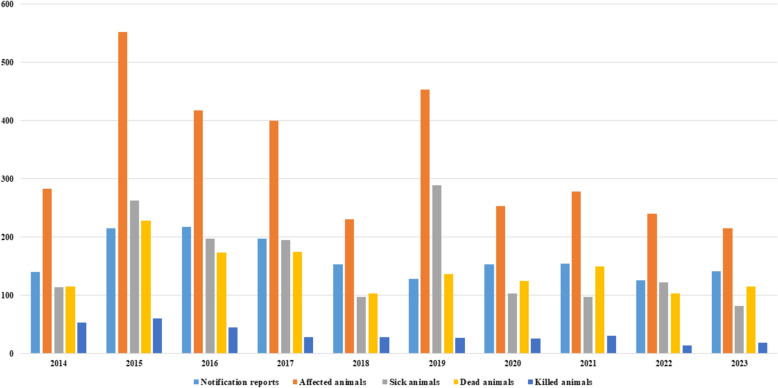 Figure 1
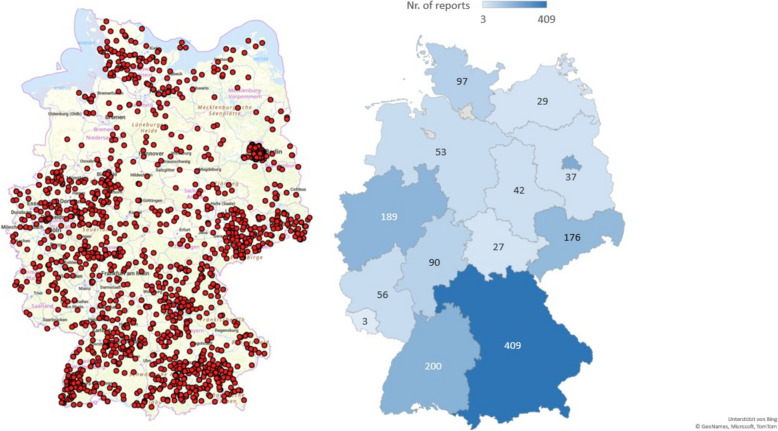 Figure 2
- —Friedrich-Loeffler-Institut, Bundesforschungsinstitut für Tiergesundheit (4246)
Peer Reviews
No public reviews on file for this paper yet. If you reviewed it on a platform where reviews are public (OpenReview, ICLR, NeurIPS, ICML), you can paste yours below so the community can read it here.
Videos
No videos yet. Explain this paper in a talk, walkthrough, or lecture? Add one.
Taxonomy
TopicsListeria monocytogenes in Food Safety · Salmonella and Campylobacter epidemiology · Food Safety and Hygiene
Introduction, methods, and results
The genus Listeria (L.) currently encompasses 31 species and 8 subspecies, according to the List of Prokaryotic Names with Standing in Nomenclature (LPSN, accessed on January 20, 2025). Among these pathogens, only L. monocytogenes and L. ivanoviii are considered pathogenic for humans and animals [1]. L. monocytogenes is a Gram-positive, non-spore-forming, anaerobic, intracellular and zoonotic pathogen. It is capable of growing at low temperatures and producing biofilms. Therefore, it could develop into a particular risk for the food production industry through its ability to multiply in ready-to-eat products. It is a ubiquitous environmental pathogen that causes foodborne outbreaks in humans worldwide [2, 3]. Listeriosis is associated with high morbidity and mortality, especially in immunocompromised individuals with severe clinical manifestations, including gastroenteritis, encephalitis, meningitis, and septicaemia. Thus, listeriosis has become a disease with significant public health and economic consequences [4, 5]. Listeriosis in animals typically results in septicaemia, abortion, or latent infection [6, 7], and in ruminants, encephalitis is the most prominent form [7].
In Germany, several large outbreaks of human listeriosis have been reported in the last two decades [8–11], and almost all of these outbreaks are associated with the consumption of animal products. Thus, it has been extensively investigated along the food chain, starting at the slaughterhouse. However, in animals, it has received less attention than other bacterial foodborne pathogens, such as Salmonella or Campylobacter. However, for sustainable disease management, this notorious pathogen needs to be studied in the farm environment. Outbreaks in animals are an obvious starting point for this research. To address this gap, we analysed mandatory notification data concerning cases and outbreaks of animal listeriosis in Germany over 10 years (2014–2023). The spatiotemporal distribution and affected hosts across German federal states are described. Incomplete data from 2024 were also considered.
According to Germany’s Infection Protection Act (IfSG), L. monocytogenes in humans must be reported only when it is directly detected in blood, cerebrospinal fluid, other normally sterile substances, or swabs taken from newborns. Additionally, L. monocytogenes and L. ivanovii are classified as animal pathogens; however, listeriosis caused exclusively by L. monocytogenes is considered a notifiable animal disease in Germany. This means that all the data presented in the notification reports exclusively pertain to cases caused by L. monocytogenes.
The mandatory reporting data concerning cases and outbreaks of animal listeriosis over the last decade (2014–2023) have been analysed. The data were retrieved from the Animal Disease News System (TierSeuchenNachrichten-System, TSN). In total, 1629 notification reports (NRs) for listeriosis were registered, affecting 3326 animals, i.e., 1560 animals were sick, 1425 were dead, 333 were killed, and only 8 animals were slaughtered (Table 1). The highest annual incidence of affected animals was observed in 2015 (n = 552), followed by 2019 (n = 453), 2016 (n = 418), and 2017 (n = 400), with the lowest annual incidence occurring in 2023 (n = 216). The highest number of notifications was registered in 2016 (n = 218), and the lowest was registered in 2022 (n = 126). The temporal distribution of animal listeriosis is shown in Table 1 and Figure 1. The infections were distributed nationwide (Figure 2). Out of 16 federal states, 14 were affected and reported listeriosis in animals, whereas no cases were identified from the city states Hamburg and Bremen with marginal animal husbandry. Bavaria had the highest incidence of cases with 409 NRs, followed by Berlin (n = 221 NRs) and Baden-Wuerttemberg (n = 200 NRs). Saarland presented the lowest incidence of listeriosis with 3 NRs, followed by Thuringia (n = 27 NRs) and Mecklenburg-Pomerania (n = 29 NRs) (Table 1, Figure 2).Table 1Spatiotemporal distribution of animal listeriosis in Germany (2014–2023), based on the annual number of notifications in each federal state.Year2014201520162017201820192020202120222023TotalNotification reports1412152181971531281541551261421.629Affected animals2835524184002314532542792402163.326Sick animals1142631981959728910397122821.560Dead animals1152281741751031371251501031151.425Killed animals53614528292726311419333Slaughtered animals1122118Geographical distribution according to federal states Year2014201520162017201820192020202120222023Total Baden-Wuerttemberg15223823141624201117200 Bavaria32606747443732412920409 Berlin810840211231302635221 Brandenburg4111722422237 Hessia817993118710890 Mecklenburg-Pomerania14645521129 Lower Saxony910956444253 North Rhine-Westphalia13252316141615281821189 Rhineland-Palatinate582993357556 Saarland––––––11–13 Saxony18233122171114131116176 Saxony-Anhalt6116343121542 Schleswig–Holstein2081491251534797 Thuringia26432323227 Total1412152181971531281541551261421.629Figure 1Time trend distribution of listeriosis in affected animals in Germany (2014–2023), based on the number of notifications per year.Figure 2Map of Germany showing the nationwide distribution of animal listeriosis in the last 10 years (2014–2023).
Listeriosis has been reported in almost all livestock but also in companion animals and wildlife. The highest number of cases was reported in cattle, followed by sheep and goats. Only 12 NRs were listed for pigs. Pet animal cases, i.e., dogs and cats, were reported in 25 and 8 NRs, respectively. Several wildlife species were mentioned, with foxes at the top with 179 NRs, followed by raccoons, fallow and roe deer, and rabbits. The names of the wild pigs are listed in the names of the 6 NRs. Poultry (chickens and pigeons) are also affected. Waterfowl (duck, 2016 and geese, 2023) have also been reported (Table 2).
Until the end of August 2024, 142 NRs encompassing 184 animals were received, equal to the number of notifications registered in 2023. Most of the cases were reported in sheep, cattle, foxes, and goats in sequence order. No cases have been reported in Brandenburg, but 32 NRs were registered for Berlin, 29 NRs for Bavaria, and 21 NRs for Baden-Wuerttemberg.
Discussion
Numerous outbreaks of listeriosis have been reported in the human population globally [12–15], and human cases and outbreaks are frequently reported in Germany [8, 10, 11, 16–18]. Ingestion of contaminated food of animal origin is the main source of human infection. Listeriosis, or “circling disease”, is an acute disease that can arise in herds of small ruminants, particularly in winter when grass silage is fed. The disease is associated with significant economic losses due to abortion, loss of animals, and treatments. L. monocytogenes has a broad host range among animals nationwide in Germany, with more than 3300 affected animals in 10 years. Despite this fact, minimal attention has been given to outbreaks in animals, and little information is available on L. monocytogenes in animal environments [19–22]. The need for studies on the epidemiological situation in the veterinary sector is prominent. On the other hand, L. ivanovii poses a significant threat, as it can lead to severe infections and share virulence factors and pathogenic mechanisms with L. monocytogenes, underscoring the need for heightened awareness. This bacterium is also prevalent in nature and is found in the soil, water, plants, and faeces of various animals and birds. It can easily contaminate food products, including cheese, meat, fish, vegetables, and fruits, putting public health at risk. The genetic diversity of L. ivanovii and the variability in its virulence traits increase its pathogenic potential [23, 24]. Consequently, it is critical that we devote more resources to researching its epidemiology, distribution, detection, and virulence. Regular monitoring of its occurrence in animal farms, food, and the environment is essential, along with a deeper understanding of its molecular mechanisms of infection and adaptation to hosts. Moreover, emphasizing its inclusion in notification reports is vital to ensure swift public health responses.Table 2Temporal distribution of listeriosis in different animal species in Germany over a period of 10 years (2014–2023).Animal species2014201520162017201820192020202120222023TotalCattle61867661633942393031528Sheep35516743384331393039416Goats13252617201720122017187Chickens11211484410114390Dogs––3123173525Pigs/wild pigs1–/321/11–/11/122218Equines––361152––18Rabbits–21112332–15Cats––––1––2418Alpaca––––––21––3Time trend distribution of listeriosis in different wildlife species Fox613154114625192020179 Racoon2–177481071662 Fallow deer5124313221 Roe deer132––2222216 Hare–2––12331–12
Dairy ruminants shed Listeria spp. in their faeces and may carry L. ivanovii in udders and L. monocytogenes in tonsils [1]. Shedding of the pathogen in faeces and subsequent colonization of tonsils and udders may explain the ubiquitous presence of Listeria in milk and a large variety of foods, as well as in soil, water, vegetation, animal feed, silage and sewage [20, 25]. L. monocytogenes was isolated from pig tonsil samples collected in abattoirs in Northwest and East Germany, highlighting the potential risk of contaminating pork meat [25]. The widespread of L. monocytogenes in livestock, companion animals, and wildlife [19–22] emphasizes the possible easy introduction of this notorious pathogen into the food chain and the potential risk of infection in humans. The susceptibility profiles of 259 L. monocytogenes strains collected over 40 years in Germany from patients, foods, and food-processing environments demonstrated that 38% were resistant to the last resort drug tigecycline and 56% (n = 145) were multidrug resistant (MDR) [26]. The drivers of resistance development are unknown and may include livestock, the food chain, humans, or the associated environment.
The impact of listeriosis on animal health and welfare still needs to be determined. Thus, systematic serogrouping, susceptibility testing, and whole-genome sequence typing of Listeria isolates from animals and their environments is necessary to help understand the epidemiological situation, detect drivers of resistance development, and ultimately protect humans. Eliminating sources of contamination will have the greatest effect on reducing the overall burden of listeriosis in Germany.