Prevalence of Potent Artificial Sweetener Neotame in Popular US-Marketed Disposable Electronic Cigarettes
Hanno C. Erythropel, Sairam V. Jabba, Remi A. Mellinghoff, Victor Garcia-Gallet, Peter Silinski, Julie B. Zimmerman, Sven E. Jordt

TL;DR
Neotame, a potent artificial sweetener, was found in all tested popular US disposable e-cigarettes, raising concerns about its health effects and appeal to youth.
Contribution
This study is the first to report the widespread presence of neotame in popular US-market disposable e-cigarettes.
Findings
Neotame was detected in all 57 tested disposable e-cigarette devices, including zero-nicotine and nicotine analogue products.
Neotame was absent in FDA-approved and Juul products, but present in some 2021-marketed devices.
The synthetic coolant WS-23 was found in most products, while menthol and WS-3 were less common.
Abstract
Sweeteners are used by tobacco product manufacturers to improve product palatability and appeal. Recently, the high-intensity artificial sweetener, neotame, was detected in nicotine analogue-containing and “zero nicotine” electronic cigarettes (e-cigarettes). The prevalence of neotame in popular US-marketed disposable e-cigarettes remains unknown. Popular disposable e-cigarette devices were chosen based on 2024 US market surveys and analyzed for neotame using Liquid Chromatography – Mass Spectrometry (LCMS). Nicotine, 6-methyl nicotine and cooling compounds were also quantified. Contents of FDA-approved e-cigarettes, nicotine analogue-containing, “zero-nicotine” disposables and a candy product were compared. Neotame was detected in all 57 tested popular disposable e-cigarette devices, zero-nicotine, and nicotine analogue products, but not in 13 FDA-approved nor Juul products. 2…
Genes, proteins, chemicals, diseases, species, mutations and cell lines named across the full text — each resolved to its canonical identifier and authoritative record.
Click any figure to enlarge with its caption.
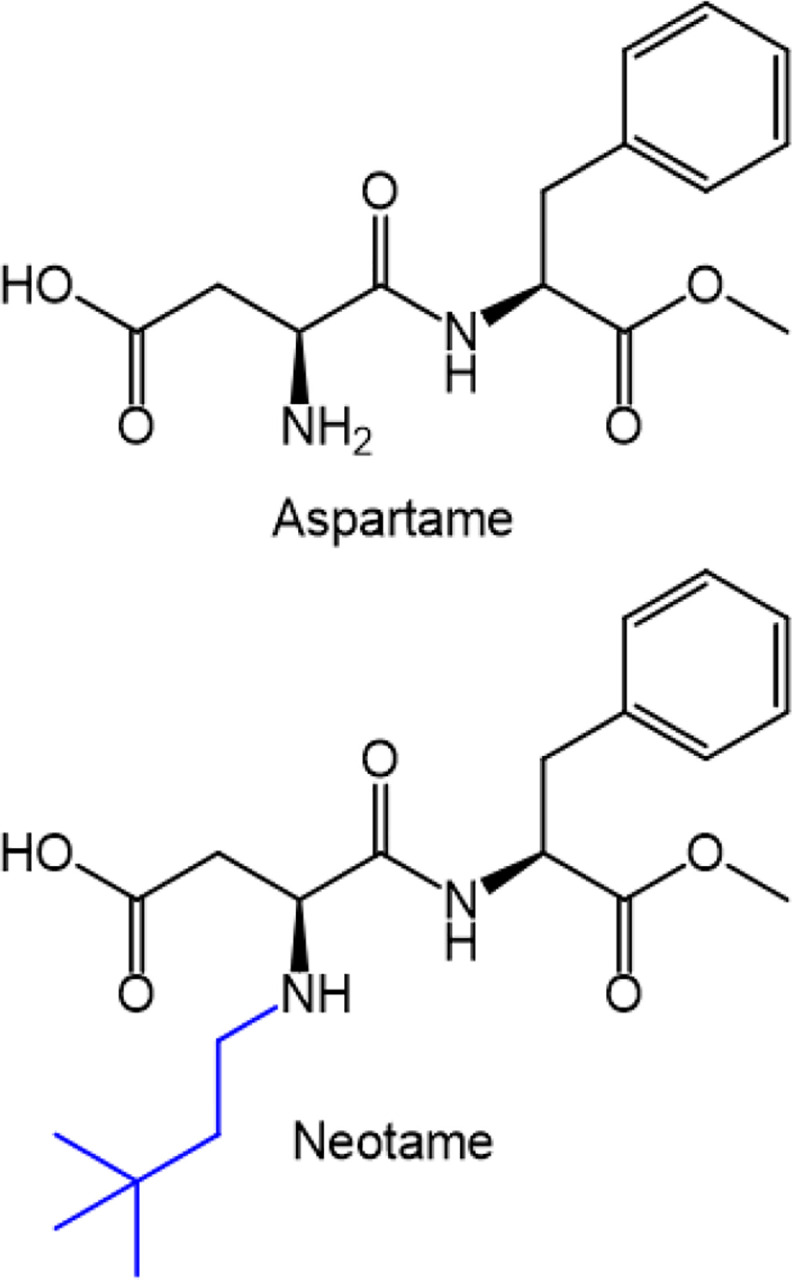 Figure 1
Peer Reviews
No public reviews on file for this paper yet. If you reviewed it on a platform where reviews are public (OpenReview, ICLR, NeurIPS, ICML), you can paste yours below so the community can read it here.
Videos
No videos yet. Explain this paper in a talk, walkthrough, or lecture? Add one.
Taxonomy
TopicsBiochemical Analysis and Sensing Techniques
Introduction
Sweeteners are used by tobacco product manufacturers to improve product palatability and appeal.^1^ We recently detected the high-intensity artificial sweetener, neotame, in electronic cigarettes (e-cigarettes) containing the nicotine analogue 6-methylnicotine.^2^ Neotame, an FDA-approved sweetener, is 7,000–13,000x sweeter than table sugar and differs from the better-known aspartame (200x) in one molecular feature (Figure). Besides a recent report on one “zero-nicotine“ brand,^3^ the prevalence of neotame addition to e-cigarette products is unknown. The aim of this study was to analyze current popular US-marketed disposable e-cigarettes, FDA-approved-, and nicotine-free products for this potent sweetener. Ancillary analysis included nicotine and nicotine analogues, menthol and synthetic cooling agents.
Methods
Eleven popular disposable e-cigarette brands (27 devices) were chosen based on the 2024 National Youth Tobacco Survey and Empty Packs Survey USA-NY.^4,5^ Additionally, all currently US FDA-approved cartridge-based e-cigarettes (11), Juul (2), two nicotine analogue-containing products (20), and four “zero-nicotine” products (8) were tested (Table). In total, 68 products and one reference product (mint-candy) were purchased online in 2024 (Supplement-1). Further, two brands purchased in 2021 (4) were tested. Neotame was quantified both at Yale and Duke University laboratories using established methods.^2^ Briefly, an e-liquid aliquot was diluted using methanol or water and neotame content was quantified by liquid chromatography-mass spectroscopy. Samples tested at Yale were also analyzed by gas chromatography-flame ionization to quantify nicotine, 6-methylnicotine, menthol, and the synthetic coolants WS-3 and WS-23 using established methods.^2^
Results
Neotame was detected in 57/72 tested vaping products, with an average neotame content ~ 4.6x higher than in a mint candy (1.75 vs. 0.38μg/mg). Neotame was detected in all products categorized as popular disposable, zero-nicotine, or nicotine analogue, while no FDA-approved cartridge nor Juul contained neotame. 2/4 samples from 2021 contained neotame (1/2 brands). Devices containing the nicotine analogue 6-methylnicotine contained the highest average neotame content albeit with large standard deviation (2.69 ± 3.91μg/mg). WS-23 was detected in the large majority of tested products (50/63), while menthol (28/63) and WS-3 (8/63) were less prevalent. No nicotine was detected in “zero-Nicotine” or nicotine analogue products.
Discussion
This study demonstrates that the artificial sweetener neotame has become a ubiquitous constituent of popular disposable e-cigarettes sold in the US in 2024, including those containing no nicotine or nicotine analogues. Some vaping products contained neotame as early as 2021. However, FDA-approved devices (Vuse, NJOY) or awaiting approval (Juul), all introduced pre-2021, do not.
Sweetened tobacco products, and especially those with fruit and candy flavors are highly popular among youth and young adults.^5^ An experimental clinical study demonstrated that addition of the sweetener sucralose increased appeal, preference, and abuse potential of e-cigarettes.^6^ The presence of neotame, the most potent FDA-approved sweetener, may thus likely also increase the appeal and sensory attributes of flavored e-cigarettes in youth and young adults, an effect potentially synergistic with the presence of the synthetic coolant WS-23. The prevalence of neotame in almost all US-marketed, popular disposable e-cigarettes also raises toxicity concerns: While neotame was probably chosen for its heat stability relative to other sweeteners, It remains unclear to what extent it decomposes when heated and vaporized in e-cigarettes, and what the respiratory and systemic health effects of neotame and its decomposition products are. Study limitations include testing only a limited number of brands and flavors, although products were chosen based on popularity.
Current federal and state regulations do not limit the sweetener content of tobacco products, including e-cigarettes, enabling manufacturers to improve product appeal by increasing their sweetness. More information on neotame’s contribution to disposable cigarette appeal, abuse liability, and toxicity is needed to determine whether regulatory intervention is necessary.
The reference list from the paper itself. Each links out to its DOI / PubMed record.
- 1Rezk-Hanna M, Talhout R, Jordt SE. Sugars and Sweeteners in Tobacco and Nicotine Products: Food and Drug Administration’s Regulatory Implications. Nicotine Tob Res. Mar 22 2023;25(4):838–840. doi: 10.1093/ntr/ntac 22236148496 PMC 10032193 · doi ↗ · pubmed ↗
- 2Erythropel HC, Jabba SV, Silinski P, Variability in Constituents of E-Cigarette Products Containing Nicotine Analogues. Jama. Sep 3 2024;332(9):753–755. doi: 10.1001/jama.2024.1240839110443 PMC 11307159 · doi ↗ · pubmed ↗
- 3Robichaud MO, Talbot EM, Ganz O, Marketing for Sensa: a ‘zero nicotine vapor product’ from a major tobacco company. Tobacco Control. 2025;doi: 10.1136/tc-2024-059074 PMC 1235401039956632 · doi ↗ · pubmed ↗
- 4W.S.P.M. Group. Empty Packs Survey USA-NY Q 1 2024. Accessed Feb. 5, 2025, https://perma.cc/Y 2AK-FMTV
- 5U.S. Food and Drug Adminisitration. Results from the Annual National Youth Tobacco Survey. Accessed Feb. 5, 2025, https://perma.cc/XT 7R-NKPH
- 6Maloney SF, Hoetger C, Bono RS, Assessment of human abuse potential of an unflavored, sucralose-sweetened electronic cigarette in combustible cigarette smokers. Exp Clin Psychopharmacol Oct 2024;32(5):588–603. doi: 10.1037/pha 000072038815111 PMC 11870153 · doi ↗ · pubmed ↗