Interaction of the endogenous antibody response with activating FcγRs enhance control of Mayaro virus through monocytes
Megan M. Dunagan, Nathânia Dábilla, Colton McNinch, Jason M. Brenchley, Patrick T. Dolan, Julie M. Fox

TL;DR
This study shows that antibody interactions with activating FcγRs help control Mayaro virus infection by preventing monocytes from prolonging the disease.
Contribution
The study reveals that FcγR engagement during natural alphavirus infection is crucial for protection and prevents monocytes from supporting viral persistence.
Findings
Mice lacking activating FcγRs showed prolonged disease and higher virus levels in joint tissues.
Monocytes from FcγR-deficient mice harbored more virus RNA and contributed to increased viral burden when transferred to wild-type mice.
Antibody Fc effector functions, not neutralizing antibodies, were critical for viral clearance.
Abstract
Mayaro virus (MAYV) is an emerging arbovirus. Previous studies have shown antibody Fc effector functions are critical for optimal monoclonal antibody-mediated protection against alphaviruses; however, the requirement of Fc gamma receptors (FcγRs) for protection during natural infection has not been evaluated. Here, we showed mice lacking activating FcγRs (FcRγ−/−) developed prolonged clinical disease with increased MAYV in joint-associated tissues. Viral reduction was associated with anti-MAYV cell surface binding antibodies rather than neutralizing antibodies. Lack of Fc-FcγR engagement increased the number of monocytes present in the joint-associated tissue through chronic timepoints. Single-cell RNA sequencing showed elevated levels of pro-inflammatory monocytes in joint-associated tissue with increased MAYV RNA present in FcRγ−/− monocytes and macrophages. Transfer of FcRγ−/−…
Genes, proteins, chemicals, diseases, species, mutations and cell lines named across the full text — each resolved to its canonical identifier and authoritative record.
Click any figure to enlarge with its caption.
 Figure 1
 Figure 2
 Figure 3
 Figure 4
 Figure 5
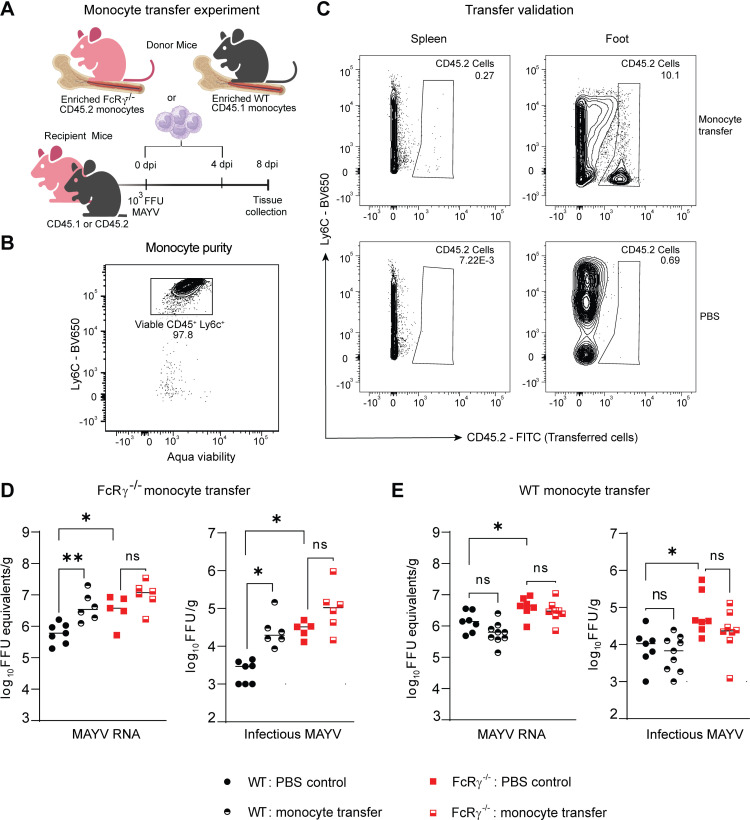 Figure 6
Peer Reviews
No public reviews on file for this paper yet. If you reviewed it on a platform where reviews are public (OpenReview, ICLR, NeurIPS, ICML), you can paste yours below so the community can read it here.
Videos
No videos yet. Explain this paper in a talk, walkthrough, or lecture? Add one.
Taxonomy
TopicsViral Infections and Vectors · Mosquito-borne diseases and control · Viral Infections and Outbreaks Research