Unveiling the silent threat: Investigating asymptomatic plasmodium infections in Gorgora, Ethiopia through microscopy and loop-mediated isothermal amplification
Tena Cherkos, Adane Derso, Banchamlak Tegegne, Abebe Birhanu, Kassahun Cherkos, Zufan Yiheyis Abreham, Banchayehu Getnet, Tsedenya Gebeyehu, Mulat Yimer, Tegegne Eshetu, Wossenseged Lemma, Aberham Abere, Yalewayker Tegegne, Dylan R. Pillai, Enoch Aninagyei, Enoch Aninagyei

TL;DR
The study found that many people in Gorgora, Ethiopia have hidden malaria infections that standard tests miss, highlighting the need for better detection methods.
Contribution
The study evaluates the effectiveness of LAMP as a more sensitive method for detecting asymptomatic Plasmodium infections compared to microscopy.
Findings
LAMP detected 11.3% asymptomatic Plasmodium infections compared to 6.1% by microscopy.
Microscopy missed six infections detected by LAMP, showing lower sensitivity.
The agreement between LAMP and microscopy was moderate (k = 0.67).
Abstract
The asymptomatic carriers of the Plasmodium parasite represent a large hidden reservoir of Plasmodium species. These individuals can carry microscopically detectable levels and sub-microscopic levels of Plasmodium parasitemia. As a result, the use of clinical diagnostic methods, such as Rapid Diagnosis Tests (RDTs) and Giemsa microscopy leads to underestimation of the burden of asymptomatic malaria. Thus, the use of highly sensitive molecular methods such as loop-mediated isothermal amplification techniques (LAMP) helps to overcome these limitations and is crucial to reporting the true burden of the disease. This study aimed to determine the prevalence of Asymptomatic Plasmodium infections (APIs), and evaluate light microscopy for the detection of APIs using the LAMP method as a reference in Gorgora, Western Dembia district, Northwest Ethiopia. A community-based cross-sectional survey…
Genes, proteins, chemicals, diseases, species, mutations and cell lines named across the full text — each resolved to its canonical identifier and authoritative record.
Click any figure to enlarge with its caption.
 Figure 1
 Figure 2
 Figure 3
 Figure 4
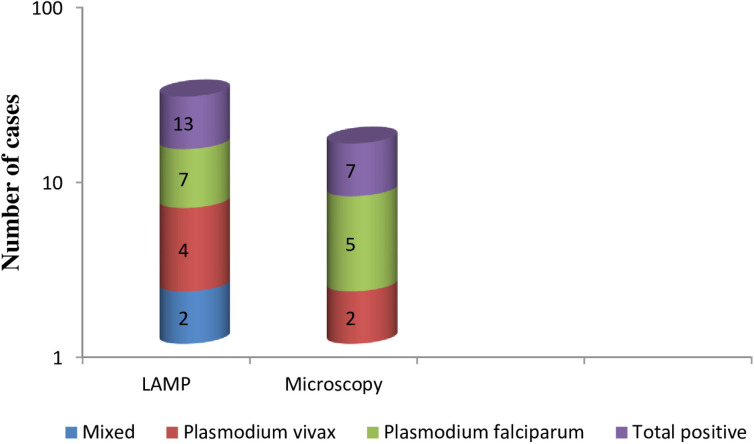 Figure 5
 Figure 6
 Figure 7
Peer Reviews
No public reviews on file for this paper yet. If you reviewed it on a platform where reviews are public (OpenReview, ICLR, NeurIPS, ICML), you can paste yours below so the community can read it here.
Videos
No videos yet. Explain this paper in a talk, walkthrough, or lecture? Add one.
Taxonomy
TopicsMalaria Research and Control · Mosquito-borne diseases and control · Digital Imaging for Blood Diseases