Eosinopenia as a predictor of clinical outcomes in hospitalized patients with community-acquired pneumonia: A retrospective cohort study
Wigdan Farah, Zhen Wang, Ognjen Gajic, Yewande E. Odeyemi, Nosheen Nasir, Nosheen Nasir, Chinh Quoc Luong, Chinh Luong

TL;DR
The study found that low blood eosinophil levels in pneumonia patients did not reliably predict worse outcomes after adjusting for disease severity.
Contribution
This study challenges prior assumptions by showing that eosinopenia may not be a strong predictor of mortality in CAP patients.
Findings
Eosinopenic patients had higher inflammatory markers but similar mortality rates after adjusting for disease severity.
No significant association was found between eosinopenia and ICU admission or ventilatory support in CAP patients.
The results suggest CAP prognosis is complex and not reliably predicted by eosinopenia alone.
Abstract
Eosinopenia has been reported as a predictor of unfavorable outcomes and a marker of severity in bacterial infections. We describe the association between eosinopenia and clinical outcomes in hospitalized patients with CAP. We conducted a retrospective study of hospitalized adult patients with community-acquired pneumonia at a large US academic medical center from January 2009 to December 2019. We collected data on patient demographics, disease severity, comorbidities, smoking history, inflammatory markers, blood eosinophil levels, mortality, length of hospital stay, and need for intensive care unit (ICU) or mechanical ventilation. According to blood eosinophil count, patients were grouped as eosinopenic (<50/μL) and non-eosinopenic (≥50/μL) based on prior studies. Analysis was performed using nonparametric Wilcoxon rank-sum test for continuous variables and the chi-square test for…
Genes, proteins, chemicals, diseases, species, mutations and cell lines named across the full text — each resolved to its canonical identifier and authoritative record.
Click any figure to enlarge with its caption.
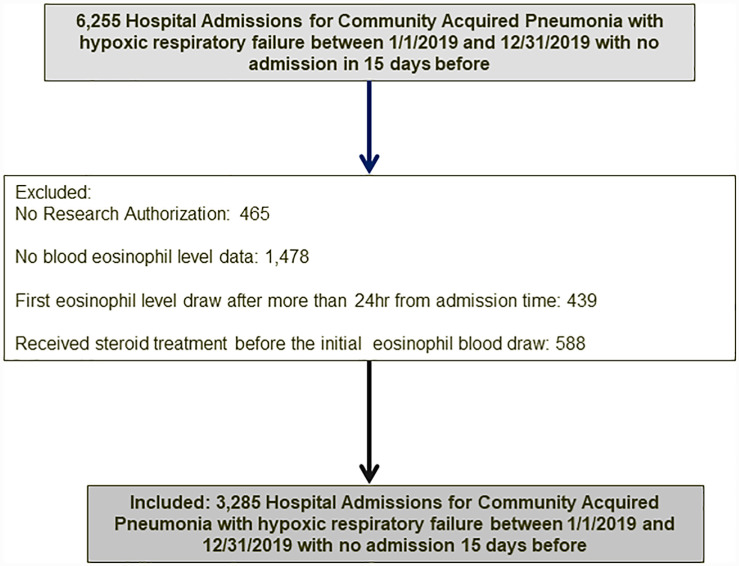 Figure 1
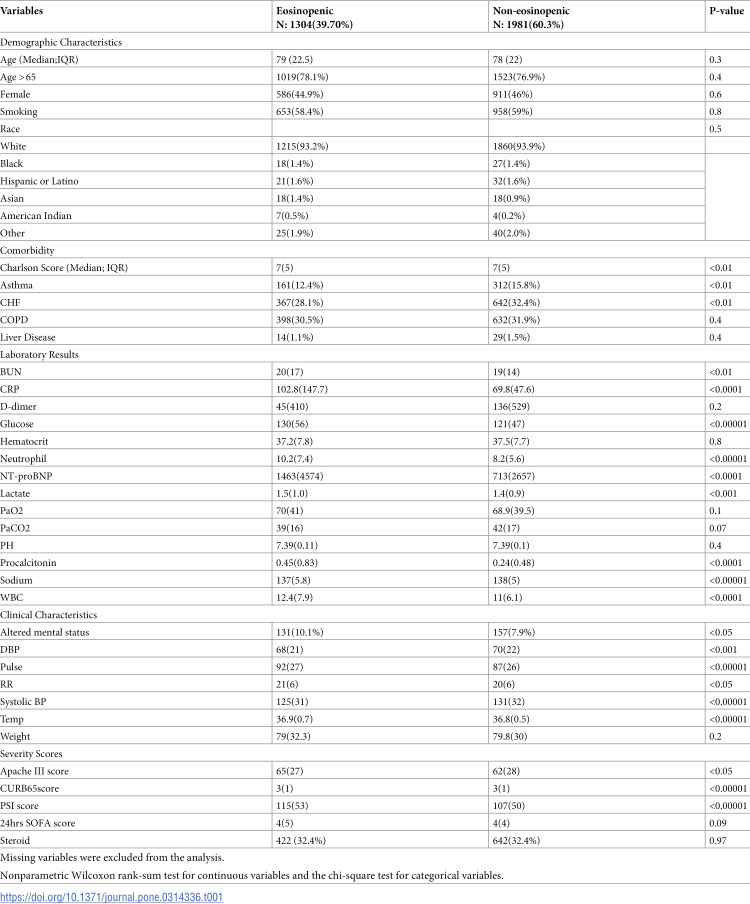 Figure 2
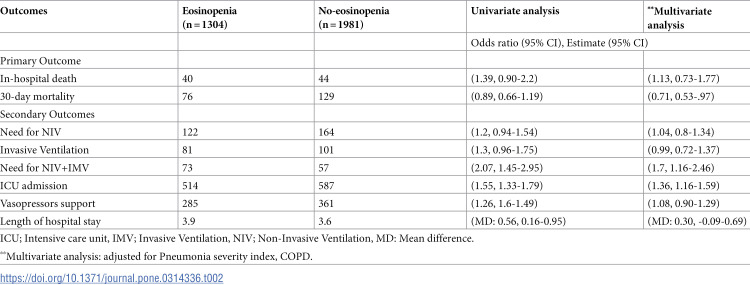 Figure 3
Peer Reviews
No public reviews on file for this paper yet. If you reviewed it on a platform where reviews are public (OpenReview, ICLR, NeurIPS, ICML), you can paste yours below so the community can read it here.
Videos
No videos yet. Explain this paper in a talk, walkthrough, or lecture? Add one.
Taxonomy
TopicsPneumonia and Respiratory Infections · Respiratory viral infections research · Pneumocystis jirovecii pneumonia detection and treatment