Psychosocial hazards and work-life balance: the role of workplace conflict, rivalry, and harassment in Latvia
Diāna Inga Paegle, Svetlana Lakiša, Linda Matisāne, Monta Matisāne, Linda Paegle, Kristīne Mārtinsone, Daiga Kamerāde, Valentīna Krūmiņa, Elīna Akmane, Amanda Ķule, Ivars Vanadziņš

TL;DR
This study in Latvia finds that workplace conflicts, harassment, and abuse significantly worsen work-life balance, especially among younger and lower-income employees.
Contribution
The study provides novel evidence on how specific psychosocial hazards like sexual harassment and workplace conflicts uniquely impact work-life balance in Latvia.
Findings
30.9% of Latvian employees reported work-life imbalance, with odds increasing for younger and lower-income individuals.
Sexual harassment and psychological abuse are strongly linked to work-life imbalance, with odds ratios of 4.90 and 3.47 respectively.
Workplace conflicts significantly increase the likelihood of poor work-life balance, suggesting leadership training could help.
Abstract
Even though the link between the psychosocial work environment and work-life balance (WLB) has been thoroughly researched, there is limited evidence evaluating the impact of workplace violence, sexual harassment, conflicts, and rivalry on WLB. A cross-sectional study was conducted among 2,471 respondents in Latvia from December 20, 2021, to July 14, 2022. WLB was measured through a survey question assessing the frequency of work-life imbalance, with responses categorized into dichotomous variables. The study evaluated the association between the selected workplace psychosocial hazards (conflicts, rivalry, psychological abuse, physical abuse, and sexual harassment), work characteristics, socio-demographic factors, and WLB by using binomial logistic regression. Our study reveals a significant lack of WLB among Latvian employees. A striking one-third of the respondents (30.9%, n = 762)…
Genes, proteins, chemicals, diseases, species, mutations and cell lines named across the full text — each resolved to its canonical identifier and authoritative record.
Click any figure to enlarge with its caption.
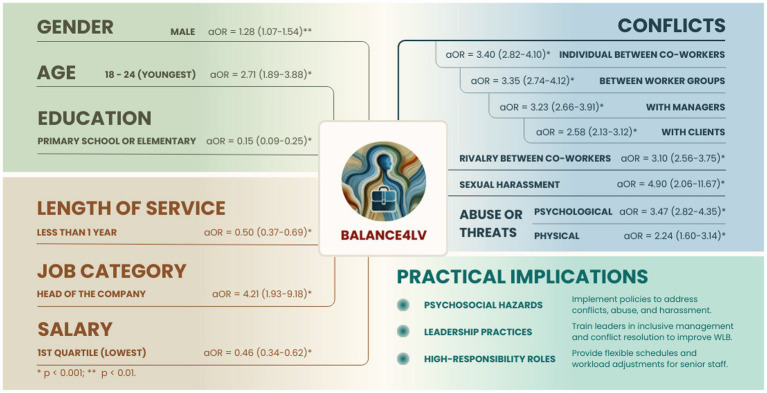 Figure 1
Peer Reviews
No public reviews on file for this paper yet. If you reviewed it on a platform where reviews are public (OpenReview, ICLR, NeurIPS, ICML), you can paste yours below so the community can read it here.
Videos
No videos yet. Explain this paper in a talk, walkthrough, or lecture? Add one.
Taxonomy
TopicsEmployment and Welfare Studies · Job Satisfaction and Organizational Behavior · Workplace Violence and Bullying