Care-Seeking Action after Helicobacter pylori Testing among a High-Risk Indigenous Population: A Cross-Sectional Study Follow-up
Heidi E. Brown, Krystelle Boyd, Melissa Howard, Denver Seaton, Rachelle L. Begay, Priscilla R. Sanderson, Robin B. Harris

TL;DR
This study explores why some people in a Native American community do or do not seek medical care after testing positive for a common stomach infection linked to cancer.
Contribution
The study identifies care-seeking behaviors and barriers in a high-risk Indigenous population following Helicobacter pylori testing.
Findings
Only 52.8% of participants followed up with a doctor after testing positive for H. pylori.
Lack of time and forgetting were the most common reasons for not seeking care.
Belief in the infection's link to symptoms increased the likelihood of seeking care.
Abstract
Helicobacter pylori is one of the most common infectious agents linked to any malignancy. Recent studies report higher H. pylori prevalence and gastric cancer incidence rates in the Navajo Nation than in general U.S. populations. Little is known about barriers to care and treatment. Participants of the 2022 Navajo Healthy Stomach Project who had a positive urea breath test for H. pylori were contacted after 6 months to assess health care services sought, treatment received, and barriers to accessing care. Descriptive statistics identified perceived barriers to care seeking and treatment. Of individuals consented to recontact, 83 were surveyed (69.8% response rate). Just over half (52.8%) reported following up with an allopathic clinician. The most common reasons for not seeking care were lack of time (37.5%) and forgetting (25.0%). Care seeking was more common among those who felt that…
Genes, proteins, chemicals, diseases, species, mutations and cell lines named across the full text — each resolved to its canonical identifier and authoritative record.
Click any figure to enlarge with its caption.
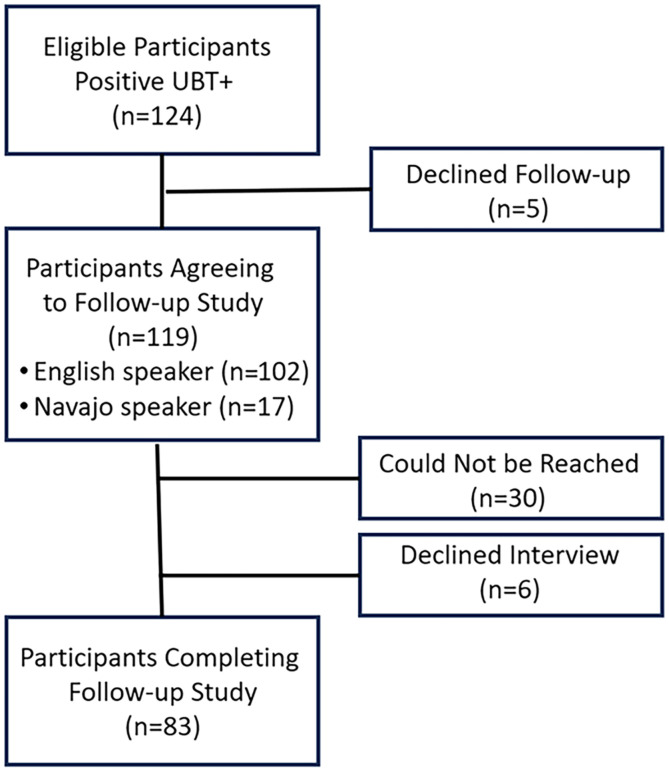 Figure 1
Peer Reviews
No public reviews on file for this paper yet. If you reviewed it on a platform where reviews are public (OpenReview, ICLR, NeurIPS, ICML), you can paste yours below so the community can read it here.
Videos
No videos yet. Explain this paper in a talk, walkthrough, or lecture? Add one.
Taxonomy
TopicsHelicobacter pylori-related gastroenterology studies · Gastroesophageal reflux and treatments · Eosinophilic Esophagitis