Using patient preference to inform ritlecitinib dose selection for alopecia areata treatment
Brett Hauber, Chiara Whichello, Jonathan Mauer, Ernest Law, Myrto Trapali, Edward Whalen, Dalia Wajsbrot, Nicolas Krucien, Tommi Tervonen, Samuel H. Zwillich, Robert Wolk

TL;DR
This study uses patient preferences to determine the best dose of ritlecitinib for treating alopecia areata, considering both benefits and risks.
Contribution
The novel use of discrete-choice experiments to integrate patient preferences with clinical data for dose selection in alopecia areata treatment.
Findings
Patients are willing to accept increased risks for higher efficacy with 50 mg ritlecitinib.
Maximum acceptable risk increases were calculated for serious infection, cancer, and blood clots.
The DCE approach can optimize treatment dose selection based on patient preferences and clinical outcomes.
Abstract
Ritlecitinib is an oral Janus kinase 3/tyrosine kinase expressed in hepatocellular carcinoma (JAK3/TEC) family kinase inhibitor approved for the treatment of severe alopecia areata (AA). Benefit–risk profiles of two doses of ritlecitinib (50 mg vs 30 mg once daily) were evaluated by integrating patient preferences and clinical efficacy and safety estimates for ritlecitinib. A discrete‐choice experiment (DCE) was utilized to elicit preferences for benefit and safety attributes of systemic AA treatments. Benefits included probabilities of ≥80% scalp hair coverage and achieving moderate to normal eyebrows and eyelashes. Potential risks included 3‐year probabilities of serious infection, cancer, and blood clots. Preference estimates were used to calculate the maximum acceptable risk (MAR) that patients would accept for expected increases in benefit from choosing a higher ritlecitinib dose…
Genes, proteins, chemicals, diseases, species, mutations and cell lines named across the full text — each resolved to its canonical identifier and authoritative record.
Click any figure to enlarge with its caption.
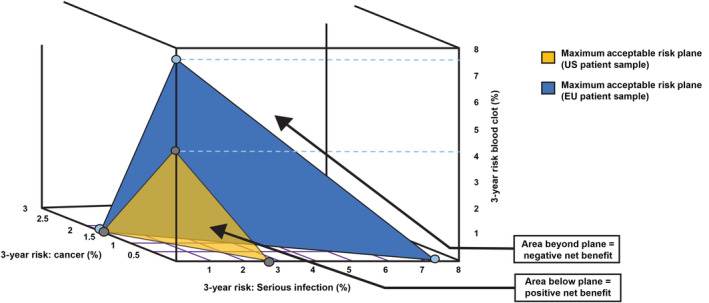 Figure 1
Peer Reviews
No public reviews on file for this paper yet. If you reviewed it on a platform where reviews are public (OpenReview, ICLR, NeurIPS, ICML), you can paste yours below so the community can read it here.
Videos
No videos yet. Explain this paper in a talk, walkthrough, or lecture? Add one.
Taxonomy
TopicsHair Growth and Disorders · Autoimmune Bullous Skin Diseases · Autoimmune and Inflammatory Disorders